
Malaysia's #1 Content Aggregator
OPINION | Why PAS’ Shot Across Bersatu’s Bow Changes the Malay Heartland Forever
31 May 2026 • 12:00 PM MYT

Malaymail
In late May 2026, a quiet sense of exhaustion hung over the rural constituencies of the Malaysian Peninsula. For months, local market traders, young ride-hailing drivers, and working-class families had been wrestling with a stubborn domestic reality: the soaring cost of daily living, erratic governance signals, and an unyielding economic squeeze. Yet, as ordinary citizens scanned the horizon for long-term socio-economic relief, they were greeted instead by the thunderous rumbling of an impending tectonic shift within the upper echelons of the federal opposition. The fragile green-and-blue fabric of Perikatan Nasional (PN) a coalition that only a few years prior swept through the northern and eastern belts like an unstoppable political tsunami was caught in an unprecedented public fracture. The long-simmering friction between its two heavyweights had finally blown its lid.
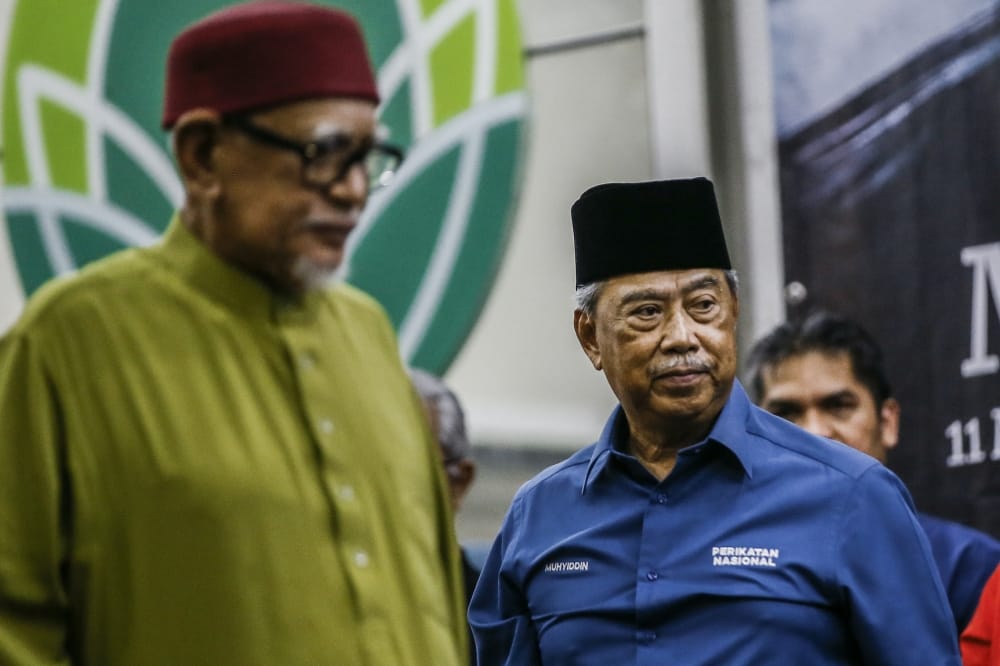
The tremor originated directly from Marang, Terengganu, where PAS President Tan Sri Abdul Hadi Awang delivered a cold, calculated warning that shook the foundations of contemporary Malaysian politics. Speaking to reporters at his residence in Rusila, Hadi announced that PAS is actively re-examining and evaluating every single aspect of its relationship with Bersatu. It was not an off-the-cuff complaint; it was a structural indictment. Citing a string of broken promises, grassroots imbalance, and internal betrayals, Hadi dropped a phrase that immediately trended across Malaysian social media networks: patience has its limits.
For the Malaysian reader accustomed to the coded, polite semantics of traditional Malay diplomacy, this aggressive posture signalled an institutional breaking point. PAS, the oldest and largest Islamist party in the nation, is no longer willing to play second fiddle to a heavily fractured, urban-centric Malay nationalist ally. The implications of this rift stretch far beyond mere parliamentary seat negotiations. It strikes at the heart of Malaysia's deep cultural and socio-political evolution, setting up a brutal narrative regarding who truly commands the soul of the conservative Malay electorate.
The Breaking Point: How the Marriage of Convenience Soured
To understand why this political marriage is teetering on a high-profile divorce, one must trace the transactional nature of the Perikatan Nasional project. Formed in the chaotic wake of the 2020 "Sheraton Move," PN was initially a defensive wall built to capture the massive, conservative Malay-Muslim vote. PAS provided the institutional stamina, an army of fiercely loyal grassroots volunteers, and absolute ideological discipline. Bersatu, led by former Prime Minister Tan Sri Muhyiddin Yassin, offered a more corporate, technocratic "Grand Old Party" aesthetic designed to appeal to middle-class, urban, and suburban Malays who found PAS’s unyielding Islamist rhetoric too alienating.
However, institutional friction quickly eroded this top-tier alignment. In his press conference, Hadi openly aired long-standing grievances regarding electoral machinery, revealing that during past state elections and by-elections, Bersatu consistently demanded a lion's share of winnable seats despite possessing virtually no logistical presence on the ground. The reality on the campaign trail was stark: Bersatu would field the candidates, but it was the tireless, self-funded PAS machinery that knocked on doors, hung up flags, and mobilized voters. This structural parasitism bred deep resentment among the PAS rank-and-file, who increasingly felt they were being used as foot soldiers to prop up a weak ally.
The flashpoints that pushed this relationship over the edge were deeply institutional. A major catalyst was the late 2025 Perlis political crisis, which saw an internal coup where a Bersatu assemblyman orchestrated the ousting of the incumbent PAS Menteri Besar to install his own nominee. This was coupled with similar territorial friction in Kedah and Kelantan regarding the appointment of executive councillors and state assembly speakers. In Hadi’s view, Bersatu had overstepped its bounds, acting like a dominant political boss while lacking the organic grassroots power to justify such arrogance. Furthermore, Hadi criticized Bersatu for actively blocking broader Malay-Muslim unification efforts by rejecting the entry of other conservative factions and non-extremist minority groups into the PN fold.
The Anatomy of an Implosion: Bersatu’s Deepening Identity Crisis
While PAS assesses its options from a position of relative strength, Bersatu finds itself staring down an existential barrel. The party has been undergoing a slow-motion implosion for over a year, culminating in a catastrophic internal split. In February 2026, the party sacked its powerful former Deputy President, Datuk Seri Hamzah Zainuddin, along with several high-profile elected representatives who breached party discipline.
This dramatic purge did not consolidate Muhyiddin’s power; instead, it fractured the party's remaining foundations. Hamzah and his band of castaways immediately launched a rival political movement named "Reset," which has been actively courting conservative voters. The rise of this movement has fundamentally altered the political landscape, offering PAS an alternative, highly motivated partner that lacks Bersatu's corporate baggage.
Compounding this misery was the messy leadership transition within Perikatan Nasional itself. In early 2026, Muhyiddin Yassin unexpectedly resigned as PN Chairman, leading to the appointment of PAS’s rising star, Terengganu Menteri Besar Dr. Ahmad Samsuri Mokhtar, to the top post. Yet, despite holding the chairmanship, PN experienced intense internal paralysis over who would assume the crucial role of Opposition Leader in Parliament, leaving Hamzah in the seat for weeks despite his lack of party locus standi. When PN finally decreed in March 2026 that the Opposition Leader must come from PAS, Bersatu's national prestige suffered a devastating blow. The message was clear: PAS was taking over the steering wheel of the entire conservative apparatus.
Sociological Shift: The Rise of the Post-Nationalist Malay Voter
From a cultural and sociological perspective, this rift exposes an ongoing evolution within the Malay electorate. For decades, Malay politics was anchored by traditional nationalist institutions like UMNO, which preached a philosophy of racial guardianship intertwined with state patronage. When Bersatu broke away from UMNO, it attempted to replicate that exact model of elite-driven, bureaucratic nationalism.
However, contemporary political analysis indicates that younger and working-class Malay voters are shifting away from these traditional, top-down structures. The modern conservative voter is increasingly motivated by a combination of digital-age religious identity and acute economic anxiety. PAS has successfully tapped into this demographic shift through an omnipresent social media strategy and a hyper-localized welfare network that operates entirely independent of federal state patronage.
To the average rural or semi-urban voter, Bersatu looks like a collection of elite, disgruntled Kuala Lumpur politicians fighting over boardrooms and ministerial titles. Conversely, PAS represents a cohesive, culturally integrated community ecosystem. By signaling a potential split from Bersatu, Hadi Awang is showing that PAS no longer needs a Westernized or corporate middleman to sanitize its image for the national stage. The party is fully confident that its brand of populist Islamism can capture the imagination of the public entirely on its own merits.
The Geopolitical and Strategic Calculus: Can PAS Truly Go Solo?
As the political dust settles, the big question dominating conversation across Malaysia is whether PAS can actually afford to cut Bersatu loose ahead of the 16th General Election (GE16). The institutional arithmetic offers a nuanced picture. Political analysts point out that when PAS contested entirely on its own in the 2018 General Election, it captured a modest 18 parliamentary seats. Yet, when it combined forces with Bersatu under the unified PN banner in 2022, that number exploded to an unprecedented 43 seats.
This statistical reality reveals a vital strategic dilemma. While PAS can easily sweep the monocultural Malay heartlands of Kelantan, Terengganu, Kedah, and Perlis without an ally, it faces an uphill battle in the mixed-demographic, urbanized constituencies of the west coast. In states like Selangor, Johor, and Perak, winning requires capturing a slice of the moderate, middle-class, and non-Malay vote areas where PAS’s hardline ideological stance historically struggles to gain traction.
However, the current leadership within PAS appears convinced that the political landscape has shifted fundamentally since 2022. Following Hadi's warning, PAS Youth Chief Afnan Hamimi Taib Azamudden issued a rallying cry, calling on the party's young machinery to prepare themselves mentally and logistically for whatever executive decision the leadership makes regarding the alliance. The party has mobilized its powerful Syura Council and central research division to map out an independent electoral blueprint. If PAS decides to drop Bersatu, it may choose to form a tactical alliance with the newly emerged "Reset" movement or selectively revive elements of its old Muafakat Nasional pact with UMNO dissidents, effectively leaving Bersatu isolated and electorally destitute.
What do you think? I’d love to hear your opinion in the comments section.
What does this mean for the future of our nation's democracy? We are witnessing the slow death of the traditional coalition model that defined the post-independence era, replaced by an volatile landscape where alliances are transient, highly transactional, and discarded the moment the grassroots machinery feels exploited. If PAS decides to officially walk away, it will mark the beginning of a polarized era in Malaysian governance one where a highly disciplined, ideologically pure bloc goes head-to-head against a diverse, urban coalition, with no nationalist buffers left in between.
The political chessboard is being rewritten in real-time, and the consequences will reverberate through our neighborhoods for a generation to come. It forces us to ask deep questions about what we value most in our leaders:
In late May 2026, a quiet sense of exhaustion hung over the rural constituencies of the Malaysian Peninsula. For months, local market traders, young ride-hailing drivers, and working-class families had been wrestling with a stubborn domestic reality: the soaring cost of daily living, erratic governance signals, and an unyielding economic squeeze. Yet, as ordinary citizens scanned the horizon for long-term socio-economic relief, they were greeted instead by the thunderous rumbling of an impending tectonic shift within the upper echelons of the federal opposition. The fragile green-and-blue fabric of Perikatan Nasional (PN) a coalition that only a few years prior swept through the northern and eastern belts like an unstoppable political tsunami was caught in an unprecedented public fracture. The long-simmering friction between its two heavyweights had finally blown its lid.
The tremor originated directly from Marang, Terengganu, where PAS President Tan Sri Abdul Hadi Awang delivered a cold, calculated warning that shook the foundations of contemporary Malaysian politics. Speaking to reporters at his residence in Rusila, Hadi announced that PAS is actively re-examining and evaluating every single aspect of its relationship with Bersatu. It was not an off-the-cuff complaint; it was a structural indictment. Citing a string of broken promises, grassroots imbalance, and internal betrayals, Hadi dropped a phrase that immediately trended across Malaysian social media networks: patience has its limits.
For the Malaysian reader accustomed to the coded, polite semantics of traditional Malay diplomacy, this aggressive posture signalled an institutional breaking point. PAS, the oldest and largest Islamist party in the nation, is no longer willing to play second fiddle to a heavily fractured, urban-centric Malay nationalist ally. The implications of this rift stretch far beyond mere parliamentary seat negotiations. It strikes at the heart of Malaysia's deep cultural and socio-political evolution, setting up a brutal narrative regarding who truly commands the soul of the conservative Malay electorate.
The Breaking Point: How the Marriage of Convenience Soured
To understand why this political marriage is teetering on a high-profile divorce, one must trace the transactional nature of the Perikatan Nasional project. Formed in the chaotic wake of the 2020 "Sheraton Move," PN was initially a defensive wall built to capture the massive, conservative Malay-Muslim vote. PAS provided the institutional stamina, an army of fiercely loyal grassroots volunteers, and absolute ideological discipline. Bersatu, led by former Prime Minister Tan Sri Muhyiddin Yassin, offered a more corporate, technocratic "Grand Old Party" aesthetic designed to appeal to middle-class, urban, and suburban Malays who found PAS’s unyielding Islamist rhetoric too alienating.
However, institutional friction quickly eroded this top-tier alignment. In his press conference, Hadi openly aired long-standing grievances regarding electoral machinery, revealing that during past state elections and by-elections, Bersatu consistently demanded a lion's share of winnable seats despite possessing virtually no logistical presence on the ground. The reality on the campaign trail was stark: Bersatu would field the candidates, but it was the tireless, self-funded PAS machinery that knocked on doors, hung up flags, and mobilized voters. This structural parasitism bred deep resentment among the PAS rank-and-file, who increasingly felt they were being used as foot soldiers to prop up a weak ally.
The flashpoints that pushed this relationship over the edge were deeply institutional. A major catalyst was the late 2025 Perlis political crisis, which saw an internal coup where a Bersatu assemblyman orchestrated the ousting of the incumbent PAS Menteri Besar to install his own nominee. This was coupled with similar territorial friction in Kedah and Kelantan regarding the appointment of executive councillors and state assembly speakers. In Hadi’s view, Bersatu had overstepped its bounds, acting like a dominant political boss while lacking the organic grassroots power to justify such arrogance. Furthermore, Hadi criticized Bersatu for actively blocking broader Malay-Muslim unification efforts by rejecting the entry of other conservative factions and non-extremist minority groups into the PN fold.
The Anatomy of an Implosion: Bersatu’s Deepening Identity Crisis
While PAS assesses its options from a position of relative strength, Bersatu finds itself staring down an existential barrel. The party has been undergoing a slow-motion implosion for over a year, culminating in a catastrophic internal split. In February 2026, the party sacked its powerful former Deputy President, Datuk Seri Hamzah Zainuddin, along with several high-profile elected representatives who breached party discipline.
This dramatic purge did not consolidate Muhyiddin’s power; instead, it fractured the party's remaining foundations. Hamzah and his band of castaways immediately launched a rival political movement named "Reset," which has been actively courting conservative voters. The rise of this movement has fundamentally altered the political landscape, offering PAS an alternative, highly motivated partner that lacks Bersatu's corporate baggage.
Compounding this misery was the messy leadership transition within Perikatan Nasional itself. In early 2026, Muhyiddin Yassin unexpectedly resigned as PN Chairman, leading to the appointment of PAS’s rising star, Terengganu Menteri Besar Dr. Ahmad Samsuri Mokhtar, to the top post. Yet, despite holding the chairmanship, PN experienced intense internal paralysis over who would assume the crucial role of Opposition Leader in Parliament, leaving Hamzah in the seat for weeks despite his lack of party locus standi. When PN finally decreed in March 2026 that the Opposition Leader must come from PAS, Bersatu's national prestige suffered a devastating blow. The message was clear: PAS was taking over the steering wheel of the entire conservative apparatus.
Sociological Shift: The Rise of the Post-Nationalist Malay Voter
From a cultural and sociological perspective, this rift exposes an ongoing evolution within the Malay electorate. For decades, Malay politics was anchored by traditional nationalist institutions like UMNO, which preached a philosophy of racial guardianship intertwined with state patronage. When Bersatu broke away from UMNO, it attempted to replicate that exact model of elite-driven, bureaucratic nationalism.
However, contemporary political analysis indicates that younger and working-class Malay voters are shifting away from these traditional, top-down structures. The modern conservative voter is increasingly motivated by a combination of digital-age religious identity and acute economic anxiety. PAS has successfully tapped into this demographic shift through an omnipresent social media strategy and a hyper-localized welfare network that operates entirely independent of federal state patronage.
To the average rural or semi-urban voter, Bersatu looks like a collection of elite, disgruntled Kuala Lumpur politicians fighting over boardrooms and ministerial titles. Conversely, PAS represents a cohesive, culturally integrated community ecosystem. By signaling a potential split from Bersatu, Hadi Awang is showing that PAS no longer needs a Westernized or corporate middleman to sanitize its image for the national stage. The party is fully confident that its brand of populist Islamism can capture the imagination of the public entirely on its own merits.
The Geopolitical and Strategic Calculus: Can PAS Truly Go Solo?
As the political dust settles, the big question dominating conversation across Malaysia is whether PAS can actually afford to cut Bersatu loose ahead of the 16th General Election (GE16). The institutional arithmetic offers a nuanced picture. Political analysts point out that when PAS contested entirely on its own in the 2018 General Election, it captured a modest 18 parliamentary seats. Yet, when it combined forces with Bersatu under the unified PN banner in 2022, that number exploded to an unprecedented 43 seats.
This statistical reality reveals a vital strategic dilemma. While PAS can easily sweep the monocultural Malay heartlands of Kelantan, Terengganu, Kedah, and Perlis without an ally, it faces an uphill battle in the mixed-demographic, urbanized constituencies of the west coast. In states like Selangor, Johor, and Perak, winning requires capturing a slice of the moderate, middle-class, and non-Malay vote areas where PAS’s hardline ideological stance historically struggles to gain traction.
However, the current leadership within PAS appears convinced that the political landscape has shifted fundamentally since 2022. Following Hadi's warning, PAS Youth Chief Afnan Hamimi Taib Azamudden issued a rallying cry, calling on the party's young machinery to prepare themselves mentally and logistically for whatever executive decision the leadership makes regarding the alliance. The party has mobilized its powerful Syura Council and central research division to map out an independent electoral blueprint. If PAS decides to drop Bersatu, it may choose to form a tactical alliance with the newly emerged "Reset" movement or selectively revive elements of its old Muafakat Nasional pact with UMNO dissidents, effectively leaving Bersatu isolated and electorally destitute.
What do you think? I’d love to hear your opinion in the comments section.
What does this mean for the future of our nation's democracy? We are witnessing the slow death of the traditional coalition model that defined the post-independence era, replaced by an volatile landscape where alliances are transient, highly transactional, and discarded the moment the grassroots machinery feels exploited. If PAS decides to officially walk away, it will mark the beginning of a polarized era in Malaysian governance one where a highly disciplined, ideologically pure bloc goes head-to-head against a diverse, urban coalition, with no nationalist buffers left in between.
The political chessboard is being rewritten in real-time, and the consequences will reverberate through our neighborhoods for a generation to come. It forces us to ask deep questions about what we value most in our leaders:
Is it corporate technocracy, or is it grassroots reliability? Can a party truly govern a multicultural nation by dominating only one specific heartland, or are we bound to a cycle of unstable coalitions that break apart at the first sign of electoral friction? The ultimate decision won't just be made in the high-walled bungalows of Marang or the modern office complexes of Shah Alam; it will be decided by the quiet calculations of regular citizens at the ballot box.


Never fear.... the vast majority of Malays will still vote for PN/ PAS/ Bersatu regardless as they will Never, Never , Never, Ever vote for PH , and mistrust UMNO over its links to PH.
ReplyDelete