
Why is China mediating the Iran war? Beijing’s energy interests and Trump-Xi summit explained

U.S. President Donald Trump and Chinese President Xi Jinping react as they hold a bilateral meeting at Gimhae International Airport, on the sidelines of the Asia-Pacific Economic Cooperation (APEC) summit, in Busan, South Korea on October 30, 2025. — Reuters pic
Saturday, 18 Apr 2026 7:00 AM MYT
BEIJING, April 18 — China is accelerating its efforts to end the Iran war, walking a diplomatic tightrope as it prepares for a summit next month with US President Donald Trump while trying not to alienate Tehran.
President Xi Jinping’s mid-May meeting with Trump is shaping Beijing’s approach to the Middle East conflict even as the world’s top crude oil importer, reliant on the Middle East for half its fuel, seeks to safeguard its energy supplies, analysts say.
China’s modulated approach to the war has protected its back-channel leverage enough that Trump credited Beijing with helping to get Iran to last weekend’s peace talks in Pakistan.
Flurry of Middle East diplomacy
“You’ve heard President Trump repeatedly mention how the Chinese talked to the Iranians,” said Eric Olander, editor-in-chief of the China-Global South Project, an independent organisation that analyses China’s engagement in the developing world. “That puts them in the room with negotiators, even if it’s not a seat at the table.”
Considering Trump transactional and susceptible to flattery, China is seeking to advance its goals on trade and its claims on Taiwan at the summit, people familiar with China’s thinking told Reuters.
The dominant view in Beijing is to “butter him up, give him a red-carpet welcome and preserve strategic stability”, one person said.
China’s Foreign Ministry did not respond to questions about its diplomacy ahead of the summit, the first visit by a US president in eight years. Trump says it will take place May 14 and 15.
With the US naval blockade of Iranian ports as a direct and growing threat, China has engaged in a flurry of diplomatic activity and refrained from strong criticism of Trump’s conduct of the war so that the summit, postponed once by the conflict, can go smoothly, analysts say.
Xi broke his silence on the crisis on Tuesday with a four-point peace plan that calls for upholding peaceful coexistence, national sovereignty, the international rule of law and balancing development and security.
After Trump warned Iran that “the entire country can be taken out in one night”, Chinese Foreign Ministry spokesperson Mao Ning avoided condemnation, saying only that China was “deeply concerned” and urging all sides to play a “constructive role in de-escalating the situation”.
Foreign Minister Wang Yi has held nearly 30 calls and meetings with counterparts seeking a ceasefire, according to a Reuters count, while special envoy Zhai Jun has toured five Gulf and Arab capitals.
Travelling at one point by road to avoid contested airspace, Zhai could hear air-raid sirens, he told reporters.
Xi announced his peace plan in a meeting with Abu Dhabi’s crown prince, Sheikh Khaled bin Mohamed bin Zayed Al Nahyan, as he sought to deepen ties with a rival to Iran while pressing Tehran towards dialogue.
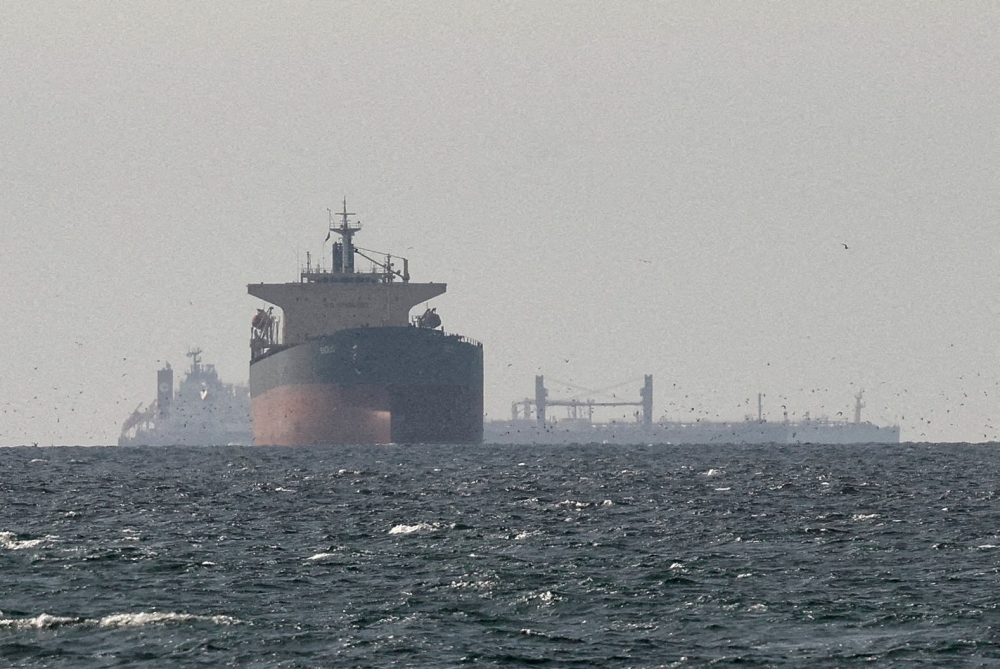
Cargo ships in the Gulf, near the Strait of Hormuz, are seen from northern Ras al-Khaimah, near the border with Oman’s Musandam governance in the United Arab Emirates on March 11, 2026. — Reuters pic
Narrow focus for Trump-Xi summit
China’s “sense of urgency and the mode of intervention at the tactical level are shifting” as the war, which the US and Israel launched on February 28, drags on, said Cui Shoujun, a professor of international affairs at Renmin University.
Still, some analysts say, Iran needs China more than China needs Iran, allowing Beijing to press for a ceasefire while protecting the summit with Trump.
“Beijing’s ideal outcome,” said Drew Thompson, a senior fellow at Singapore’s S. Rajaratnam School of International Studies, “is the maintenance of no-strings-attached relationships with anti-Western countries like Iran but also preserving its opportunity to achieve some form of modus vivendi with the US”
While China played a role in getting Iran to talk to the US, its ability to shape decisions is limited, as it lacks a military presence in the Middle East capable of backing up its words.
Some observers say China’s energetic Middle East diplomacy is more theatre than statecraft.
“While the Iranians are keen to play up their relationship with China and have asked Beijing to serve as a guarantor of a ceasefire, Beijing has shown zero interest in assuming such a role,” said Patricia Kim of the Brookings Institution. “Beijing appears content to remain on the sidelines as the United States bears the brunt of the pressure.”
At the summit with Trump, China may agree to buy Boeing aircraft, a deal held back for years over regulatory concerns that could be the biggest such order in history, as well as significant agricultural purchases.
The meeting is likely to be narrowly focused, analysts say, avoiding ambitious topics such as AI governance, market access and manufacturing overcapacity.
“There is zero chance China will reach some sort of grand bargain with the United States,” said Scott Kennedy, trustee chair in Chinese business and economics at the Washington-based Center for Strategic and International Studies. — Reuters


There is a real risk fuck will betray Taiwan, including halting the sale of arms that Taiwan needs to defend itself, for his transactional bid width CCP.
ReplyDeleteAnyone still remember the 2023 CCP-brokered Iran-Saudi "diplomatic breakthrough".
ReplyDeleteIt was supposed to herald CCP arrival as a major influence in the Middle East, displacing the Wankees.
The Iran-Saudi rapproachment has completely collapsed in April 2026 after IRGC attacked Saudi Arabia assets, far beyond American bases that Saudis had anyway refused to allow to be used to attack Iran.
Wakakaka… yr kibd of mfering geopolitical fart
DeleteA commentator remarked that Foreign Ministry do not normally face with large financial corruption, so the disruption at the top level raise eyebrow. Wang Yi was reportedly not getting favourable eye...
ReplyDeleteApparently the meme is suggesting...Wang Yi: I'm too old for this...
https://www.aljazeera.com/news/2026/4/14/china-dismisses-vice-minister-of-foreign-affairs-sun-weidong
China dismisses Vice Minister of Foreign Affairs Sun Weidong
Vice Foreign Minister Sun Weidong’s sudden dismissal comes amid a wave of removals amid anticorruption campaign.
...
Sun Weidong was removed from his position as Vice Minister of Foreign Affairs of China in a sudden decision announced on April 14, 2026. The dismissal was confirmed by the Ministry of Human Resources and Social Security citing a decision by the State Council, though no official reason or timeline for the removal was provided.
Sun Weidong – Quick facts:
Removed: April 14, 2026, from the post of Vice Minister of Foreign Affairs.
Last Public Engagement: Meetings with ambassadors of Brunei and Malaysia on March 13, 2026.
Previous Roles: Served as China's Ambassador to India (2019–2022) and Pakistan (2013–2017).
Appointment: Appointed Vice Minister of Foreign Affairs on November 15, 2022.
Context: The removal is widely viewed by observers as part of President Xi Jinping's ongoing anti-corruption drive and internal disciplinary actions.
The sudden removal of this senior diplomat marks the latest high-level exit from Beijing's diplomatic establishment. While no formal investigation has been announced, such abrupt dismissals in China often signal impending disciplinary action. The notice also confirmed the simultaneous removal of An Lusheng from his role as deputy director of the National Railway Administration, suggesting a broader reshuffle within the government system.
AI-generated answer. Please verify critical facts.