
Is Trump’s Venezuela blockade really about drugs — or is it about oil and regime change?
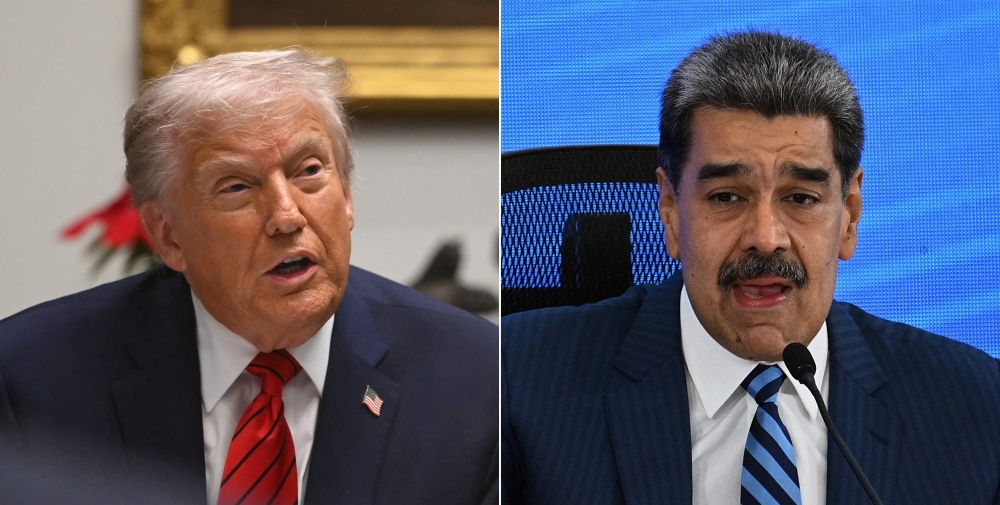
A combination of photos shows US President Donald Trump (left) speaking in Washington, DC on December 10, 2025 and Venezuelan President Nicolas Maduro (right) speaking in Caracas on November 14, 2025 as the US increases pressure on Venezuela’s oil industry. — AFP pic
Tuesday, 23 Dec 2025 10:34 AM MYT
CARACAS, Dec 23 — As US forces deployed in the Caribbean have zoned in on tankers transporting sanctioned Venezuelan oil, questions have deepened about the real motivation for Donald Trump’s pressure campaign on Caracas.
Is the military show of force really about drug trafficking, as Washington claims? Does it seek regime change, as Caracas fears? Could it be about oil, of which Venezuela has more proven reserves than any other country in the world?
“I don’t know if the interest is only in Venezuela’s oil,” Brazil’s leftist President Luiz Inacio Lula da Silva, who has offered to mediate in the escalating quarrel, said last week.
The US president himself has accused Venezuela of taking “all of our oil” and said: “we want it back.”
What we know:
Oil ties
Companies from the United States, now the world’s leading oil producer, have pumped Venezuelan crude from the first discoveries there in the 1920s.
Many US refineries were designed, and are still geared, specifically for processing the kind of heavy crude Venezuela has in spades.
Until 2005, Venezuela was one of the main providers of oil to the United States, with some monthly totals reaching up to 60 million barrels.
Things changed dramatically after socialist leader Hugo Chavez took steps in 2007 to further nationalize the industry, seizing assets belonging to US firms.
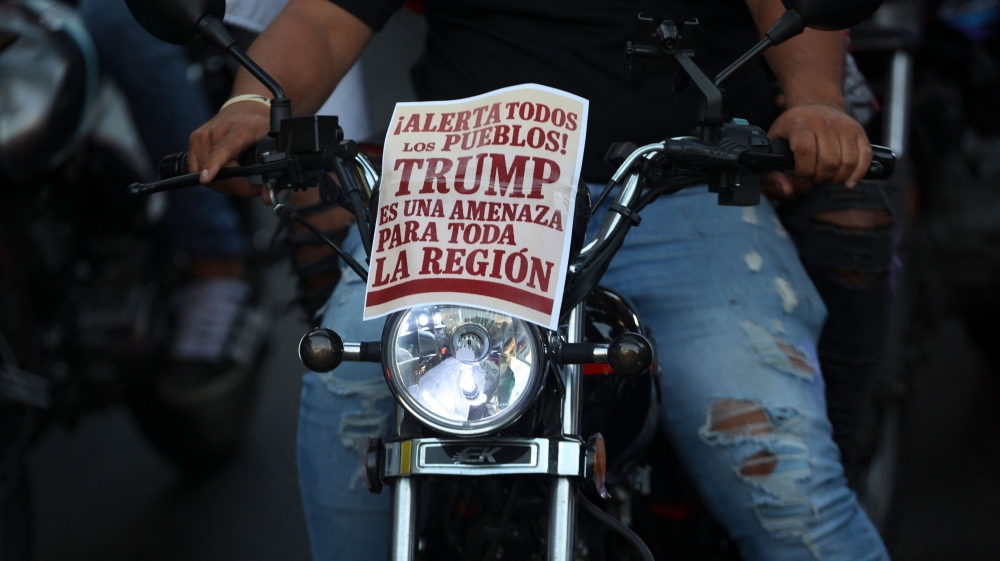
A motorcyclist carries a sign stating “Alert all peoples, Trump is a threat to the entire region” as demonstrators dressed as pirates ride through Caracas on December 22, 2025, to protest the United States’ seizure of ships carrying Venezuelan oil. — AFP pic
And now
Down from a peak of more than three million barrels per day (bpd) in the early 2000s, Venezuela today produces about a million barrels per day – roughly two per cent of the global total.
US firm Chevron extracts about 10 per cent of the total under a special license.
Chevron is the only company authorized to ship Venezuelan oil to the United States – an estimated 200,000 barrels per day, according to a Venezuelan oil sector source.
The South American country’s domestic industry has declined sharply due to corruption, under-investment and US sanctions in place since 2019.
Analysts say the high investment required to rebuild Venezuela’s crumbling oil rigs would be unappetizing for US firms, given the steady global supply and low prices.
According to Carlos Mendoza Potella, a Venezuelan professor of petroleum economics, Washington’s actions were likely “not just about oil” but rather about the United States “claiming the Americas for itself.”
“It’s about the division of the world” between the United States and its rivals, Russia and China, he added.
Venezuela exports about 500,000 barrels per day on the black market, mainly to China and other Asian countries, according to Juan Szabo, a former vice president of state oil company PDVSA.
Blockade
Trump on December 16 announced a blockade of sanctioned oil vessels sailing to and from Venezuela.
Days earlier, US forces seized the M/T Skipper, a so-called “ghost” tanker transporting over a million barrels of Venezuelan oil, reportedly destined for Cuba.
Washington has said it intends to keep the oil, valued at between $50 and $100 million.
Over the weekend, the US Coast Guard seized the Centuries, identified by monitoring site TankerTrackers.com as a Chinese-owned and Panama-flagged tanker.
An AFP review did not find the Centuries on the US Treasury Department’s sanctions list, but the White House said it “contained sanctioned PDVSA oil” – some 1.8 million barrels of it.
On Sunday, officials said the Coast Guard was pursuing a third tanker, identified by news outlets as the Bella 1 – under US sanctions because of alleged ties to Iran.
The PDVSA insists its exports remain unaffected by the blockade.
This was critical, according to Szabo, as the company only has capacity to store oil for several days if exports stop.
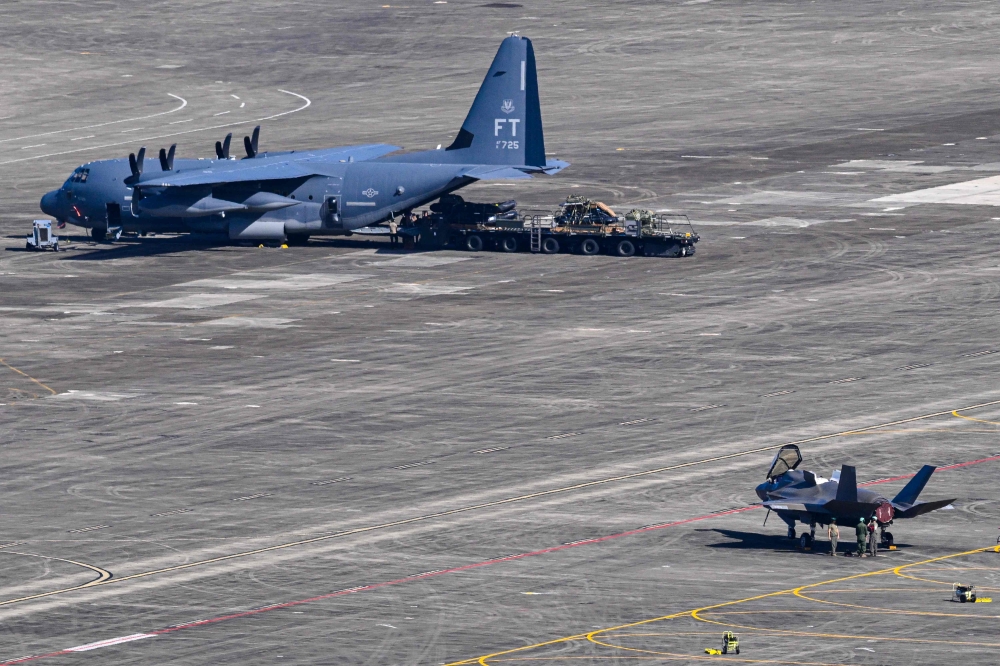
A US Air Force C-130 Hercules and a US Air Force F-35A fighter jet sit on the tarmac at the José Aponte de la Torre Airport in Ceiba, Puerto Rico on December 20, 2025. — AFP pic
Impact
Whatever Trump’s goal with Venezuelan oil, the blockade, if it continues, is likely to scare off shipping companies and push up freight rates.
Szabo expects Venezuela’s oil exports will fall by nearly half in the coming months, slashing critical foreign currency income from Venezuela’s black market sales.
This would asphyxiate the already struggling economy of Venezuela, piling more pressure on Nicolas Maduro.
The Trump administration has tip-toed around explicitly demanding for Maduro to leave.
While Trump has said he does not anticipate “war” with Venezuela, he did say Maduro’s days “are numbered.”
US Homeland Security Secretary Kristi Noem told Fox News on Monday that the oil tanker seizures send “a message around the world that the illegal activity that Maduro’s participating in cannot stand, he needs to be gone.” — AFP
***
Wankees are plain highway robbers


Houthis sinking ships in Red Sea OK, right ?
ReplyDeleteCCP attacking Phillipines ships 160km from Palawan OK , right ?
What have you got to complain about?
Eastern Bully robbing poor Peruvian fishermen....
ReplyDeleteThe red dots show Chinese fishing vessels swarming Peru’s EEZ in 2024
525 Chinese boats in Peruvian waters, while Peru itself barely had 239
China’s greedy pirates emptied their own seas and are now hijacking the livelihoods of other nations’ fishermen.
https://x.com/DWalpiri/status/1992202885799792887?s=20
Thousands of Chinese fishing vessels are swarming Peru’s 200-mile maritime border, a massive floating armada sitting exactly on the EEZ demarcation line. Why stop there? Because the second they’re out of public view, they kill their AIS trackers, cross into foreign waters.
ReplyDeletehttps://x.com/amlivemon/status/2003339322410348841?s=20
The Chinese Distant Water Fishing Fleet is now a Global Problem.
ReplyDeleteHaving depleted the seas close to home, the Chinese fishing fleet has been sailing farther afield in recent years to exploit the waters of other countries, including those in West Africa and Latin America, where enforcement tends to be weaker as local governments lack the resources or inclination to police their waters.
Most Chinese distant-water ships are so large that they scoop up as many fish in one week as local boats from Senegal or Mexico might catch in a year.
The Chinese distant water fishing felts are also notorious for hunting critically endangered & protected spiciest like sharks, sea turtles, giant squids, giant clams etc.
They deliberately engage in some of the most destructive fishing methods like electro-fishing, dynamite fishing, Sea floor scraping etc.
https://x.com/IsabellaAn67/status/1995042732302372875?s=20
Ecuador stood up for the Galápagos, but other countries don't stand a chance against the 17,000-strong China distant-water fleet.
ReplyDeleteIn the Indo-Pacific region, for example, China is responsible for 95% of all illegal fishing.
https://x.com/ECOWARRIORSS/status/1997842136625254421?s=20
Eastern Bully drawing more dashed lines in the Yellow Sea with South Korea. They cause nothing but disputes with ALL their neighbours except Russia where they don't want to claim 1,000,000 sq km rampassed from the Qing Dynasty during the Century of Humiliation.
ReplyDeleteChina is unilaterally building structures in Provisional Measures Zone, shared waters with South Korea.
Zone was set up in 2001 to manage overlapping EEZ claims between both countries.
This is why negotiating with China never works. They'll just go ahead & take it for themselves.
https://x.com/DWalpiri/status/2003080500047679920?s=20
China wants us to believe that this massive ship, water-cannoning a bangka- a tiny wooden canoe- is just a “fishing boat.”
ReplyDeleteTheir entire territorial claim is built on lies and somehow they’re still terrible at lying.
https://x.com/MinhDr18/status/2003059373342593222?s=20
Off topic...when Isaacs are concerned it is ALWAYS a problem, lain orang bikin, OK.....
ReplyDeleteLast year, AIPAC Spent $100M Lobbying the US Govt.
That same year,
China spent $460M
Japan spent $410M
Pharma spent $387M
Saudi spent $310M
Qatar spent $256M
And unlike those other lobbyists, AIPAC is entirely funded by Americans who uniquely support the U.S.-Israel alliance.
https://x.com/EYakoby/status/2003255416197988827?s=20