
Khalil was killed and her colleague injured in what Lebanese officials are calling a ‘double-tap’ strike by Israeli forces

Amal Khalil, a Lebanese journalist working for the daily Al Akhbar newspaper, reports near a destroyed bridge in Qasmiyeh, Lebanon, March 22, 2026 [Mohammed Zaatari/AP]

By Caolán Magee
Published On 23 Apr 2026
Lebanese Prime Minister Nawaf Salam has accused Israel of crimes against humanity for killing journalist Amal Khalil and wounding her colleague Zeinab Faraj in an air strike in the village of al-Tayri in southern Lebanon.
Khalil and Faraj were reporting on an earlier Israeli attack on a vehicle on Wednesday, when they were targeted while fleeing towards a building to take shelter.
Recommended Stories
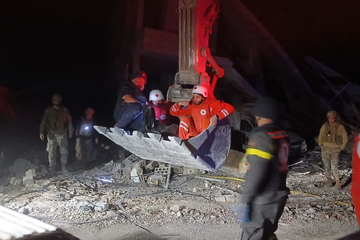
Paramedics rescued Faraj and recovered Khalil’s body from the rubble hours later.
Here’s what we know so far:
The journalist was last heard from at about 4:10pm local time (13:10 GMT), when she called her family members and the Lebanese military, according to colleagues and media reports.
She had taken cover inside the house after an earlier Israeli air raid killed two people near the car in which she was travelling with Faraj.
Rescue workers initially tried to reach the veteran Al Akhbar journalist, but came under Israeli fire and were forced to withdraw, according to Lebanon’s Ministry of Public Health.
A second strike then hit the house where the two journalists had sought refuge. Khalil’s body was recovered shortly before midnight, more than seven hours after the attack.
Khalil was killed in what Lebanese officials described as a “double-tap” strike in al-Tayri.
Israel kills journalist and wounds another in south Lebanon targeted attack
Lebanon Latest: Israel attacks kill journalist and target first responders
Iran captures two vessels in Strait of Hormuz after ship comes under fire

Trump ordered to ‘shoot and kill’ any boat putting mines in Strait of Hormuz
Rescuers were able to pull Faraj, who was seriously wounded, from the scene and recover the bodies of two people killed in the first strike. But efforts to reach Khalil were delayed after Israeli forces fired on emergency workers, the ministry said.
Khalil had been covering a renewed escalation of hostilities between Israel and the Lebanese group Hezbollah, which resumed in early March amid wider regional tensions linked to the US-Israel war on Iran.
Khalil is the ninth journalist killed in Lebanon this year.
Born in 1984 in Baysariyyeh, southern Lebanon, she had covered the region for Al Akhbar since the 2006 war. Her latest reporting focused on Israeli demolitions of homes in villages where Israeli troops are positioned inside Lebanon.
In an interview earlier this year with The Public Source, Khalil said her reporting sought to highlight the resilience of residents in Lebanon’s border villages.
“I debunk the enemy’s narrative of targeting only military sites by showing evidence of them bombing homes, farms, and killing children,” she said. “Through my work, I have tried to be in solidarity with these people – the people of the land.”
Israel condemned for the killing
In a statement to Al Jazeera, the Committee to Protect Journalists (CPJ) said Khalil’s killing “must be a wake-up call for the international community to enforce international law, urgently investigate Israel’s 262 killings of journalists across the region, and hold all those responsible to account”.
“The Israeli military’s obstruction of medical crews from rescuing wounded civilians is a brutal and recurring crime we have already witnessed in Gaza and now again in Lebanon. Khalil, an unarmed civilian journalist, remained trapped under the rubble for more than seven hours while the Red Cross was prevented from reaching her,” said the CPJ’s regional director, Sara Qudah.
Lebanese President Joseph Aoun offered his condolences over Khalil’s death and wished Faraj a swift recovery.
In a post on X, Aoun accused Israel of the “deliberate and consistent targeting of journalists” in an effort to “conceal the truth of its aggressive acts against Lebanon”.
Reporting from Tyre, southern Lebanon, Al Jazeera’s Heidi Pett said Khalil was “a well-known and respected journalist here in Lebanon”.
Pett said Khalil had received direct threats during the last war from an Israeli phone number on WhatsApp, warning her to stop reporting.
“In fact, [they were] telling her that she should leave Lebanon if she wanted her head to remain on her shoulders,” Pett said.
The Israeli military denied reports it had prevented rescue teams from reaching the scene and said it does not target journalists.
Less than a month ago, three journalists were killed in another reported “double-tap” attack in southern Lebanon. Their vehicle was struck, then hit again, while rescue workers who arrived afterwards also came under attack.
Following that incident, the Israeli army posted an image alleging one of the journalists was a member of Hezbollah’s elite forces, but later acknowledged the photo had been altered.
Lebanon’s Information Minister Paul Morcos described the latest attack as a flagrant violation of international humanitarian law.


All Hands On Deck to Torpedo the Peace talks between Isaac & Lebanon, like Harm-ass ambushed Isaac-Saudi signing Ibrahim Accords by executing Oct 7.
ReplyDeletemfer, what kind of a peace talk is between an unpopular puppet Lebanon & the zionist state?
DeleteThat useless Lebanon administration ISN'T fighting the invading zionist militia, so what has it to talk to the marauding zionists?
KAFNO — THE FORGOTTEN GENOCIDE OF THE MARONITE CHRISTIANS OF MOUNT LEBANON.
ReplyDeleteThe world remembers the genocides of Armenians, Assyrians, and Greeks under the Turkish Ottoman Empire.
But Lebanon… was left in silence. 💔
During the Great Famine of Mount Lebanon (1914–1918), a genocide unfolded through hunger.
“Kafno”—hunger in Syriac—was not just a word.
It was death, slow and relentless. 😔
Over 200,000 Maronite Christians perished. The Turkish Ottoman authorities imposed blockades, seized food for the army, and cut off supplies to Mount Lebanon. They isolated an entire population—knowing that without food, survival was impossible. This was not an accident. This was not only nature. It was a policy that turned starvation into mass death.
The mountains of Lebanon—once full of life—became a place of horror:
💔 Wells filled with bodies
💔 Roads lined with the dead
💔 Entire villages erased from existence
Food was cut off.
Supplies were blocked.
Hunger was allowed to spread until it consumed a people.
No mercy.
No escape.
Just slow death.
Those who survived fled across oceans to escape extinction. Among them were the ancestors of Carlos Slim Helú—a Lebanese-Mexican businessman who later became the richest man in the world (2010–2012). His family escaped Mount Lebanon during this period and rebuilt their lives in Mexico.
Kafno is not just a famine. It is remembered by many as a genocide carried out through starvation.
A people starved.
A nation broken.
A history the world has almost forgotten.
Lebanon remembers. 🇱🇧
Never forget Kafno. Never erase its victims. 💔
#Kafno #Genocide #Maronite #Lebanon #NeverForget #1915 #OttomanEmpire #History #Memory 💔 #Syriac #Assyrian #AssyrianGenocide #ArmenianGenocide #GreekGenocide #MaroniteGenocide
wakakaka… gun blazing full force on zionist atrocity diversion
Delete