
Sunday, 12 Apr 2026 | 10:10 PM MYT
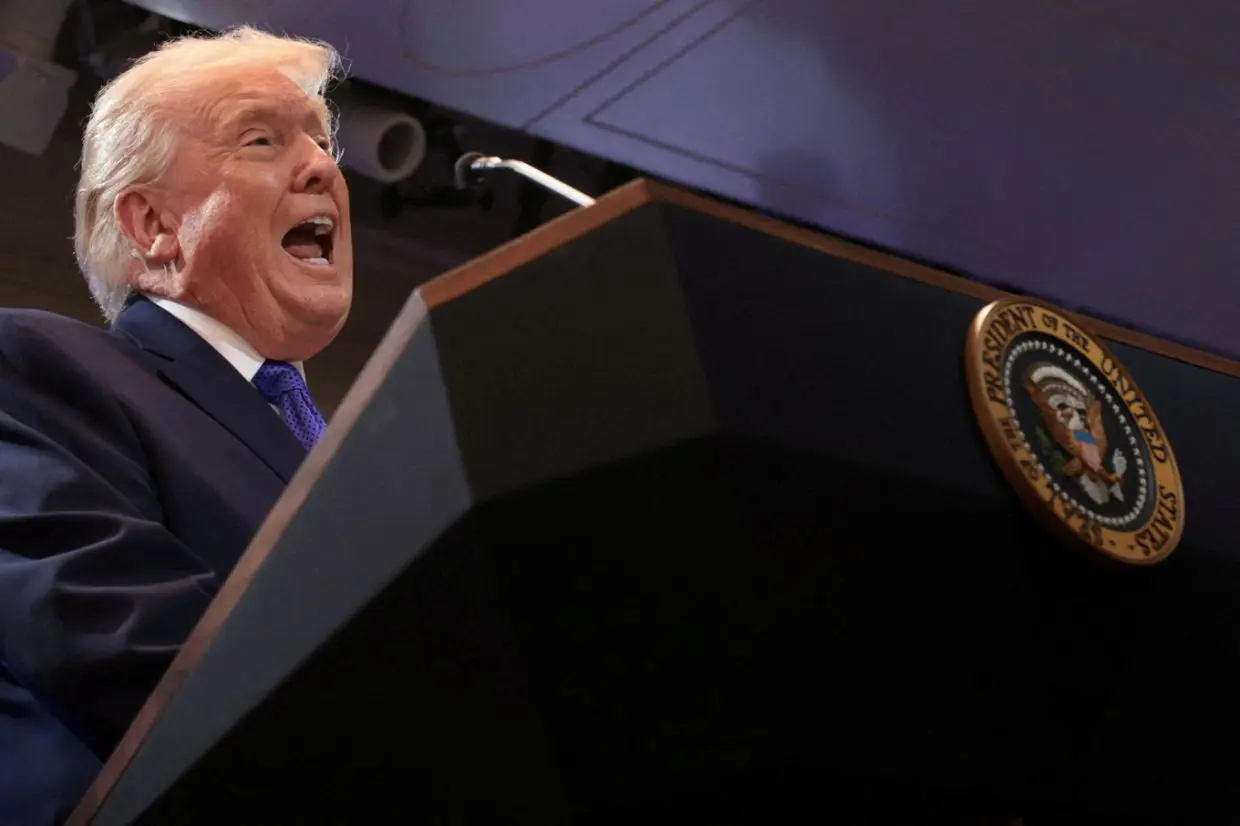
Trump said the US was ready to "finish up” Iran at the "appropriate moment". — Reuters
ISLAMABAD (AP): President Donald Trump on Sunday said the US Navy would "immediately” begin a blockade to stop ships from entering or leaving the Strait of Hormuz, after US-Iran peace talks in Pakistan ended without an agreement.
Trump sought to exert strategic control over the waterway responsible for the transportation of 20% of global oil supplies before the war, hoping to take away Iran’s key source of economic leverage in the fighting.
"I have instructed the Navy to seek and interdict every vessel in International Waters that has paid a toll to Iran.
"No one who pays an illegal toll will have safe passage on the high seas,” he said on Sunday (April 12).
Trump also said the US was ready to "finish up” Iran at the "appropriate moment," stressing that Tehran's nuclear ambitions were at the core of the failure to end the war.
Face-to-face talks ended earlier Sunday after 21 hours, leaving a fragile two-week ceasefire in doubt.
US officials said the negotiations collapsed over what they described as Iran’s refusal to commit to abandoning a path to a nuclear weapon, while Iranian officials blamed the US for the breakdown of the talks without specifying the sticking points.
ISLAMABAD (AP): President Donald Trump on Sunday said the US Navy would "immediately” begin a blockade to stop ships from entering or leaving the Strait of Hormuz, after US-Iran peace talks in Pakistan ended without an agreement.
Trump sought to exert strategic control over the waterway responsible for the transportation of 20% of global oil supplies before the war, hoping to take away Iran’s key source of economic leverage in the fighting.
"I have instructed the Navy to seek and interdict every vessel in International Waters that has paid a toll to Iran.
"No one who pays an illegal toll will have safe passage on the high seas,” he said on Sunday (April 12).
Trump also said the US was ready to "finish up” Iran at the "appropriate moment," stressing that Tehran's nuclear ambitions were at the core of the failure to end the war.
Face-to-face talks ended earlier Sunday after 21 hours, leaving a fragile two-week ceasefire in doubt.
US officials said the negotiations collapsed over what they described as Iran’s refusal to commit to abandoning a path to a nuclear weapon, while Iranian officials blamed the US for the breakdown of the talks without specifying the sticking points.
Neither side indicated what would happen after the 14-day ceasefire expires on April 22.
Pakistani mediators urged all parties to maintain it. Both said their positions were clear and put the onus on the other side, underscoring how little the gap had narrowed throughout the talks.
"We need to see an affirmative commitment that they will not seek a nuclear weapon, and they will not seek the tools that would enable them to quickly achieve a nuclear weapon,” Vice President JD Vance said after the talks.
Iran’s parliament speaker Mohammad Bagher Qalibaf, who led Iran in the negotiations, said it was time for the United States "to decide whether it can gain our trust or not.”
He did not mention the core disputes in a series of social media posts, though Iranian officials earlier said the talks fell apart over two or three key issues, blaming what they called US overreach.
Iran has long denied seeking nuclear weapons but has insisted on its right to a civilian nuclear program. It has offered "affirmative commitments” in the past in writing, including in the landmark 2015 nuclear deal.
Experts say its stockpile of enriched uranium, though not weapons-grade, is only a short technical step away.
Since the US and Israel launched the war on Feb 28, it has killed at least 3,000 people in Iran, 2,020 in Lebanon, 23 in Israel and more than a dozen in Gulf Arab states, and caused lasting damage to infrastructure in half a dozen Middle Eastern countries.
Iran’s grip on the Strait of Hormuz has largely cut off the Persian Gulf and its oil and gas exports from the global economy, sending energy prices soaring.
Pakistani Foreign Minister Ishaq Dar said his country will try to facilitate a new dialogue between Iran and the US in the coming days.
"It is imperative that the parties continue to uphold their commitment to the ceasefire,” Dar said.
The deadlock - and Vance’s take-it-or-leave-it proposal that Iran end its nuclear program - mirrored February’s nuclear talks in Switzerland.
Though Trump has said the subsequent war was meant to compel Iran’s leaders to abandon nuclear ambitions, each side's positions appeared unchanged in negotiations following six weeks of fighting.
The US and Iran entered talks with sharply different proposals and contrasting assumptions about their leverage to end the war.
Before negotiations began, the ceasefire was already threatened by deep disagreements and Israel’s continued attacks against the Iranian-backed Hezbollah in Lebanon.
Iran’s 10-point proposal ahead of the talks called for a guaranteed end to the war and sought control over the Strait of Hormuz. It included ending fighting against Iran’s "regional allies,” explicitly calling for a halt to Israeli strikes on Hezbollah.
Pakistani officials told The Associated Press in March that the US 15-point proposal included monitoring mechanisms and a rollback of Iran’s nuclear program. Speaking on condition of anonymity as they weren’t authorised to discuss details, they said it also covered reopening the Strait of Hormuz.
During the talks, the US military said two destroyers transited the critical waterway ahead of mine-clearing work, a first since the war began. Iran’s state media, however, reported that the country's joint military command denied that.
"We’re sweeping the strait. Whether we make a deal or not makes no difference to me,” Trump said as talks extended into early Sunday morning.
The impasse raises new questions about fighting in Lebanon. Israel has pressed ahead with strikes since the ceasefire was announced, saying the agreement did not apply there. Iran and Pakistan claimed otherwise.
Negotiations between Israel and Lebanon are expected to begin Tuesday in Washington, Lebanese President Joseph Aoun’s office has said, after Israel’s surprise announcement authorising talks despite the lack of official relations between the countries.
Protests erupted in Beirut on Saturday over the planned negotiations.
Israel wants Lebanon's government to assume responsibility for disarming Hezbollah, much like was envisaged in a November 2024 ceasefire. But the militant group has survived efforts to curb its strength for decades.
Pakistani mediators urged all parties to maintain it. Both said their positions were clear and put the onus on the other side, underscoring how little the gap had narrowed throughout the talks.
"We need to see an affirmative commitment that they will not seek a nuclear weapon, and they will not seek the tools that would enable them to quickly achieve a nuclear weapon,” Vice President JD Vance said after the talks.
Iran’s parliament speaker Mohammad Bagher Qalibaf, who led Iran in the negotiations, said it was time for the United States "to decide whether it can gain our trust or not.”
He did not mention the core disputes in a series of social media posts, though Iranian officials earlier said the talks fell apart over two or three key issues, blaming what they called US overreach.
Iran has long denied seeking nuclear weapons but has insisted on its right to a civilian nuclear program. It has offered "affirmative commitments” in the past in writing, including in the landmark 2015 nuclear deal.
Experts say its stockpile of enriched uranium, though not weapons-grade, is only a short technical step away.
Since the US and Israel launched the war on Feb 28, it has killed at least 3,000 people in Iran, 2,020 in Lebanon, 23 in Israel and more than a dozen in Gulf Arab states, and caused lasting damage to infrastructure in half a dozen Middle Eastern countries.
Iran’s grip on the Strait of Hormuz has largely cut off the Persian Gulf and its oil and gas exports from the global economy, sending energy prices soaring.
Pakistani Foreign Minister Ishaq Dar said his country will try to facilitate a new dialogue between Iran and the US in the coming days.
"It is imperative that the parties continue to uphold their commitment to the ceasefire,” Dar said.
The deadlock - and Vance’s take-it-or-leave-it proposal that Iran end its nuclear program - mirrored February’s nuclear talks in Switzerland.
Though Trump has said the subsequent war was meant to compel Iran’s leaders to abandon nuclear ambitions, each side's positions appeared unchanged in negotiations following six weeks of fighting.
The US and Iran entered talks with sharply different proposals and contrasting assumptions about their leverage to end the war.
Before negotiations began, the ceasefire was already threatened by deep disagreements and Israel’s continued attacks against the Iranian-backed Hezbollah in Lebanon.
Iran’s 10-point proposal ahead of the talks called for a guaranteed end to the war and sought control over the Strait of Hormuz. It included ending fighting against Iran’s "regional allies,” explicitly calling for a halt to Israeli strikes on Hezbollah.
Pakistani officials told The Associated Press in March that the US 15-point proposal included monitoring mechanisms and a rollback of Iran’s nuclear program. Speaking on condition of anonymity as they weren’t authorised to discuss details, they said it also covered reopening the Strait of Hormuz.
During the talks, the US military said two destroyers transited the critical waterway ahead of mine-clearing work, a first since the war began. Iran’s state media, however, reported that the country's joint military command denied that.
"We’re sweeping the strait. Whether we make a deal or not makes no difference to me,” Trump said as talks extended into early Sunday morning.
The impasse raises new questions about fighting in Lebanon. Israel has pressed ahead with strikes since the ceasefire was announced, saying the agreement did not apply there. Iran and Pakistan claimed otherwise.
Negotiations between Israel and Lebanon are expected to begin Tuesday in Washington, Lebanese President Joseph Aoun’s office has said, after Israel’s surprise announcement authorising talks despite the lack of official relations between the countries.
Protests erupted in Beirut on Saturday over the planned negotiations.
Israel wants Lebanon's government to assume responsibility for disarming Hezbollah, much like was envisaged in a November 2024 ceasefire. But the militant group has survived efforts to curb its strength for decades.


If there is one country you should listen to when it comes to shipping…..
ReplyDeleteSingapore’s Foreign Minister Vivian Balakrishnan in Parliament (7 April 2026):
“We will not negotiate with Iran, nor will we pay any toll for safe passage through the Strait of Hormuz.
The right of transit passage is a legal right under the United Nations Convention on the Law of the Sea (UNCLOS) — not a privilege to be granted, not a license to be begged for, and certainly not a toll to be paid.”
He added pointedly:
“Singapore overlooks a strait that is only 2 nautical miles wide, yet we have never considered violating international law. The navigable corridor in the Strait of Hormuz is 21 nautical miles wide… so why entertain such recklessness?”
Clear words from a statesman who understands that firmness in principles is the foundation of global trade security.
Great nations are not run by piracy… they are governed by law and consistency. 🇸🇬
https://x.com/saif_aldareei/status/2043311021037871301?s=46&t=8K6fzabO3g6uaj4KxwSSjg
LaoLee's vision for RedDot was to know her place in the scheme of geopolitical strategy.
DeleteThe current patchcof singgie politikus r just a bunch of followers who COULDN'T see the reality of the role plays by a cikumai nation. More likely they just kowtow to the wish of their yankee hegemony.
Rules based international order!!! As definite by who, mfer?
In 2020, the world was united to keep the SOH open to free trade. And 45 was in the WH then, and Macron in Paris.
ReplyDeleteOperation Agenor is the military component of the French-led European Maritime Awareness in the Strait of Hormuz (EMASOH), launched in 2020 to ensure safe navigation and de-escalate tensions in the Persian Gulf. Based in Abu Dhabi, it involves European naval and aerial surveillance to protect merchant shipping.
Key aspects of Operation Agenor include:
Purpose: To provide independent maritime situational awareness, monitor activity, and guarantee freedom of navigation in the Strait of Hormuz and the Gulf.
Leadership and Coalition: Initiated by France and supported by eight other nations: Belgium, Denmark, Germany, Greece, Italy, the Netherlands, Norway, and Portugal.
Operations: The mission involves deploying frigates and maritime patrol aircraft to accompany merchant vessels and monitor activities.
Origin: The mission was launched in response to increasing regional instability and attacks on oil tankers in 2019.
SOH was always open until a couple of terrorist states frigged that status
DeleteIRGC is a Bully, Pirate and Mafia thug. Once they have nuklear boms the SOH will be really closed, except for their own ships.
ReplyDeletemfer, vis-a-vis the Monroe accord of fart lah
DeletePedro Easily Forgets…
ReplyDeleteHow quickly Spain forgets. This day (April 12) in 1985, Iran via Hezbollah bombed the El Descanso Restaurant (9 miles from Madrid & minutes from the US Torrejon Air Base) on a busy Friday night & murdered 18 Spanish civilians while wounding another 84 (including 11 American airmen).
At around 10:30 p.m. a Hezbollah terrorist placed a sports bag containing roughly 5 kg of high explosive under the bar counter and walked out. Minutes later the bomb detonated. The blast was so powerful that the entire three-story building collapsed, pancaking the upper floors onto the ground level and basement where between 200–300 diners and staff were eating, drinking, and enjoying a normal evening.
Hezbollah made clear their main target was the US airmen, but they did not care how many Spanish civilians they killed: “The bomb was meant as an attack against the Yankee armed forces.”
https://x.com/cptallenhistory/status/2043332104772051147?s=46&t=8K6fzabO3g6uaj4KxwSSjg
Groups claiming responsibility for the attack included Basque separatist group ETA, the First of October Anti-Fascist Resistance Groups (GRAPO), Unity of the Abu Zeinab Martyrs, Wa'd (a front of the PFLP-SC) and the Islamic Jihad Organization
Delete🚨 DONALD TRUMP JUST STUNNED THE WORLD
ReplyDeleteSuddenly, oil and gas tankers want to RUSH to the US to fill up on energy. Look at the Gulf of America!
It's almost like 47 had a plan this entire time 🔥
"Boats are sailing up, heading to OUR country, big, beautiful tankers — we're loading them up with oil, gas, and everything else!"
"It's a pretty beautiful thing to see."
https://x.com/ericldaugh/status/2043386342629953556?s=46&t=8K6fzabO3g6uaj4KxwSSjg
transactional fart of move from a moneyed dickhead, reinforces via self imposed 2ndary maritime blockage outside SOH!
DeleteTrump won. Iran lost.
ReplyDeleteThe entire global energy market reshuffled itself to accommodate the closure of the Strait of Hormuz. And it just so happens that the world's biggest producer of oil and natural gas is the United States of America.
Iran will never recover from this.
https://x.com/mattforney/status/2043338081361633369?s=46&t=8K6fzabO3g6uaj4KxwSSjg
wakakaka…
DeleteOoop… mfer, u obviously DON'T know that Iran has been selling more oil & profited hugely during the Yankee/zionist state initiated war against her
BREAKING NEWS
ReplyDeleteThe United Arab Emirates no longer needs the Strait of Hormuz. It has begun extracting one and a half million barrels of oil daily through the Abu Dhabi-Fujairah pipeline, 380 km in length, built with Chinese support at a cost of 4.2 billion dollars. A good portion of that oil goes to China and India, which are distancing themselves from Iran. With this pipeline, Tehran is left without the leverage it exerted by controlling the passage of Arab oil through the Strait of Hormuz.
https://x.com/homeroboscan/status/2043364919530164718?s=20
wakakaka
DeleteBaca Betul Betul.
ReplyDeleteBlockade is only on ships entering or leaving Iranian ports.
ULL CENTCOM STATEMENT ON NAVEL BLOCKADE:
TAMPA, Fla. — U.S. Central Command (CENTCOM) forces will begin implementing a blockade of all maritime traffic entering and exiting Iranian ports on April 13 at 10 a.m. ET, in accordance with the President’s proclamation.
The blockade will be enforced impartially against vessels of all nations entering or departing Iranian ports and coastal areas, including all Iranian ports on the Arabian Gulf and Gulf of Oman. CENTCOM forces will not impede freedom of navigation for vessels transiting the Strait of Hormuz to and from non-Iranian ports.
Additional information will be provided to commercial mariners through a formal notice prior to the start of the blockade. All mariners are advised to monitor Notice to Mariners broadcasts and contact U.S. naval forces on bridge-to-bridge channel 16 when operating in the Gulf of Oman and Strait of Hormuz approaches.
https://x.com/Osint613/status/2043434098350534737?s=20
so, mfer, its that yr rules based international order?
DeleteSingapore is the first and only Asian country so far to publicly refuse negotiating passage with Iran.
ReplyDeleteMany others have made deals with Tehran to allow their shipments through. Some vessels are reportedly paying as much as $2m in fees to Iran to cross the waterway without coming under fire.
This speech which was given for a domestic audience in Singapore's parliament but somehow, it has ended up triggering a diplomatic incident with Malaysian politicians who are friendly and supportive of the Iranian regime.
Singapore refuses to accept the principle of turning transit through international straits as an extortion racket or a modern pirate toll booth. It’s a right under UNCLOS transit passage rules, the same rules that keep the global economy breathing.
Partly, this is due to self-interest as Singapore, Malaysia and Indonesia lie at the crossroads of another chokepoint - the Malacca Strait. The narrowest point is the Phillips Channel in the Singapore Strait is barely 2 nautical miles wide, squeezed between Singapore’s islands and Indonesia’s Riau chain.
Compared to the Strait of Hormuz’s 21 nautical mile pinch point, Singapore’s narrowest stretch is ten times tighter. Every eastbound ship on the planet is funneled through its Traffic Separation Scheme. If anyone had a temptation to start charging “protection fees,” it would be Singapore.
Negotiating with Iran would shred the legal norm that protects every strait used for international navigation. Malaysia, Indonesia, or anyone else with "geographical privilege" and a grudge could do the same.
And before you say “but Israel and America violated international law so why can't Iran," let me just reiterate that two wrongs don’t license Iran to play 17th-century privateer with 21st-century oil tankers. Clearly the same people making this argument don't extend the accusations of flouting of international law to an Iranian regime that has cut the internet off for its people, murdered several tens of thousands, and has been found in breach of international nuclear safeguards and IAEA obligations due to undeclared nuclear materials and activities, particularly in violating the 2015 JCPOA deal by enriching uranium up to 60% and limiting inspector access.
Selective outrage is the refuge of people who only care about rules when they hurt their preferred side. Singapore has never played that game.
https://x.com/MsMelChen/status/2043314221148987765?s=20
During the 1973 and 1979 oil crises, Singapore faced a severe shock and given that it was an oil refining hub, it could have nationalized foreign oil stocks and kept the lights on for two years. But Lee Kuan Yew didn't do that. Singapore honored contracts and kept the system running.
Part of its brand in a chaotic world is that of being a responsible actor. This decision prioritized long term global trust and reliability over short term national gain. It positioned Singapore as a dependable partner in the eyes of multinational oil companies and international business. As a result, it attracted even more investment, expanded its role as a major refining and trading hub, and strengthened its economy far beyond what hoarding the oil would have achieved. Building credibility pays dividends for decades.
Furthermore, every single dollar funneled to Iran’s “safe passage” scheme ends up subsidizing the very terror networks rebuilding Hezbollah and Hamas. Singapore knows it.
the current RedDot politikus couldn't see beyond their front port entrance!
DeleteThey afraid of the possible copycat move by M'sia/Indonesia over the Strait of Malacca.
With the explosive growth of the Hainan free port, the incoming fleet traffic to S'pore would drop more - further jeopardizing the S'pore entrepot volume.
This case is not as unhinged as it sounds.
ReplyDeleteA blockade of a blockade has historical precedent, and has been successful before in different circumstances.
Britain carried out a difficult but ultimately successful blockade of a blockade during WW 1 after Imperial Germany instituted unrestricted submarine warfare against Britain.
fuck Just has to disable or sink one or two cargo ships or tankers transiting the Straits of Hormuz under Iranian approval terms , and Iranian approved shipments will shudder to a halt.
what happened if the sinked ship carried goods of China, or Russia, mfer?
DeleteU want a WWIII!!!
Crucially important distinction.
ReplyDeleteWe are not shutting down the Straits of Hormuz to all traffic as originally widely reported.
Instead, we are clearing the Straits of mines and opening them to all comers, except for access into and out of Iran's ports.
This helps the whole world, with two exceptions:
1. Iran.
2. China.
Thank you for your attention to this matter.
https://x.com/CynicalPublius/status/2043489934238253334?s=20
mfer, gets the yanks fleet to try on the ships carrying China cargo lah
DeleteMany don’t seem to understand this “blockade”.
ReplyDeleteTrump is NOT blocking the entire strait.
The only ships being blocked are ships attempting to leave/enter Iranian ports, namely oil exports. All other commercial ships will be free to pass.
Trump is squeezing Iran, and simultaneously forcing the world to buy oil from us, while also securing the strait for safe passage for other commercial vessels traveling to/from other nations in the Arabian Gulf, like UAE, Qatar, Saudi Arabia, etc.
This is all around an excellent move, which is exactly why the usual suspects are so upset about it.
https://x.com/WarClandestine/status/2043468596781912502?s=20
1/10 The U.S. naval blockade of the Strait of Hormuz would cost Iran approximately $276M/day in lost exports and disrupt $159M/day in imports, a combined economic damage of ~$435M/day, or $13B/month.
ReplyDeleteOver 90% of Iran's $109.7B in annual trade transits the Persian Gulf. Oil/gas accounts for 80% of government export earnings and 23.7% of GDP. Kharg Island alone generates ~$53B/year, or as I noted to
@TIME
, "$78 billion a year in energy revenue.
2/10 CRUDE OIL: Iran was exporting ~1.5M barrels/day, earning $139M/day at wartime pricing (~$87/barrel), though with minimal proceed repatriation due to banking sanctions. A blockade zeroes this out overnight. Kharg Island, which handles 92% of crude exports, sits deep inside the Gulf with no viable alternative. That's $139M/day, gone.
3/10 PETROCHEMICALS: Iran exported $19.7B in petrochemicals in 9 months of 2024/25, ~$54M/day. Virtually all of it ships through Assaluyeh, Imam Khomeini, and Shahid Rajaee, all inside the blockade zone. No overland route can move these volumes. Another $54M/day, gone.
ReplyDelete4/10 NON-OIL EXPORTS: Iran's non-oil trade hit $51.7B in 2025. After subtracting petrochemicals, ~$88M/day in goods (minerals, metals, etc.) flow through Persian Gulf ports. Roughly 90% would be blocked. That's another ~$79M/day in lost revenue.
5/10 PORTS: Over 90% of Iran's seaborne trade transits the Strait of Hormuz. Shahid Rajaee (Bandar Abbas) alone handles 53% of all cargo operations. Imam Khomeini handles 58% of basic goods imports. Bushehr ports moved 57M tons last year. All deep inside the Gulf.
6/10 ALTERNATIVES? Iran's options outside the Strait are negligible. Jask, the much-touted bypass, operates at a fraction of its 1M bbl/day design capacity. Only 10 of 20 storage tanks were built. Effective throughput: ~70K bbl/day. Chabahar handles just 8.5M tons/year. The five Caspian ports combined handle 11M tons, versus 220M+ through the Gulf.
7/10 IMPORTS: Iran imported $58B in goods in 2025, ~$159M/day. A blockade chokes off industrial inputs, machinery, and consumer goods. Food inflation already hit 105% by February 2026. Rice prices are up 7x. This gets dramatically worse under blockade. Blockade will hopefully allow offloading of the humanitarian cargos.
8/10 Extremely important topic is the storage clock: Iran has ~50-55M barrels of total onshore oil storage, roughly 60% full. Spare capacity: ~20M barrels. With 1.5M bbl/day of surplus production that normally exports, storage fills in ~13 DAYS. After that, Iran must shut in wells.
Why is this very important: when mature oil wells shut down, bottom water rushes in, a process called water coning. Oil droplets get permanently trapped in rock pores. This oil can never be recovered. Iran's fields already decline 5-8% annually. Forced shut-ins could permanently destroy 300,000-500,000 bbl/day of production capacity, that's $9-15B/year in revenue, gone forever.
9/10 CURRENCY COLLAPSE ACCELERANT: The rial has already cratered from 42,000 to 1.5M per dollar. Banks are limiting withdrawals to $18-30/day. Overall inflation: 47.5%. A blockade eliminating all forex earnings pushes the rial into terminal hyperinflation. The regime issued its largest-ever banknote, 10M rials, worth about $7.
10/10 BOTTOM LINE: A naval blockade imposes ~$435M/day in combined economic damage. Storage fills in 13 days, forcing well shut-ins that cause permanent reservoir damage. The rial enters terminal collapse. Iran's alternatives outside the Strait can replace less than 10% of Gulf throughput. The blockade makes continued resistance economically impossible.
Some French and British vessels reportedly paid up to $2M to the Islamic regime in Iran to pass through the Strait of Hormuz. They should be held accountable for funding terrorism. The U.S. Navy is identifying who is paying Tehran. The UAE does not negotiate with terrorists or give in to threats.
ReplyDeleteCountries/Regions that have declared IRGC as terrorists:
USA
Canada
EU
Bahrain
Saudi Arabia
Etc
mfer, how come no referencing article?
DeleteWakakaka… trying to parade yr know-nothingness for credit