
Quebec Hits Back at Trump’s Bombardier Threat. Says “No One Dictates Where Our Companies Must Produce”
By Sakshi Tiwari
-September 9, 2026
Amid intensifying tensions with Canada, US President Donald Trump has threatened to ban the sale of Bombardier aircraft in the United States ahead of Canadian counter-tariffs taking effect against Washington. US lawmakers, however, have pushed back against the move, which is expected to hurt jobs in the country.
“NO MORE SELLING BOMBARDIER IN THE UNITED STATES!” Trump wrote in a post on his social media site, Truth Social. “If they want our Market, they must build here and stop treating America like a “piggy bank.”
Although the US and Canada have remained embroiled in tensions since Donald Trump became President, tensions peaked last month when Washington imposed 50% tariffs on about $20 billion in Canadian goods on August 22 after trade talks collapsed. In response, Canada hit back with retaliatory tariffs on about $20 billion in annual US imports.
The tit-for-tat tariffs have further fueled a diplomatic war between the two sides, which earlier saw Trump ordering the renaming of “Lake Ontario” to “Lake America” and engaging in sustained bellicose rhetoric against Canada.
Moreover, Trump has accused Canada of “ripping” the US off for decades by enjoying special treatment given to a US state.
Trump’s latest Truth Social post suggests that he wants to expand the fight against Canada by targeting one of its biggest companies, Bombardier. However, he stopped short of specifying how he intends to block Bombardier from doing business in the US.

This is the second time this year that Trump has openly targeted Bombardier.
In January 2026, the President announced that the US was decertifying Bombardier Global Express business jets, and threatened to impose a 50% import tax on all aircraft manufactured in Canada until the country’s regulator certified aircraft manufactured by rival Gulfstream, as the EurAsian Times reported at the time.
The following month, Transport Canada certified the Gulfstream Aerospace flagship G700 and G800 aircraft.
Despite ongoing US-Canada tensions, which have mobilized public opinion in both countries, Trump’s threats against Bombardier have received notable pushback at home.
“The presence of Bombardier in Wichita supports a local workforce of more than a thousand employees, who contribute their talent and expertise to our nation’s defense and aerospace capabilities,” Senator Jerry Moran, who represents Kansas, wrote on X. “This afternoon, I reached out to the Trump administration to ensure the President is aware of Bombardier’s significant contributions to Kansas and the importance of its presence in Wichita to many Kansas workers at Bombardier and in the Bombardier supply chain.”
Kansas is home to Bombardier’s US headquarters.
“Bombardier supports 1,500 Kansas families, providing good-paying jobs that put food on the table and keep a roof over their heads during a cost-of-living crisis caused by Washington. And now, the president is trying to take that away,” Adam Hamilton, the Kansas-based democratic nominee for US Senate, said in a statement posted to X:
Meanwhile, the US Representative to Congress, Ron Estes, hit back against the US President, saying, “Wichita has long been at the forefront of global aerospace, and Bombardier’s impact locally plays a critical role in our region’s dominance. Beyond the talented men and women that work there, Bombardier supports an extensive American supply chain, boasts maintenance and repair capabilities across the U.S., and is trusted by our military for critical national security missions.”
Similarly, Trump’s threats drew flak from Quebec, home to Bombardier’s corporate birthplace. Christine Fréchette, the Premier of Quebec, said in a post on X that she will not respond to provocation with provocation.
“Bombardier is a source of pride for Quebec, a flagship of our economy, and a major player in our aerospace industry. Behind this company are thousands of Quebec workers who showcase our expertise around the world. I have reached out to Éric Martel, CEO of Bombardier, to offer him our full support. Quebec will not allow anyone to dictate where our companies must produce in order to access a market. We will defend our companies, our workers, and our expertise with resolve,” she said in her post.
Bombardier is Deeply Embedded in The US
On September 8, Bombardier published a statement detailing its footprint in the US, although it did not directly address Trump’s threats. “The American aerospace industry is a clear winner on trade and exports. Bombardier is a strong contributor to the sector, creating tens of thousands of jobs across the United States. Aerospace is routinely one of the top export sectors for the United States and a continual trade surplus winner,” it stated.
“Bombardier’s American workers are based all around the United States with sites in Kansas, Texas, Arizona, Florida, Connecticut, Illinois, Delaware, California, Washington, D.C., and New Jersey, as well as overall direct employment presence in more than 20 states,” the company noted, highlighting its presence in the US.
The company also emphasized a robust US supply chain and pointed to the “American-made components” used in its planes. “Significantly, the wings for the world’s fastest business jet are made by American workers at Bombardier’s facility in Red Oak, Texas, while crucial flight control components are made in Bombardier’s Los Angeles, California, area facility,” the company noted in the statement.
According to the company’s website, Bombardier manufactures its aircraft at sites in the US, Canada, and Mexico. Additionally, it adheres to the USMCA in the US and CUSMA in Canada, the North American free trade agreements Trump signed during his first term.
Notably, it may be much harder for Trump to block Bombardier’s sales in the US, given how deeply embedded the company is there. For one, about 5,100 aircraft, forming half of the Bombardier fleet, are operated by customers based in the United States.
US aerospace researcher Richard Aboulafia told Reuters he did not think Trump could prevent the sale of Bombardier jets and that no business jet buyers would cancel their purchases. He said most Bombardier private aircraft are powered by American engines made by Honeywell Aerospace and GE Aerospace, arguing against Trump’s threats.
In addition to civilian use, the US military also uses Bombardier aircraft.
This includes the US Air Force E-11A BACN (Battlefield Airborne Communications Node), a modified Bombardier Global 6000-series business jet equipped with Northrop Grumman systems that act as high-altitude “Wi-Fi in the sky” relays, bridging incompatible communications for forces.
Separately, the US Army is set to operate the Bombardier Global 6500 jets as part of the HADES (High Accuracy Detection and Exploitation System), a next-generation aerial ISR (Intelligence, Surveillance, and Reconnaissance) program that reportedly emphasizes higher speed, altitude, range, and endurance for “deep sensing.”
Bombardier employs a total of 3,500 workers across the United States, with a dedicated defense facility in Wichita, Kansas, employing between 1000-1500 people.
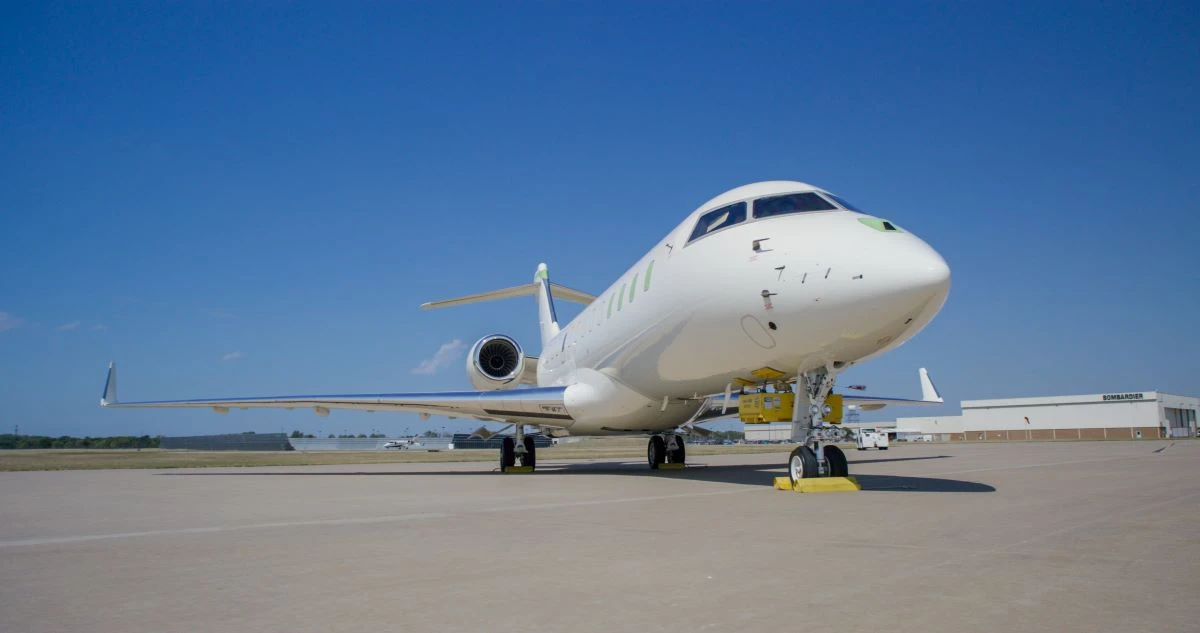
Bombardier Global 6500 aircraft delivered to the U.S. Army in support of the HADES program (Via Bombardier)
Bombardier’s Green (civilian-configured) Global and Challenger aircraft are transferred to Kansas for the high-value structural, engineering, and airframe preparation work needed to turn them into military platforms. This includes major structural modifications, mission wiring, systems hardpoints, certification support, and related OEM-level changes.
Next, US-based defense integrators—such as Sierra Nevada Corporation (SNC) and L3Harris—handle much of the mission-systems integration, including installing the sensors, ISR payloads, electronic warfare suites, communications gear, workstations, and software that define the aircraft’s operational role.
This partnership model lets the military leverage Bombardier’s reliable high-performance business jets while relying on specialized US defense companies for the classified or highly customized sensor and electronics packages.
If the Trump administration were to limit Bombardier aircraft sales in the US, it may even impact the sale of the Global 6500 airframe to the US Army.
President Trump’s threats could, therefore, target US military readiness.
More importantly, it could further strain ties with Canada, which is currently reviewing its F-35 purchase and whose citizens have called for abandoning the American stealth aircraft and buying the Saab Gripen-E amid sustained hostility with Washington.
However, Trump has not yet issued a concrete legal instrument, and a social-media declaration alone does not automatically halt certified aircraft sales or existing contracts.
Bombardier’s Green (civilian-configured) Global and Challenger aircraft are transferred to Kansas for the high-value structural, engineering, and airframe preparation work needed to turn them into military platforms. This includes major structural modifications, mission wiring, systems hardpoints, certification support, and related OEM-level changes.
Next, US-based defense integrators—such as Sierra Nevada Corporation (SNC) and L3Harris—handle much of the mission-systems integration, including installing the sensors, ISR payloads, electronic warfare suites, communications gear, workstations, and software that define the aircraft’s operational role.
This partnership model lets the military leverage Bombardier’s reliable high-performance business jets while relying on specialized US defense companies for the classified or highly customized sensor and electronics packages.
If the Trump administration were to limit Bombardier aircraft sales in the US, it may even impact the sale of the Global 6500 airframe to the US Army.
President Trump’s threats could, therefore, target US military readiness.
More importantly, it could further strain ties with Canada, which is currently reviewing its F-35 purchase and whose citizens have called for abandoning the American stealth aircraft and buying the Saab Gripen-E amid sustained hostility with Washington.
However, Trump has not yet issued a concrete legal instrument, and a social-media declaration alone does not automatically halt certified aircraft sales or existing contracts.
Contact the author at sakshi.tiwari13 (at) outlook.com
***
Truly a real S-Whole


No comments:
Post a Comment