
Malaysia's #1 Content Aggregator
OPINION | "Treason, Treason!" – What Happens When Politicians Try To “Overthrow” A Ruler…?!!
26 Sep 2026 • 9:30 AM MYT

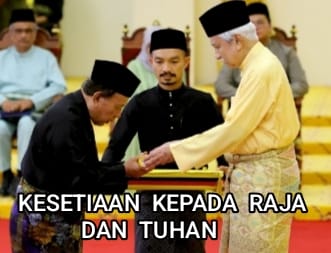
Wasn't the new Negeri Sembilan Menteri Besar from UMNO sworn in by the same current ruler Tuanku Muhriz whom his party is now attempting to replace? Credit Image: Malay Mail (Bernama pic)
God forbid, but if politicians are allowed to ‘oust’ a ruler, imagine what else they might do!
Amid the disturbing happenings in Negeri Sembilan, where the current ruler is being allegedly forced to abdicate the throne, the question many may be asking is this: are politicians now above the monarchy and the laws of the land?
It looks like the rollercoaster UMNO-Negeri Sembilan royal crisis has taken another twist after Menteri Besar Ismail Lasim reportedly verified the earlier media statement released by his state executive council (Exco) on the removal of Tuanku Muhriz Tuanku Munawir as the Yang di-Pertuan Besar of Negeri Sembilan—even ordering for the decision to be gazetted.
According to reports, the April 19 proclamation removing Tuanku Muhriz under Article 10 of the Laws of the Constitution of Negeri Sembilan 1959 had been signed and sealed by the lawful Undang, and became complete after Ismail signed it on Aug 3.
Yet, more recently, on Sept 9, Ismail admitted that he had signed the said proclamation "under duress,” and that his state government considered it invalid for not following Article 10.
He even lodged a police report and pledged loyalty to Tuanku Muhriz as the "sole legitimate and sovereign" ruler.
God forbid, but if politicians are allowed to ‘oust’ a ruler, imagine what else they might do!
Amid the disturbing happenings in Negeri Sembilan, where the current ruler is being allegedly forced to abdicate the throne, the question many may be asking is this: are politicians now above the monarchy and the laws of the land?
It looks like the rollercoaster UMNO-Negeri Sembilan royal crisis has taken another twist after Menteri Besar Ismail Lasim reportedly verified the earlier media statement released by his state executive council (Exco) on the removal of Tuanku Muhriz Tuanku Munawir as the Yang di-Pertuan Besar of Negeri Sembilan—even ordering for the decision to be gazetted.
According to reports, the April 19 proclamation removing Tuanku Muhriz under Article 10 of the Laws of the Constitution of Negeri Sembilan 1959 had been signed and sealed by the lawful Undang, and became complete after Ismail signed it on Aug 3.
Yet, more recently, on Sept 9, Ismail admitted that he had signed the said proclamation "under duress,” and that his state government considered it invalid for not following Article 10.
He even lodged a police report and pledged loyalty to Tuanku Muhriz as the "sole legitimate and sovereign" ruler.
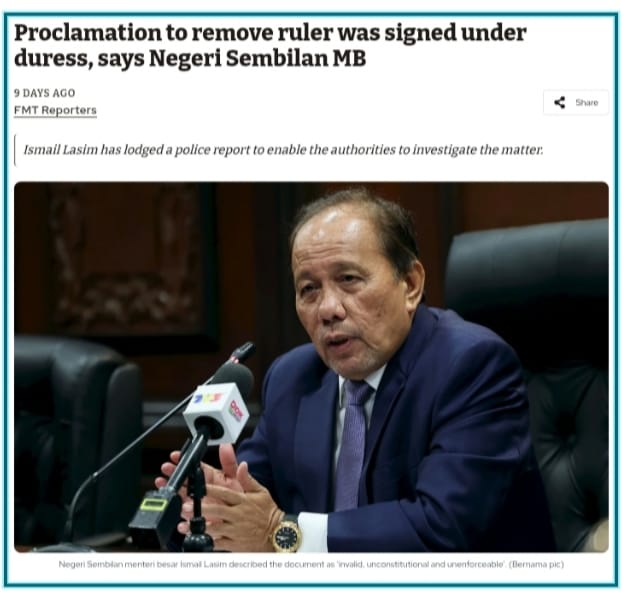
(Screenshot of news headline and image from FMT)
So why the sudden U-turn?
Or could Ismail merely be the fall guy for actors orchestrating this move behind the scenes?
Royalty strikes back…
Nevertheless, responding to Ismail’s latest announcement, the state’s Dewan Keadilan dan Undang (DKU) and its secretary have reported that they intend to initiate contempt proceedings against him and members of his Exco over the said proclamation which seemed to breach an existing injunctive order by the court.
In fact, their lawyers have also affirmed that the parties concerned have no jurisdiction, authority or power to make such a proclamation while citing it as unconstitutional, void and without any legal effect.
They asserted that the conduct is tantamount to a coup d'etat and an act of treason, which is punishable under the Penal Code and other relevant laws.
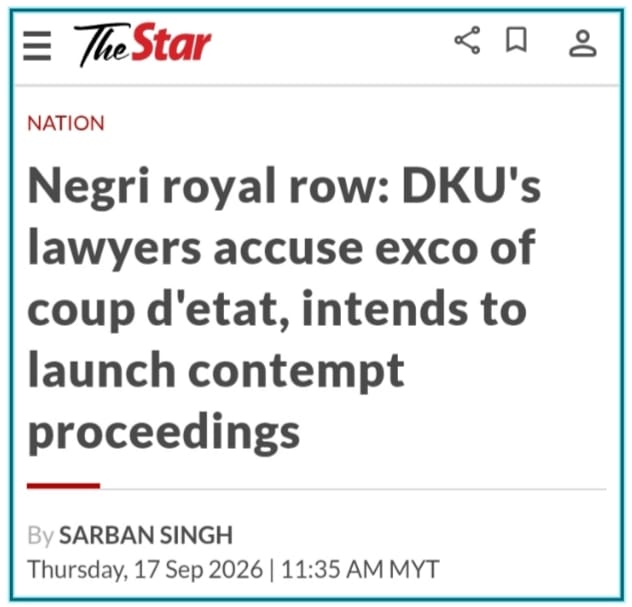 Screenshot of news headline and image from The Star.
Meanwhile, commenting on the same crisis, which seems far from over, Senator Sheikh Omar Ali from DAP has raised some fundamental questions.
Firstly, what wrong did Tuanku Muhriz commit to warrant His Royal Highness's removal from the throne?
Is it not odd that until this day this question remains unanswered?
Why the silence?
What’s the real agenda behind all the drama?
Crucially, even the powerful DKU has maintained that Tuanku Muhriz is still the legitimate ruler of the state while dismissing the controversial April 19 proclamation that sought to remove the latter from power.
Secondly, the Exco’s statement claimed that the April 19 abdication proclamation was “finalized” when it was signed by the Menteri Besar on August 3 and that Tuanku Nadzaruddin had been chosen as successor on April 19.
But the thing is, if the abdication was finalized only on August 3, how was a successor chosen earlier on April 19?
Doesn't it sound like a poorly written script with many holes?
Thirdly, since the Exco claims that the April 19 proclamation became fully valid on August 3, then what was Tuanku Muhriz's legal status between April 19 and August 3?
And what about the legitimacy of official events held during that intervening period, including Ismail’s appointment as Menteri Besar as he had taken his oath in front of Tuanku Muhriz on August 2?
Likewise, what would be the status of his appointed Exco and the entire new state government?
As for the outcome of the recent state election—would there be a question mark hanging over that too?
Sheikh Omar signed off with a note of caution as removing a King is a grave matter requiring valid grounds, legal bases, and proper judicial resolution for any disputes.
Furthermore, according to him, the country's Constitution, the dignity of the monarchy, and public trust in the rule of law must always be defended.
Isn't that what the Rukun Negara always reminds us?
Interestingly, many will recall how a few months ago the state UMNO had complained that the previous Menteri Besar from PH had failed to handle the royal crisis well.
And did it not cite that same reason for withdrawing from the PH-led state government, which eventually led to the dissolution of the assembly and a subsequent state election?
Inevitably, all these may prompt critics to ask: is there a broader political agenda to challenge the authority of Tuanku Muhriz, who is well-known and well-liked for his humble, people-centred approach and staunch anti-corruption stance?
Still, based on what the ruler's lawyers had highlighted earlier, the bigger and more troubling question may well be this: aren't the actions of those involved in the ongoing attempt to remove the state’s legitimate ruler tantamount to a coup d'etat and an act of treason?


No comments:
Post a Comment