
Hadi defends PAS-Umno cooperation, cites need for Malay-Muslim unity
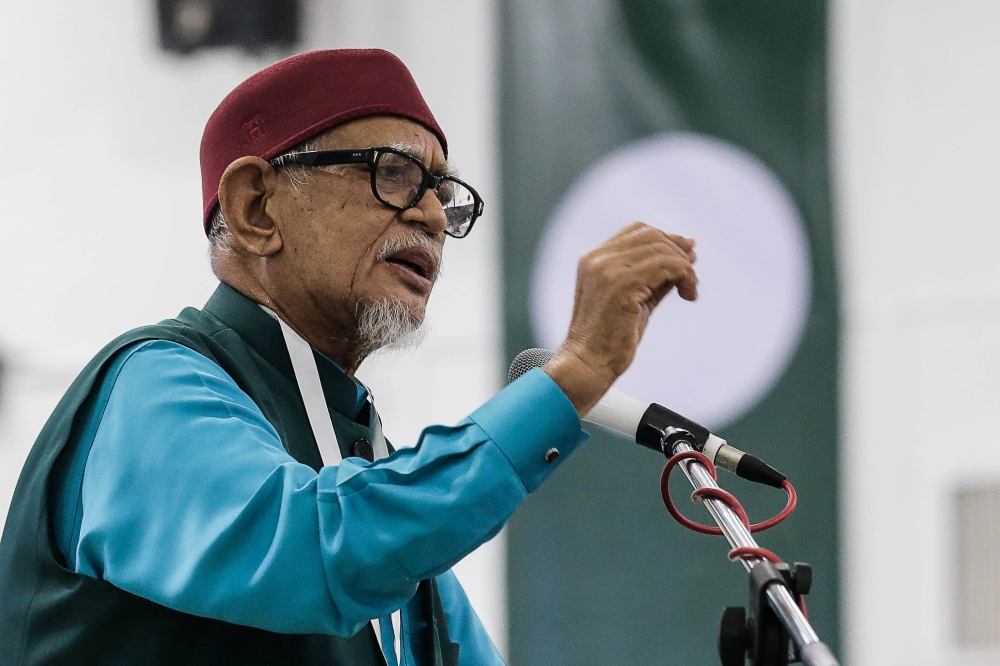
PAS president Tan Sri Abdul Hadi Awang Abdul Hadi said divisions among Muslims could lead to the loss of strength and influence, citing examples from Islamic history where internal conflicts contributed to the decline of Muslim powers. — Picture by Sayuti Zainudin
First Published: Tuesday, 21 Jul 2026 3:37 PM MYT
KUALA LUMPUR, July 21 — PAS president Tan Sri Abdul Hadi Awang said the party was “forced” to cooperate with Umno as part of efforts to unite Malays and Muslims, warning that continued division could weaken their political position.
In his latest “Minda Presiden PAS” article, Abdul Hadi rejected claims that cooperation between Perikatan Nasional (PN) and Barisan Nasional (BN) was merely political manoeuvring, saying such alliances should instead be viewed as efforts to strengthen unity.
“Cooperation between Perikatan Nasional (PN) and Barisan Nasional (BN) is considered a political game as imagined by those who are still afflicted by compounded ignorance and do not understand religion itself,” he said.
Abdul Hadi said divisions among Muslims could lead to the loss of strength and influence, citing examples from Islamic history where internal conflicts contributed to the decline of Muslim powers.
“Islam, which is universal, calls for cooperation towards the unity of the ummah, which is an obligatory approach in responding to Allah’s call,” he said.
He said PAS had previously worked with various political parties, including Umno before and after independence, but those partnerships ended due to disagreements over principles and conditions.
“PAS had cooperated with Umno before independence and with the Alliance Party (the precursor to Barisan Nasional, comprising Umno, MCA and MIC) before and after independence, but the cooperation broke down again when conditions and principles were violated,” he said.
Abdul Hadi also recalled PAS’ past cooperation with DAP and PKR through opposition coalitions such as Barisan Alternatif (BA) and Pakatan Rakyat (PR).
He said BA, formed in 1999, involved PAS, Parti Keadilan Nasional, Parti Rakyat Malaysia and DAP, but the coalition later weakened after disagreements emerged, including over PAS’ push for an Islamic state.
He added that Pakatan Rakyat, formed after the 2008 general election involving PAS, PKR and DAP, later collapsed after differences over issues including PAS’ stance on syariah implementation in Kelantan and Terengganu.
Abdul Hadi said PAS subsequently joined the formation of PN with Parti Pribumi Bersatu Malaysia (Bersatu) and other parties, before making major gains in the 15th general election.
He said the party’s performance in GE15 reflected strong support from Malay Muslim voters, allowing PAS to form governments in four states and secure the largest number of parliamentary seats won by a single party.
“PAS won big by successfully governing four state governments, besides obtaining the highest number of parliamentary seats and the most seats in several states through strong support from Malay Muslims,” he said.
The PAS president said the current political situation required cooperation between Malay Muslims and non-Muslims who were not extreme, adding that the party had adopted what he described as a wise political approach.
“PAS had to take a wise political step by taking lessons from Rasulullah SAW, who united the Arabs who were divided and involved in civil wars, followed by the unity of a multiracial society in Malaysia,” he said.
Abdul Hadi also explained PAS’ role in recent state elections, saying its strategy differed depending on the political situation.
He described PAS’ participation in the Johor state election as symbolic, saying the party’s role was to strengthen Malay unity, while its involvement in Negeri Sembilan was aimed at challenging the Pakatan Harapan-led state government.
“Unlike Negeri Sembilan, which is controlled by PH with the dominance of DAP and Malays who have been carried away, PAS contested as an attacking force with a strategic position to take over power,” he said.
Abdul Hadi warned that political disputes, racial divisions and sectarian conflicts could weaken communities, citing the fall of Muslim powers including Andalusia and the Ottoman Empire as examples.
He ended his statement by stressing that Malay Muslim leadership should not be equated with racism.
“Malay Muslims leading is not racism, because Islam requires justice for all, prohibits racial fanaticism and there is no compulsion in religion,” he said.


No comments:
Post a Comment