
‘Everyone's afraid to die’: Struggle to recruit soldiers in Ukraine turns violent
32 minutes ago
Sarah Rainsford
Eastern Europe correspondent , Kyiv
BBC
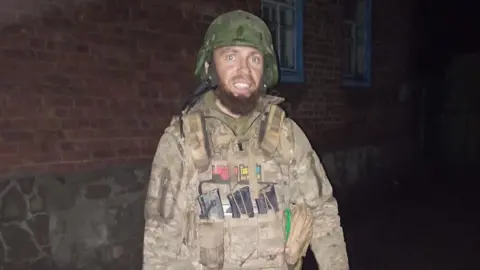
Vasyl Krupych, a serving soldier, was assaulted while out searching for draft dodgers
Vasyl Krupych knows what it is to fight for Ukraine.
He describes terrifying scenes from battles in the eastern Donbas region where, sometimes praying, sometimes crying, the machine gunner somehow survived the onslaught by Russian troops.
But last December, by then serving in the rear, Krupych was attacked by his own countrymen whilst out searching for draft dodgers.
He says two men ignored demands to show their documents and fled. When his patrol gave chase, Krupych was badly beaten with a crowbar. He spent six weeks in hospital.
"He broke my rib, I was lying there and couldn't breathe," the veteran recalled in a recent interview.
"What did we fight for, if soldiers can now get beaten?"
Surge in violence
Ukraine's military ombudswoman says such attacks are now "regular" and "a major problem" as the country struggles to mobilise men to fight in the fifth, draining year of Russia's full-scale invasion.
It's not a topic people here care to discuss much, wary of feeding Russian propaganda.
But the latest National Police Service report recorded more than 600 assaults on recruitment officers to date and warned that the aggression has become "increasingly threatening".
The first big alert came in April when several recruiters were stabbed, one fatally. Then this month in Lviv, some 200 protesters surrounded officers attempting to detain a suspected draft dodger and smashed and overturned their car.
The riot made headlines as President Volodymyr Zelensky condemned violence against serving soldiers.
His controversial decision since then to sack Defence Minister Mykhailo Fedorov – over a clash of character and vision with Ukraine's commander-in-chief – means attempts to address the conscription crisis will stall.
But the anger that just exploded in Lviv suggests that the need is urgent.
Vasyl Krupych, a serving soldier, was assaulted while out searching for draft dodgers
Vasyl Krupych knows what it is to fight for Ukraine.
He describes terrifying scenes from battles in the eastern Donbas region where, sometimes praying, sometimes crying, the machine gunner somehow survived the onslaught by Russian troops.
But last December, by then serving in the rear, Krupych was attacked by his own countrymen whilst out searching for draft dodgers.
He says two men ignored demands to show their documents and fled. When his patrol gave chase, Krupych was badly beaten with a crowbar. He spent six weeks in hospital.
"He broke my rib, I was lying there and couldn't breathe," the veteran recalled in a recent interview.
"What did we fight for, if soldiers can now get beaten?"
Surge in violence
Ukraine's military ombudswoman says such attacks are now "regular" and "a major problem" as the country struggles to mobilise men to fight in the fifth, draining year of Russia's full-scale invasion.
It's not a topic people here care to discuss much, wary of feeding Russian propaganda.
But the latest National Police Service report recorded more than 600 assaults on recruitment officers to date and warned that the aggression has become "increasingly threatening".
The first big alert came in April when several recruiters were stabbed, one fatally. Then this month in Lviv, some 200 protesters surrounded officers attempting to detain a suspected draft dodger and smashed and overturned their car.
The riot made headlines as President Volodymyr Zelensky condemned violence against serving soldiers.
His controversial decision since then to sack Defence Minister Mykhailo Fedorov – over a clash of character and vision with Ukraine's commander-in-chief – means attempts to address the conscription crisis will stall.
But the anger that just exploded in Lviv suggests that the need is urgent.
'Busification'
The reasons appear to range from plain fear of the front line – now everyone knows someone who's been injured or killed - to a reluctance to sign up for a war that has no end in sight.
The only surge of enthusiasm since the initial rush to the front was in late 2023, when Ukraine launched a counter-offensive to seize back territory in the south-east.
It didn't last.
That's when the "brutal mobilisation" phase began, according to opposition MP Oleksandr Honcharenko.
He blames that for the backlash.
"These officers are hunting for people on the streets and sometimes using quite violent methods," the MP says.
"Violence leads to violence. It's a huge problem and it's going to get worse."
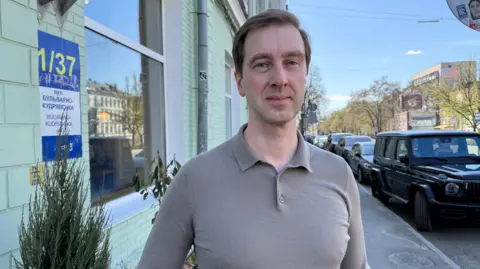
Ivan Stupak said that Ukraine's high command was forced to use "busification" to tackle a lack of manpower on the battlefield
Military analyst Ivan Stupak agrees.
"We started to suffer a lack of manpower on the battlefield, constant losses," he recalls. "Ukraine's high command had to refill these losses so they started busification."
That's the term Ukrainians use for mobile patrols that end up with men bundled into buses, and off to serve.
"When they need an extra 5,000 men, they start grabbing them - and if they refuse it turns into fights on the street."
The professor's story
So for every story of a draft officer attacked, there are accounts of violence by recruiters themselves.
Ukraine's Human Rights Commissioner recorded more than 6,000 such complaints last year - double the 2024 tally. They include claims of abuse and unlawful detention as well as poor conditions at recruitment centres.
Kyrylo Ogdansky still gets upset when he talks about what happened to him in Dnipro last November.
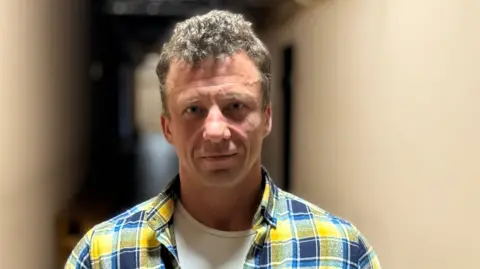
Kyrylo was brutally beaten by recruiters despite being exempt from the draft
The university professor, who is exempt from the draft, was approached in the street by a man in plain clothes who wanted to check his call-up status.
There are rules about such patrols, including having police officers present, so Ogdansky objected.
The university professor, who is exempt from the draft, was approached in the street by a man in plain clothes who wanted to check his call-up status.
There are rules about such patrols, including having police officers present, so Ogdansky objected.
Then he was assaulted.
"One of them knocked the phone from my hand and two pushed me into the bus from behind. When I asked what's happening, one started to beat me to the head. He hit me in the nose several times," Ogdansky tells me.
He remembers the threat to send him straight to the front line. "He said 'I can call the commander and you'll go to Pokrovsk'."
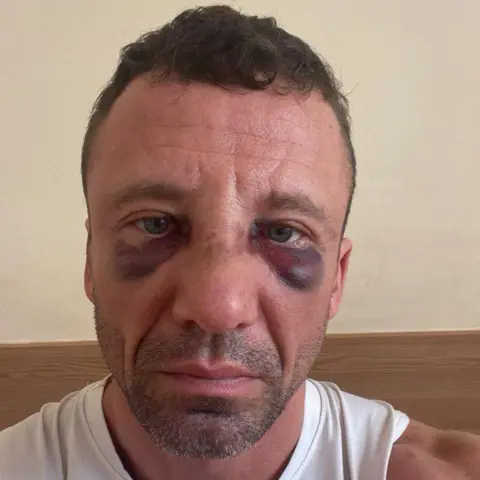
Kyrylo spent two weeks in hospital following the attack and has made formal official complaints
Instead, the professor spent two weeks in hospital with a suspected neck injury and big purple-black bruises beneath his eyes.
He has made formal official complaints but was hesitant about speaking publicly, aware that such things look bad for Ukraine in the middle of a war.
"Russian propaganda uses such things very actively. But such a problem exists," Ogdansky explains his decision.
"If everyone is silent, then why would it stop? I understand the problem of conscription, but no official has the right to act like this."
Vasyl's story
It's clear that Vasyl Krupych experienced horrors at war.
He volunteered at the very start and has survived some of the grimmest battles.
Krupych is proud of his service - a tattoo on his neck declares "Glory to the Ukrainian Armed Forces" – but he suffers from nightmares.
When his vehicle was hit by an FPV drone, he was badly injured but managed to drag one friend to safety. He saw two others burned to death.
Now, when we discuss the increase in attacks against draft officers, his words drip with hurt.
It's not just about what he suffered himself: that case is still going through the courts. It's also the gulf between what he has endured and those doing everything possible to avoid the same.
"We are doing our duty. We fought, we defended our people - and now they are attacking us."
I wonder what he thinks might motivate people to serve, instead of coercing them, and he mentions raising salaries.
But then he shrugs.
"It can't be done differently, it can't. Our lads need to be replaced. But nobody volunteers," he says.
"Everyone is afraid to die."
Instead, the professor spent two weeks in hospital with a suspected neck injury and big purple-black bruises beneath his eyes.
He has made formal official complaints but was hesitant about speaking publicly, aware that such things look bad for Ukraine in the middle of a war.
"Russian propaganda uses such things very actively. But such a problem exists," Ogdansky explains his decision.
"If everyone is silent, then why would it stop? I understand the problem of conscription, but no official has the right to act like this."
Vasyl's story
It's clear that Vasyl Krupych experienced horrors at war.
He volunteered at the very start and has survived some of the grimmest battles.
Krupych is proud of his service - a tattoo on his neck declares "Glory to the Ukrainian Armed Forces" – but he suffers from nightmares.
When his vehicle was hit by an FPV drone, he was badly injured but managed to drag one friend to safety. He saw two others burned to death.
Now, when we discuss the increase in attacks against draft officers, his words drip with hurt.
It's not just about what he suffered himself: that case is still going through the courts. It's also the gulf between what he has endured and those doing everything possible to avoid the same.
"We are doing our duty. We fought, we defended our people - and now they are attacking us."
I wonder what he thinks might motivate people to serve, instead of coercing them, and he mentions raising salaries.
But then he shrugs.
"It can't be done differently, it can't. Our lads need to be replaced. But nobody volunteers," he says.
"Everyone is afraid to die."
What to do?
In his six months as defence minister, Mykhailo Fedorov did start introducing reforms to tackle the growing crisis.
He began with moves meant to make military service more attractive: fixed-term contracts for new recruits, with the option to defer further service, and better salaries, especially for the riskiest roles.
But it was an early work in progress and overhauling conscription was still on his to-do list when he was sacked.
Proposals have included handing draft patrols over to police, who are less personally invested in the task. There's talk of proper training, too, for officers, and psychological screening.
Ukraine does admit openly that it has a problem, which is new.
But it now has only an acting defence minister, and still no solution.


Rasputin cannot recruit enough in his own country so he is now recruiting children in Occupied Ukraine.
ReplyDeleteRussians are ramping up the systemic brainwashing of Ukrainian children in the occupied areas of Ukraine, with all efforts toward pushing them into military conscription.
The occupation administration has brought in another 50 "educators" from various regions of Russia, promising them high salaries, housing subsidies, and other financial benefits, according to Ukraine's Center for National Resistance.
Officially, this is explained by a shortage of personnel, but the real goal of the Kremlin is to completely transform Ukrainian schools to Russian educational standards.
Starting in September, education will be conducted according to Russian programs, using Russian textbooks, distorted history, propaganda courses, and the imposition of Russian identity on children.
Through lessons, extracurricular activities, and special propaganda programs, children are being raised to be loyal to Russia, distorting their perception of Ukraine and justifying Russian aggression.
https://x.com/StratcomCentre/status/2079098151345197068?s=20
Slava Ukraini.
ReplyDeleteUkraine is doing the world a favour by destroying Russian strategic bombers, capable of delivering nuklear boms, one by one.
Satellite image of a Russian Tu-95MS strategic bomber destroyed by an SBU drone.
Engels Air Base, Saratov Oblast, 17 July.
"The most likely estimate is that Russia can have around 20-24 Tu-95MS ready for operations at any given time, with variations depending on maintenance and repairs."
https://x.com/TheDeadDistrict/status/2078782937118490752?s=20
Slava Ukraini.
ReplyDeleteThank You Ukraine for destroying Rasputin's fleet of strategic bombers.
(Equivalent to B52s)
🇷🇺 Inventory
Before the Ukrainian operation "Spiderweb," the inventory stood at 55-58 Tu-95MS, though that figure included aircraft not fully operational.
Following the losses of 2025 and subsequent ones, it is estimated that the truly usable fleet had been reduced to about 27-34 Tu-95MS in service.
That said, "in service" does not mean "available to fly today."
In a fleet of bombers over 40 years old, subjected to very intensive use since 2022, it is reasonable to assume availability lower than the theoretical in peacetime:
👉🏻High availability (80%): 22-27 aircraft.
👉🏻More realistic availability after years of war (65-75%): 18-25 aircraft.
The most likely estimate is that Russia can have around 20-24 Tu-95MS ready for operations at any given time, with variations depending on maintenance and repairs.
🇷🇺💥 Tu-95MS
A 🇺🇦 attack split a Tu-95MS in two. The news broke yesterday but I was waiting for images.
In the end, strategic bombers are aircraft present in limited numbers and any destruction is a major blow.
https://x.com/ReinaldoDMM/status/2078787035611922908?s=20