
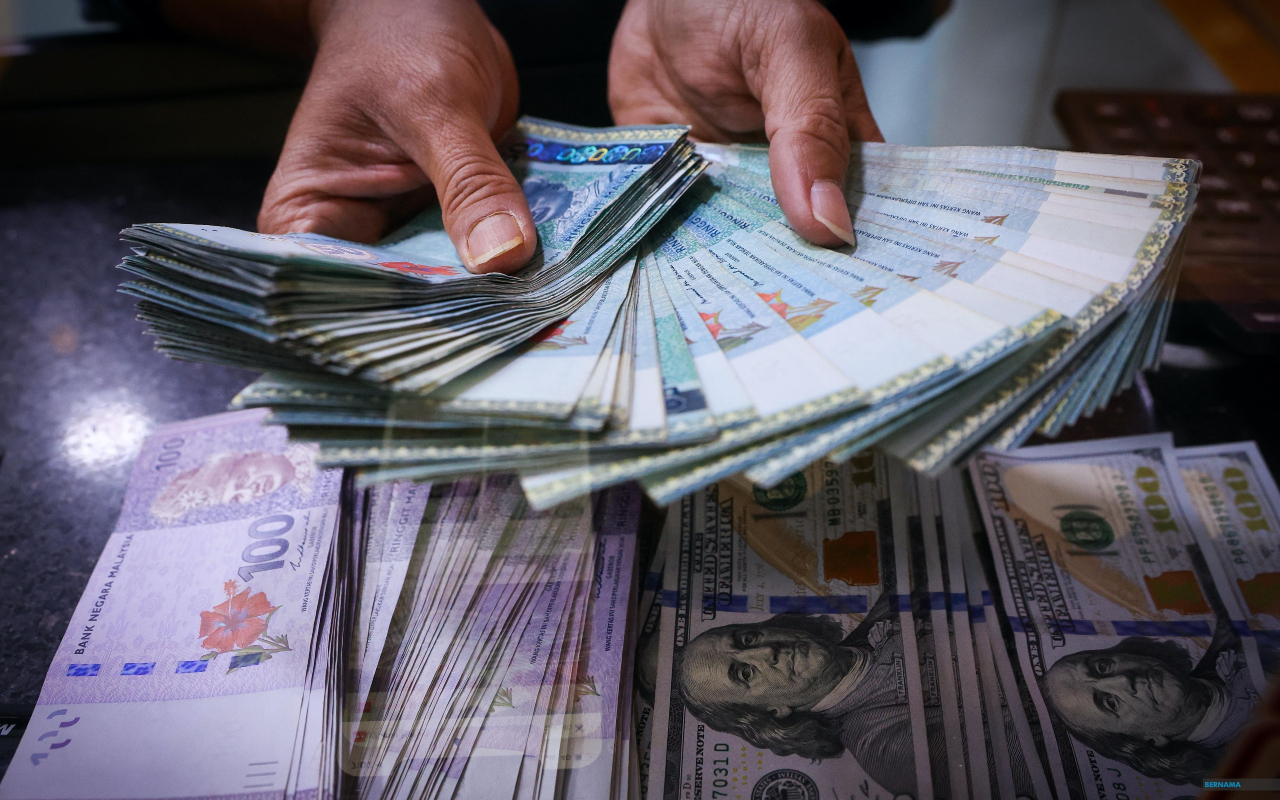
The ringgit has seen a strong resurgence, indeed, emerging as one of Asia's best-performing currencies this year, driven by robust economic fundamentals, rising tech exports, and investor confidence. - Bernama file pic, February 22, 2026
Deja vu as ringgit touches 3.80 – Rocky Bru
As the ringgit edges back toward the symbolic 3.80 mark, memories of the 1998 Asian Financial Crisis and the dramatic clash between Datuk Seri Anwar Ibrahim and Tun Dr. Mahathir Mohamad resurface

Rocky Bru
Updated 24 seconds ago
22 February, 2026
11:44 AM MYT
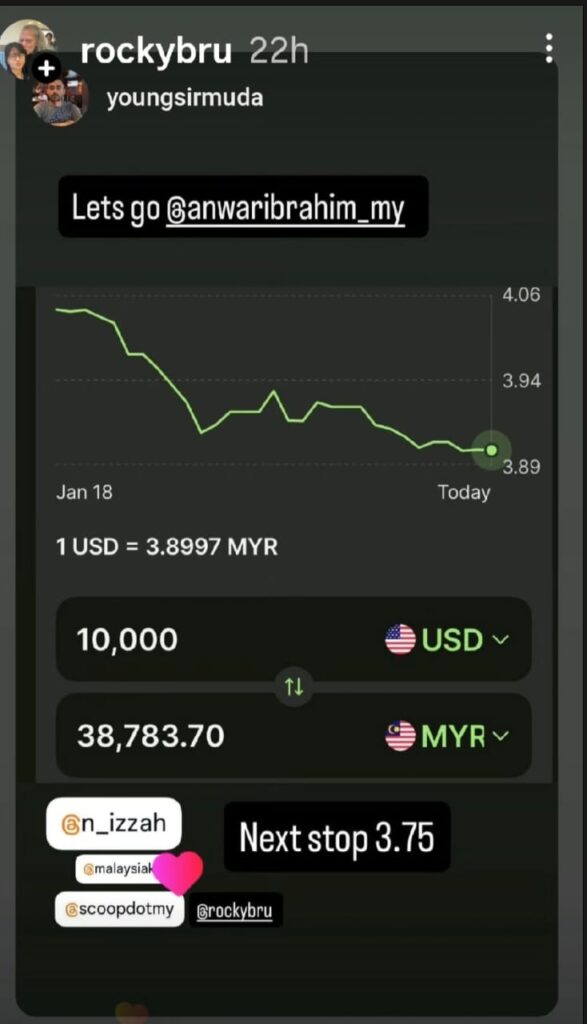
I had a moment of deja vu when my young friend Muda, a Malaysian in the US, tagged me to his post about the ringgit doing 3.8997 against the greenback on Wednesday. “Let’s go @anwaribrahim_my. Next stop 3.75.”
The ringgit has seen a strong resurgence, indeed, emerging as one of Asia’s best-performing currencies this year, driven by robust economic fundamentals, rising tech exports, and investor confidence.
It had not smelled 3.80 in a decade. Some predicted it never would.
“3.80 is a magical number. Tun Mahathir pegged the ringgit at 3.80 against the greenback the same day he sacked Anwar Ibrahim in 98,” I replied to Muda.
Deja vu as ringgit touches 3.80 – Rocky Bru
As the ringgit edges back toward the symbolic 3.80 mark, memories of the 1998 Asian Financial Crisis and the dramatic clash between Datuk Seri Anwar Ibrahim and Tun Dr. Mahathir Mohamad resurface
Rocky Bru
Updated 24 seconds ago
22 February, 2026
11:44 AM MYT
I had a moment of deja vu when my young friend Muda, a Malaysian in the US, tagged me to his post about the ringgit doing 3.8997 against the greenback on Wednesday. “Let’s go @anwaribrahim_my. Next stop 3.75.”
The ringgit has seen a strong resurgence, indeed, emerging as one of Asia’s best-performing currencies this year, driven by robust economic fundamentals, rising tech exports, and investor confidence.
It had not smelled 3.80 in a decade. Some predicted it never would.
“3.80 is a magical number. Tun Mahathir pegged the ringgit at 3.80 against the greenback the same day he sacked Anwar Ibrahim in 98,” I replied to Muda.
He was probably too young to have any memory of that tumultuous time.
It was September 2 1998, the height of the Asian Financial Crisis. Mahathir Mohamad, the PM then, was facing mounting pressure to step down. His counterparts in Thailand and Indonesia had already subscribed to the IMF’s rescue plan.
But instead of “succumbing”, Mahathir decided to go rogue by pegging the ringgit and enforcing other capital controls. He also sacked his deputy, who was proving to be a major threat. Anwar, also Finance Minister, was a strong advocate of IMF’s remedy for Malaysia and the region. His sin, however, was for implying that Mahathir was the reason behind the deep-rooted corruption, cronyism and nepotism responsible for the country’s vulnerability during the crisis.
I was the Editor of Business Times, Malaysia’s only financial daily at the time. I remember wanting to lead the next day’s edition with the sacking but Kadir Jasin, the Group Editor In Chief, said BT should go with pegging and capital controls. Both were sensational.
The sacking was just a start. Anwar was later tried for sodomy and corruption. He was detained without trial under the Internal Securities Act and then a total of 11 years behind bars.
The peg was lifted in 2005. Anwar was kept in jail, on and off, until his royal pardon in 2018.
Today, 28 years on, Anwar is the Prime Minister after winning the 2022 General Election, the same one that saw Mahathir, now 100, lose badly (his first election defeat in 53 years!).
The ringgit was never the same after the Asian Financial Crisis. After the peg was removed in 2005, the best it did was 3.16. In 2015 when the 1MDB shit hit the fan, it fell to historical lows. The last time it tested 3.80 was in 2015.. By the time Mahathir ended his ill-fated second tour as PM in 2020, the ringgit stayed down around 4.80.
When Anwar became PM on 24 Nov 2022, the ringgit surged by 1.8 percent, its largest single-day gain since March 2016. The next day it improved further to 4.45 vs dollar. But analysts were not impressed. A flash in the pan. Many predicted the currency would remain weak.
Dr Sailesh K. Jha, RHB Bank’s group chief economist and head of financial market research, was just one of them: “Our year-end target is 4.6, and the first half of next year (2023), we’re at 4.7 to 4.8. So there’s been no major changes in our currency view.”
Fast forward to the start of 2026, analysts remained diffident. The Edge spoke to two of them on Jan 8. While Mizuho Research said the Malaysian currency could breach the 4.00 threshold in the second quarter, it’s average forecast for the year was about 4.015, “with the ringgit spending most of 2026 knocking on the door of 4.00.”
UOB Global Economics and Markets was even more cautious. Despite Malaysia’s “remarkable fundamentals”, its FX Strategist Peter Chia saw the ringgit as somewhat overbought. “We are a little more cautious about projecting strength beyond the 4.00 level at this point in time. Our forecast is for the ringgit to stay around four.”
The ringgit had other ideas. Last Friday it closed 3.9030 against the USD. Over the past month, MYR has strengthened 3.55 per cent and over the last one year, it is up by nearly 12 per cent.
Robust economic performance, rising exports, investor confidence.
Still, there’s a lesson we should learn from those faithless analysts (and from the Asian Financial Crisis, too, for that matter): We must remain cautious and translate that caution into vigilance. The good work of the last year, especially, must continue. The fight against the corrupt cannot falter.
We have seen how fragile currencies and economies, including our own, can be. Get the people to take to the streets, disseminate fake information and alarming news, undermine institutions like the Malaysian Anti-Corruption Commission, and create political instability.
Already we are seeing this happening: frustrated politicians promoting havoc, mad mob cheering on people who openly admit to giving bribes, the rich corrupt (under MACC investigation) engaging foreign agents to carry out economic sabotage.
It does not take much to spook investors. – February 22, 2026
Datuk Ahirudin Attan is the Executive Director of Big Boom Media that publishes Scoop.my. This article was first published in Rocky Bru’s blog


No comments:
Post a Comment