Turkiye has publicly dismissed Malaysia's announcement that 10,000 Rohingya refugees would be resettled there.
In a short statement posted on X last night, it labelled reports of the said plan as "unfounded".
"The claims in some international press and broadcast outlets and social media accounts that 10,000 Rohingya will be resettled in Turkiye are unfounded.
"The public is earnestly requested not to give credence to content that is untrue," said Turkiye's Directorate of Communications for the Centre for Combating Disinformation (DMM).
In a statement on Friday, Deputy Prime Minister Ahmad Zahid Hamidi said that the Malaysian and Turkish governments had agreed to resettle 10,000 Rohingya refugees in Turkiye through a structured skills training programme.
He said the proposal followed his recent official working visit to the republic, and that the training would last three to six months, focusing on skills matched to the needs of Turkish industries. Deputy Prime Minister Ahmad Zahid Hamidi
However, about an hour later, the statement was deleted from his social media accounts without any explanation.
Following the sudden removal, Putrajaya was then urged to clarify whether the Turkish government had indeed agreed to accept the Rohingya refugees from Malaysia.
However, late last night, Zahid's press secretary, Shuhaimi Mohamed, stressed that the plan is still in the pipeline and assured that further updates will follow.
"The earlier statement was issued as we are indeed working towards this initiative, which is ultimately in the best interest of our country and our people.
"However, certain matters will still require further clarification and coordination with the relevant parties.
"We remain committed to pursuing this proposed arrangement, and further announcements will be made once the necessary processes have been completed," he said in a statement posted on his Instagram account.
ICJ rules Myanmar committed genocide
Following Zahid's Nov 20 announcement, Euronews' Turkish-language service questioned whether an agreement had been finalised, highlighting several unanswered questions, including who would fund the programme, where the training would take place, and whether participants would be allowed to settle permanently in Turkiye.
Zahid's statement came a day after the International Court of Justice (ICJ) found that Myanmar had committed genocide against the Rohingya in northern Rakhine State during its 2017 military operations.
Myanmar, however, reportedly described the verdict as "not fair” and “not unanimous", with presidential spokesperson Khaing Khaing Soe maintaining that the military operations had targeted insurgents rather than civilians.
She said that the military-backed government would review the judgment.
In its ruling, the ICJ ordered Myanmar to provide reparations to victims and take steps to prevent further violations.
The Gambia, a West African nation, brought the case against Myanmar in 2019.
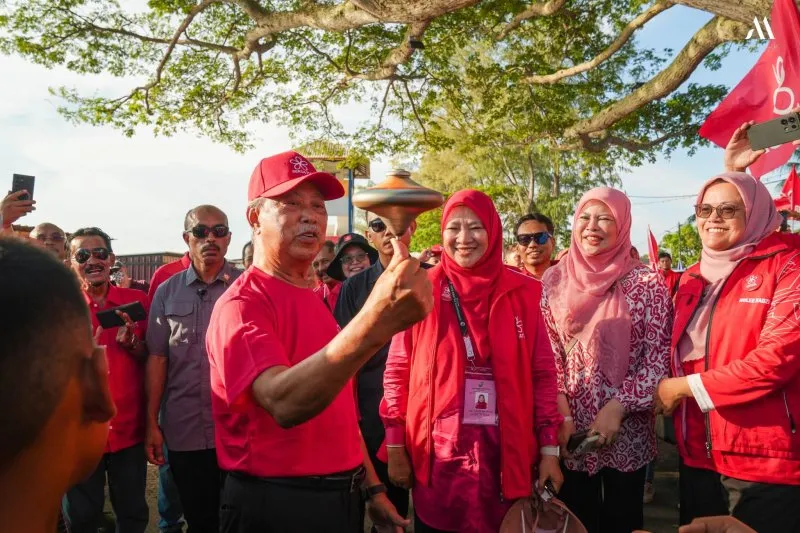
Bersatu is discussing what next for the party after incumbent president Tan Sri Muhyiddin Yassin (centre) steps down, secretary-general Datuk Seri Mohamed Azmin Ali confirmed to Berita Harian on November 21, 2026. — Picture from Facebook/Azmin Ali
Summary
Bersatu has started talks on who will lead the party after president Tan Sri Muhyiddin Yassin, secretary-general Datuk Seri Mohamed Azmin Ali said.
Azmin said the transition is being handled orderly and fairly, after Muhyiddin agreed years ago to step aside but stayed on at the grassroots’ request.
He also said suspended and disaffected members are beginning to return, and Bersatu is ready to welcome them back to strengthen the party.
First Published: Sunday, 22 Nov 2026 11:28 AM MYT
KUALA LUMPUR, Nov 22 — Bersatu has begun discussing who will lead the party after president Tan Sri Muhyiddin Yassin, its secretary-general has confirmed.
Datuk Seri Mohamed Azmin Ali said the talks, which include the process of handing over Muhyiddin’s leadership, were being carried out in an orderly manner to keep the party’s struggle going, Berita Harian reported last night.
“I want to stress that Bersatu is the only party that has started discussions on the transition of top leadership,” he was quoted as saying.
He said he had not heard of any other party doing the same.
Azmin said Bersatu was being fair to Muhyiddin, who declared three years ago that he no longer wanted to contest in party elections.
He said Muhyiddin carried on as leader only because the grassroots pressed him to stay, which he described as the party’s wish.
Muhyiddin announced a succession plan at a party convention in Selayang in July 2024, which gave Datuk Seri Hamzah Zainudin the deputy president’s post uncontested on the understanding that he would one day replace him.
In July this year, Muhyiddin said that plan had failed, causing divisions that forced the party to take disciplinary action against several members, and that his current term as president would be his last.
At Bersatu’s annual general assembly in September 2025, delegates approved a motion for Muhyiddin to remain president.
They also approved naming the Pagoh MP as Perikatan Nasional’s prime minister candidate for GE16.
Azmin said some Bersatu members who were earlier suspended or had turned their backs on the party had begun to return.
He said Bersatu was ready to welcome them for the sake of strengthening the party and serving the people.
“We are not severing ties with them,” he told Berita Harian, adding that the party had taken legal action in accordance with the Constitution.
“We may all have our mistakes and weaknesses, but if someone is prepared to apologise or do their best, we accept,” he added.
Bersatu had earlier suspended several leaders, including Beluran MP Datuk Seri Ronald Kiandee, a former party vice-president, and Masjid Tanah MP Datuk Mas Ermieyati Samsudin, both linked to open support for Hamzah.
On May 8, the party suspended seven elected representatives for two election terms: Tanah Merah MP Datuk Seri Ikmal Hisham Abdul Aziz, Rompin MP Datuk Abdul Khalib Abdullah, Lumut MP Nordin Ahmad Ismail, Hulu Terengganu MP Datuk Rosol Wahid, Ketereh MP Datuk Khlir Mohd Nor, Kuala Sepetang assemblyman Ahmad Man and Chenderoh assemblyman Syed Lukman Hakim Syed Mohd Zain.
Three days later, it suspended two more leaders for two election terms: Mersing MP Muhammad Islahuddin Abas and Bukit Bunga assemblyman and Jeli division chief Mohd Almidi Jaafar.
Why GE16 will boil down to a dramatic contest of wills and skills between Ahmad Zahid Hamidi and Anwar Ibrahim.
Following the 2026 state elections, many are predicting that Umno and Perikatan Nasional (PN) will team up and win power in the next general election (GE).
Most analysts see it as an almost certain clash between PH and a PAS-led PN in the peninsula. Some argue that GE16 will be fought primarily on traditional flashpoints: Malay rights, Islamic values, economic delivery, and non-Malay frustrations.
That may be true, but I think this election is more likely to boil down to a dramatic contest of political agility and manoeuvres between Ahmad Zahid Hamidi and Anwar Ibrahim.
While East Malaysia’s blocs in Sabah and Sarawak will—as always—play a decisive kingmaker role post-election to protect local autonomy, the battle to capture Putrajaya itself remains a peninsula-driven contest. Within that crucible, GE16 will essentially be a battle of wills and operational skill between two men who know how to survive at the top.
Zahid’s core competency is political engineering. He treats relationships as leverage, public statements as bargaining signals, and possesses a feel for power dynamics that is probably unmatched in modern Malaysian politics.
Yet, while his “blue wave” narrative resonates powerfully with Malay voters, it does not travel cleanly to the urban, mixed, and non-Malay constituencies that ultimately decide a national majority—though Umno relies on its traditional Barisan Nasional coalition mechanisms to manage multi-ethnic seats.
Conversely, Anwar’s strength lies in policy, narrative, and survival. A reformist with international credibility and a coherent platform, Anwar has ridden the waves of triumph and defeat, navigated various crises, and risen to become prime minister.
He is waging a war of attrition, using his control over the national budget and administrative levers to delay the electoral clock while Zahid tries to force an early hand.
To understand why this duel will define GE16, we must look back at how their paths have intertwined over the last three decades.
When the bitter fallout between then-Umno president Mahathir Mohamad and his deputy Anwar erupted in the late 1990s, Zahid—serving as Umno Youth chief—initially backed Anwar. Yet, after Anwar’s sacking in 1998, Zahid quickly pivoted, reconciled with Mahathir, and demonstrated the classic Umno survival instinct: prioritising pragmatism over loyalty.
From that point, Zahid embarked on a meticulously calculated ascent: consolidating his base in Perak, building a formidable personal network, becoming Umno’s deputy president, and finally taking the top spot in 2018.
Following the 2022 humiliation when Umno won just 26 seats, calls for his resignation mounted. He weathered the storm, teamed up with Anwar to secure the post of deputy prime minister, and used his proximity to power to reassert Umno’s relevance.
Anwar, for his part, pursued his long game: forming PKR, driving the Reformasi movement, riding the 2008 opposition surge, and eventually making an uneasy truce with his arch-rival Mahathir to wrest power in 2018. But political betrayals caused Mahathir’s government to collapse, paving the way for short-lived administrations under Muhyiddin Yassin and Ismail Sabri Yaakob.
The inconclusive 2022 general election threw Anwar and Zahid together into an improbable partnership. Zahid secured ministerial perks and shared authority, and by December 2025, the Attorney General’s Chambers granted him a discharge not amounting to an acquittal (DNAA) on the 47 corruption charges involving the Yayasan Akalbudi fund.
Critics blasted the move as a classic manoeuvre to shield allies and buy loyalty, though it has consistently been denied.
Since then, Zahid has supercharged Umno’s stature among Malay supporters by leaning into the reliable narrative of Malay unity and perceived threats to Malay dominance.
The resulting PAS-Umno tactical cooperation benefits both parties. This momentum was reflected in the 2026 state elections, though formulas varied: in Johor, BN swept 48 of 56 seats alone (while PN supporters were quietly instructed to back BN in uncontested seats), whereas in Negeri Sembilan and Melaka, BN and PN formally shared seats.
True to form, Zahid is keeping all options open by refusing to commit to a formal GE16 pact with PN, executing a masterstroke that forces both PH and PN to compete for Umno’s favour.
Simultaneously, he has tightened his internal grip: the Umno Supreme Council has postponed party polls to a date no later than six months after GE16, and an “unconditional open-door” policy has welcomed back former rivals like Khairy Jamaluddin and Hishammuddin Hussein. Zahid is building a broad electoral coalition while keeping his own leadership uncontested.
Demonstrating his pragmatic ambition further, Zahid acknowledged Gabungan Parti Sarawak’s (GPS) absolute regional dominance by confirming that BN would sit out the Sarawak state election to respect East Malaysian autonomy and keep the federal focus razor-sharp on the peninsula.
Conversely, Anwar’s Pakatan Harapan has been battling severe internal friction. PKR has suffered heavy blows: high-profile figures like Rafizi Ramli and Nik Nazmi Nik Ahmad departed to form Parti Bersama Malaysia, Nurul Izzah went on indefinite leave as deputy president, and the party suffered a major rout in Melaka.
Anwar’s prospects now hinge heavily on timing. PH’s parliamentary term runs until December 2027, with GE16 legally due by February 2028. Every month of delay buys both sides different advantages: Zahid consolidates his machine, while Anwar attempts to deliver tangible economic relief.
If Anwar can produce visible improvements in the cost of living by late 2027 and push through more reforms, the votes will return.
Furthermore, PH retains a structural edge in the urban and mixed constituencies that decide a national majority. State elections are typically less diverse and more heavily Malay-majority, making the “blue wave” less effective on a national scale.
Moreover, non-Malay support for PH is driven less by uncritical loyalty and more by a structural fear of the alternative (a PAS-led PN). As the Malay vote consolidates behind BN-PN, non-Malay voters increasingly rally behind DAP and PH as a defensive counterweight, keeping PH viable nationally even as it bleeds support in heartland seats.
Also, as seat negotiations between Umno and PAS heat up, deep fractures in the Malay-Muslim vote will be exposed.
Yet, as these electoral calculations play out, Zahid carries a heavy legal overhang. The Court of Appeal allowed the Malaysian Bar’s judicial review challenge in May 2026, the Federal Court granted Zahid and the AG leave to appeal in October 2026, and the High Court has slated case management for June 2027, with the full hearing deferred until the Federal Court appeal concludes. It is a sword of Damocles that is certain to become a major campaign issue.
Ultimately, GE16 will be a contest of political operators. The 2026 state elections suggest Zahid holds the momentum. However, Anwar’s control over the electoral timeline, his economic levers, and the structural divide between state and national electorates keep the race wide open.
What began as a clash between reform and patronage has evolved into a masterclass in machine politics versus institutional statecraft. The next general election will not be decided by slogans or promises alone—it will be decided by who plays the sharper game over the next six to twelve months.
Whatever one feels about the decision to place the former prime minister under house arrest, it must be acknowledged that the matter went through due process.
The Najib Razak saga has, in many ways, eclipsed even Anwar Ibrahim’s ‘Reformasi’ struggles, which saw many of us old-timers go through some very harrowing times.
Both were deputy prime ministers and served under Dr Mahathir Mohamad.
Their parallels are striking. Anwar was sacked, charged, convicted and spent time in prison before being pardoned, later rising to become prime minister.
Najib took the opposite route. An Umno prime minister, no less, he lost power, was charged, convicted and served time, before being pardoned twice, albeit conditionally.
Despite the unbridled demonisation of the DAP and non-Malays as traitors out to wreck a nation, it must be stressed that it was a courageous Malay judge—a woman no less—who sent the former Umno president to jail.
Now, there are many “firsts” in this saga.
Najib went on trial in what became known as “the world’s largest kleptocracy case”, a notorious distinction that brought his party and the country the sort of international headlines it could have done without.
Secondly, Najib is the first prime minister to be incarcerated in Malaysia.
And thirdly, this is the first documented house arrest case in the country, even preceding a proposed new law that the government intends to introduce in Parliament.
Now there are many views about the former Pekan MP’s house arrest.
Among them is the perceived double-standard. Why is Najib allowed these perks, while other convicts are not?
There is also the matter of the king’s decision in Najib’s pardon application. Must the king adhere to the pardon board’s advice? And should the minutes have been declassified?
As for the king’s decision to allow Najib to be placed under house arrest, that is his prerogative, one that is enshrined in our Federal Constitution.
He has chosen to exercise it in Najib’s favour for reasons known only to him. Not being privy to that decision, and without any insights into his reasons, it would not be proper to comment on it.
But it has to be emphasised that there is no prefect constitution, no perfect rendition of history, and no perfect interpretation of religion.
Hence, we need to rely on the wisdom and experience of those who make such decisions with the nation’s best interests at heart.
The recent publication of the minutes of that meeting of the pardons board has given the public a rare insight into what transpired and the stance taken by each board member.
That said, the published document should not trigger a blame game.
Whatever one feels about the decision, it must be acknowledged that it went through due process.
If Malaysians believe that process should be improved or changed, the proper avenue is through their elected representatives in the Dewan Rakyat.
For my part, I am satisfied that due process has been observed and therefore respect and accept the decision reached.
Still, I find it comical that Umno has been so worked up over the declassification of the document simply because it was not accompanied by a royal decree, even arguing that the omission was somehow tantamount to disrespecting the Malay rulers.
Has that same respect been shown to Tuanku Muhriz Tuanku Munawir amid the seemingly unending constitutional crisis in Negeri Sembilan, a controversy that bears Umno’s fingerprints all over it?
The time has come for us to put the brouhaha over Najib’s house arrest to rest.
At the end of the day, Najib was convicted for a crime, served some time in jail, applied for a pardon, as allowed by law, and was granted one.
Placing him under house arrest does not erase his criminal conviction.
There is no value in bickering over the merits of the house arrest as it serves no purpose other than to instigate one party and weaponise the issue.
It is time we focused on the more important stuff, like the bread-and-butter issues affecting ordinary Malaysians. That is a far more worthy cause.


 Deputy Prime Minister Ahmad Zahid Hamidi