
When a neighbour’s political culture starts to look familiar
Sunday, 30 Aug 2026
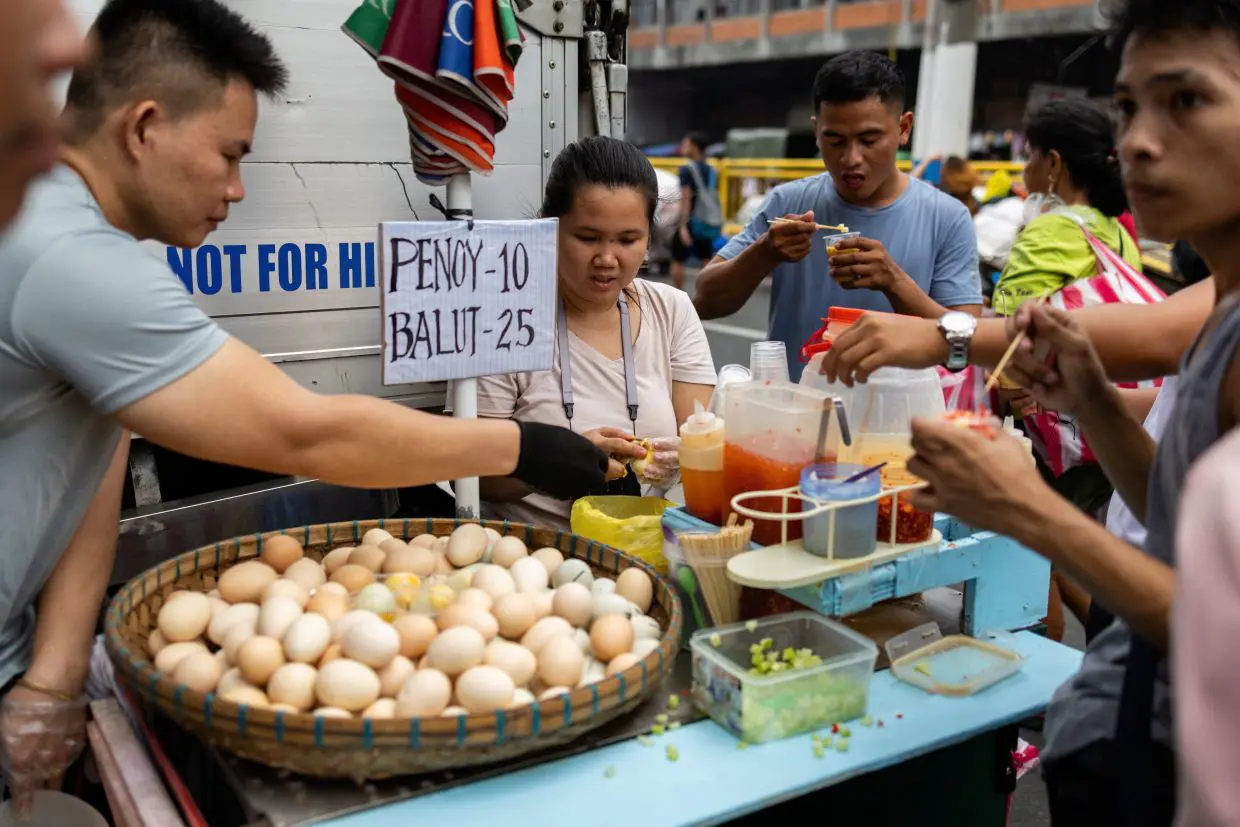
Inequality is high in the Philippines with the wealth concentrated in the hands of the top 1% of elite families. — Reuters
THE other day, at a Persian restaurant in Manila, I chatted with friends, including a former Cabinet secretary (equivalent to a minister in Malaysia) who served under president Gloria Macapagal Arroyo during her 2001-2010 terms. He is familiar with Malaysian politics, as he has professional and personal dealings with Malaysian ministers and prime ministers.
THE other day, at a Persian restaurant in Manila, I chatted with friends, including a former Cabinet secretary (equivalent to a minister in Malaysia) who served under president Gloria Macapagal Arroyo during her 2001-2010 terms. He is familiar with Malaysian politics, as he has professional and personal dealings with Malaysian ministers and prime ministers.
We shared marites (Tagalog for gossip) about Malaysian and Philippine politics, and he noted similarities between the two countries.
“Malaysia’s politics is starting to resemble our politics,” he remarked.
It was a sobering observation given how deeply institutionalised political plunder is in the Philippines.
On that day, Aug 27, in a historic albeit unwelcome milestone for Malaysia, three ex-prime ministers were in the court complex in Kuala Lumpur. Datuk Seri Najib Razak, Tan Sri Muhyiddin Yassin, and Datuk Seri Ismail Sabri Yaakob were facing separate trials and asset declaration proceedings.
The number of top politicians in jail or facing corruption trials arguably surged only after Barisan Nasional fell following the 14th General Election in 2018. But in the Philippines, it is almost a culture.
President Ferdinand Marcos was overthrown in February 1986 following mounting unpopularity driven by decades of massive state plundering, widespread human rights abuses, and fraudulent snap elections, culminating in a historic mass civic uprising and military defections that forced him to flee to Hawaii in the United States.
The culture of plunder continues today. Under Philippine law, the systemic looting of the state is classified as non-bailable plunder, and it is a crime punishable when public officers amass at least 50 million pesos (about RM3.2mil).
“Malaysia’s politics is starting to resemble our politics,” he remarked.
It was a sobering observation given how deeply institutionalised political plunder is in the Philippines.
On that day, Aug 27, in a historic albeit unwelcome milestone for Malaysia, three ex-prime ministers were in the court complex in Kuala Lumpur. Datuk Seri Najib Razak, Tan Sri Muhyiddin Yassin, and Datuk Seri Ismail Sabri Yaakob were facing separate trials and asset declaration proceedings.
The number of top politicians in jail or facing corruption trials arguably surged only after Barisan Nasional fell following the 14th General Election in 2018. But in the Philippines, it is almost a culture.
President Ferdinand Marcos was overthrown in February 1986 following mounting unpopularity driven by decades of massive state plundering, widespread human rights abuses, and fraudulent snap elections, culminating in a historic mass civic uprising and military defections that forced him to flee to Hawaii in the United States.
The culture of plunder continues today. Under Philippine law, the systemic looting of the state is classified as non-bailable plunder, and it is a crime punishable when public officers amass at least 50 million pesos (about RM3.2mil).
StarPicks
The Philippine House of Representatives impeached sitting Vice-President Sara Duterte earlier this year. Meaning, a large majority of congressmen voted to formally charge her with corruption and abusing public trust over unaccounted funds, sending her case forward to the Senate for trial.
Now she is facing the senators. It takes two-thirds of the Senate to impeach her – which is unlikely, as she has a solid bloc of eight senators with her, which serves as a mathematical blocking minority since conviction requires 16 out of 24 votes.
Of the 24 senators, the third most powerful political position after the president and vice- president, several face corruption charges or investigations themselves.
Senator Jinggoy Estrada, who previously spent years detained at a Philippine National Police custodial centre over a multi- billion-peso pork barrel scam before beating plunder charges, is back in jail, facing a fresh non-bailable plunder case involving infrastructure kickbacks
Senator Loren Legarda went on medical/personal leave in Paris, coincidentally as she faced a preliminary investigation by the Ombudsman alongside her son, Congressman Leandro Leviste, over a controversial multi-billion-peso solar power franchise.
Other sitting senators caught in intense legislative and investigative crosshairs over flood- control anomalies include Senator Emmanuel Joel Jose Villanueva, Senator Francis Joseph “Chiz” Escudero, Senator Mark Aguilar Villar, Senator Camille Aguilar Villar, and Senator Christopher Lawrence “Bong” Tesoro Go.
The charges brought against Malaysian politicians involve millions, even billions. A lot of money. But I get the impression that top Filipino politicians, or even mid-level ones, are more loaded than ours.
I have been in and out of the Philippines for three decades as a journalist. I have seen provincial political warlords who rule with guns, goons, and gold in their little kingdoms, and political elites whose immense, unchecked fortunes manifest in sprawling compounds, fleet-level security details, and staggering displays of dynastic opulence.
I like to people-watch, and I’ve often seen the super-rich arrive or depart luxury hotels in Manila as I wait for my ride. They pull up in bulletproof American SUVs, armoured Land Cruisers, and chauffeured European sedans flanked by bodyguards and personal assistants.
It seems to me that, somehow, the rich in Manila are richer than the rich Malaysians I see in Kuala Lumpur. Yes, there are multi-millionaires and billionaires in our luxury hotels, but their presence is sort of “diluted” a little by members of our significant middle class, who also patronise such places.
The money in the Philippines is in the hands of the top 1% of elite families. In politics, for instance, across a population of 117.7 million people spread over 82 provinces, municipal and city power is held by roughly 180 to 250 dominant political warlords and clans, known locally as angkan or political dynasties.
Sons and daughters of Philippine presidents often become presidents or vice presidents themselves: Marcos’s son, Ferdinand “Bongbong” Marcos Jr, is currently president; Diosdado Macapagal’s daughter, Gloria served; Corazon Aquino’s son, Benigno “Noynoy”, ruled; and Rodrigo Duterte’s daughter Sara is currently vice-president.
In Malaysia, although sons of prime ministers have become prime ministers, somehow we are more egalitarian. A child raised by a single mother can rise to become a minister too.
Yes, there are dirt-poor Filipinos who became senators. For example, Manny Pacquiao rose from extreme street poverty. Or upper-middle-class people like Joseph Estrada, who used a pro-poor cinematic persona to become president. But they are the exceptions, not the rule.
The other day, I was on the LRT and noticed it was filled mostly with the working class. Manila’s LRT and MRT systems suffer from ageing infrastructure, overcrowding, and long queues, making them far less sophisticated compared with the modern rail networks in Kuala Lumpur, Bangkok, and Singapore, which are clearly patronised by a mix of middle class and working class.
I asked a contact in Manila why this difference, and the answer was that the Philippines has a sharply polarised social structure: a tiny apex of hyper-wealthy oligarchs; a very thin layer of middle class compared with Malaysia, Thailand, and Singapore; and a massive base struggling at a subsistence level.
Filipino politicians have turned plundering into a fine art, while Malaysia’s politics have been less defined by grand-scale looting. But with three former prime ministers crowding the courtroom steps in Kuala Lumpur, we might no longer be able to claim we are all that different. We are beginning to look just as plundered as our neighbour.


No comments:
Post a Comment