Sunday, March 01, 2026

Footage Shows U.S. Patriot Air Defences Repeatedly Fail to Hit Iranian Ballistic Missiles


Military Watch:


Footage Shows U.S. Patriot Air Defences Repeatedly Fail to Hit Iranian Ballistic Missiles

North America, Western Europe and Oceania , Missile and Space
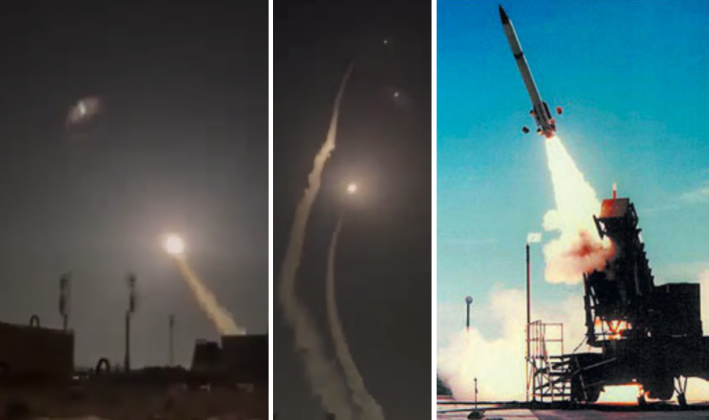

Footage taken at  Al Udeid Air Base in Qatar has shown three interceptor missiles launched by MIM-104 Patriot long range air defence systems fail to shoot down incoming Iranian ballistic missiles. Iran launched strikes on February 28, after Israel and the United States initiated a coordinated large-scale military assault against the country. While Patriot units usually launch two missiles against each incoming target to ensure a high probability of kill, a third launch may have been intended to compensate for the lower than optimal reliability of the system. This itself remains an issue due to the very limited stocks of missiles the U.S. Armed Forces have, which in July 2025 were confirmed to have fallen to just 25 percent of the volume deemed necessary by the Pentagon. 
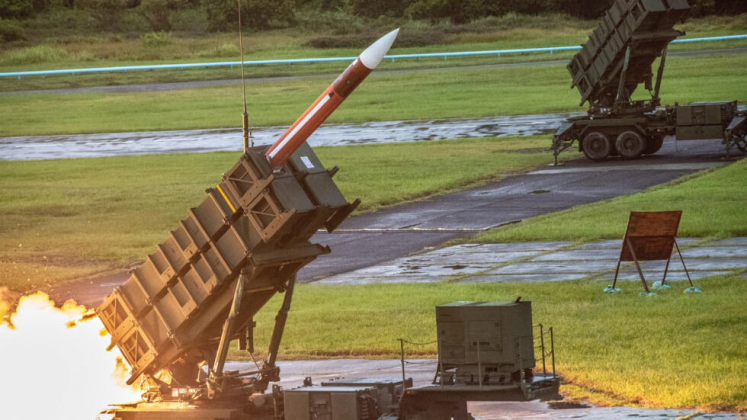
Missile Launch From Patriot Air Defence System

The failure of Patriot systems closely coincides with confirmation that Iranian strikes destroyed key air defence radars at Al Udeid Air Base, which may be among several targets that have been hit at the facility as a result of the limitations of U.S. air defences. The reliability of the Patriot system has long been in serious question, with even very limited Iranian strikes on June 23, 2025, having proven capable of striking Al Udeid Air Base, despite using lower end Fateh-313 missiles, and in spite of prior warning of the attacks having been provided to the United States. Although U.S. officials at first praised the success of U.S. Army and Qatari Air Force Patriot systems that month, the release of satellite footage showing the destruction of a radome housing the modernisation enterprise terminal communications suite forced Pentagon sources to concede that they were not fully successful despite the optimal conditions in place.

Three Interceptors From Patriot System Fail to Hit Targets Over Al Udeid Air Base

The capabilities of the Patriot system have long been cause for considerable controversy, with the systems assessed to have almost totally failed against very basic Iranian Scud missile attacks during the Gulf War, before being a primary cause of friendly fire during the U.S.-led invasion of Iraq firing on multiple U.S. fighter aircraft. Despite claims of success by U.S. and Saudi sources in intercepting Yemeni ballistic missile attacks in late 2017, an investigation quickly proved that they had totally failed. When deployed to guard Saudi oil fields, they were also totally unsuccessful in intercepting drone strikes launched by either Yemeni paramilitary units or by Iran in 2019. The effectiveness of the Patriot system against Russian missile attacks has increasingly been brought to question in the Ukrainian theatre, with Ukrainian and Western sources having for months warned that its ability to intercept attacks has been limited. Ukrainian Air Force spokesman Igor Ignat having on May 26 highlighted the system’s shortcomings in this regard, , while chief of communications for Ukrainian Air Force Command Yuri Ignat in early October confirmed that the service was facing growing challenges in intercepting Russian ballistic missile attacks.
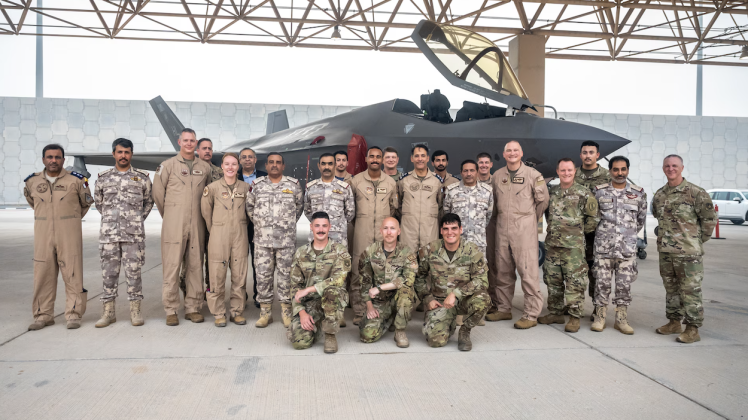
U.S. Air Force F-35 with U.S. and Qatari Personnel at Al Udeid Air Base

Constructed in 1996 with Qatari funding, Al Udeid serves as one of the largest U.S. military bases outside the United States, and the largest U.S. air installation in the Middle East. The base hosts the forward headquarters of U.S. Central Command (CENTCOM), the U.S. joint command responsible for military operations across the Middle East, and houses the Combined Air Operations Center (CAOC) which plans, directs, and controls coalition air operations across a wide region stretching from North Africa through Southwest and Central Asia. The base covers roughly 31 square kilometres, approximately twice the size of the primary hub of U.S. air operations in Europe Ramstein Air Base in Germany. The facility has at times operated close to 10,000 personnel, and played central roles in both years long offensives against Syria, and in the air campaign in Afghanistan up to 2021. Chinese satellite imagery in early February exposed the exact positions of an Army MIM-104 Patriot air defence system at the facility, before later confirming deployments of large numbers of support aircraft as part of the military buildup against Iran. 

One killed and 11 injured at Dubai and Abu Dhabi airports as Iran strikes region


One killed and 11 injured at Dubai and Abu Dhabi airports as Iran strikes region


2 hours ago
Tom Bennett


debris across floor of damaged Dubai airport


One person has been killed and 11 injured at airports in Dubai and Abu Dhabi, as Iran launched attacks across the Middle East in response to a massive and ongoing attack against it by the US and Israel.


Authorities in Abu Dhabi confirmed a drone targeting Zayed International Airport (AUH) was intercepted, leading to "falling debris", killing one person and injuring seven.


Dubai International Airport (DXB) - the world's busiest by passenger traffic - was damaged in an "incident" that injured four staff, according to authorities.


Thousands of flights have been grounded to and from the region, in one of the most serious disruptions to global travel since the Covid-19 pandemic.


Retaliatory strikes from Iran continued on Sunday with explosions heard in Doha, Dubai and Manama.


Iran has used ballistic missiles and drones to launch wide-scale attacks on US allies and assets across the Gulf, after its supreme leader was killed in the ongoing US-Israel air offensive launched on Saturday morning.


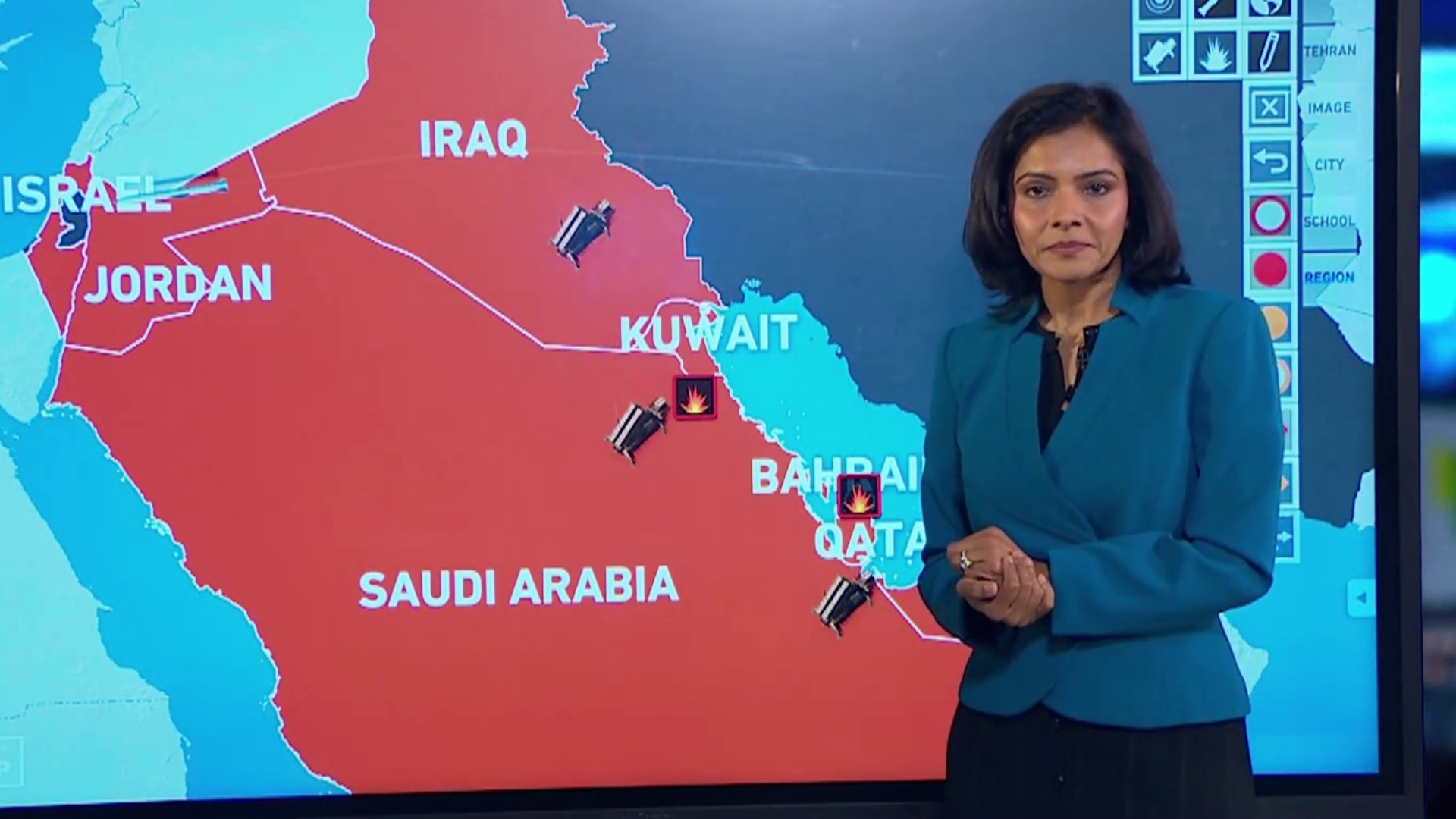
Qatar, Bahrain, Jordan and Kuwait - all home to US military bases - said they had intercepted missiles fired towards them, but falling debris appeared to have caused widespread damage.


Also in Dubai, debris from an "aerial interception" caused a fire in a berth at the Jebel Ali deep sea port - the world's ninth busiest.


Reuters
Authorities say they have intercepted multiple missiles and drones over Dubai since Saturday, including at Jebel Ali port


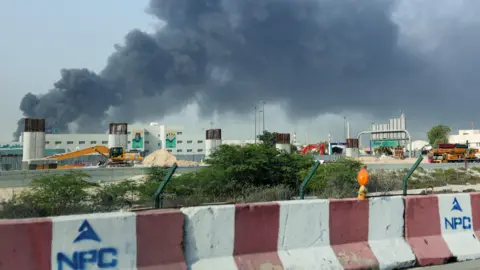
On the Palm Jumeirah, Dubai's luxury man-made archipelago, the five-star Fairmont The Palm hotel was struck by a large explosion. Video verified by the BBC shows a fire raging as black smoke rises into the sky.


Authorities also confirmed debris from an intercepted drone had caused a "minor fire" on the outer facade of the five-star Burj Al Arab hotel.


In Bahrain, the interior ministry said the airport was damaged after being targeted by a drone. There were unconfirmed reports of continuing attacks on Sunday morning.


On Saturday, Iran's Islamic Revolutionary Guard Corps (IRGC) said they had struck the headquarters of the US Navy's Fifth Fleet, located in Bahrain's capital Manama. Huge plumes of black smoke were seen rising from an area near the base.


Meanwhile, Oman's state news agency reported Duqm commercial port was targeted by two drones, injuring one worker.


UK joins Wanks and Shailoks in the latest war against Iran


From the FB page of:


Nury Vittachi


Sperotosdn0223u87ha2a7igl957t2fhf7gcg0l160igm79ht7i519tu5it4 ·


BREAKING NEWS: THE UK ROYAL AIR FORCE and other British military elements are active on the US-Israel side of the current brutal attack on Iran, the British Prime Minister revealed earlier today.

“Our forces are active and British planes are the sky today,” Sir Keir Starmer said in a speech a few hours ago.

The RAF has fighter jets in the air around the region to prevent Iranians taking out US military bases around the region, as the Islamic nation tries to slow the Trump-led attacks.


** Is that the RAF's frigging job?


Prime Minister Keir Starmer claimed the UK forces were acting “defensively”, but international law says that armed forces taking action on one side of a conflict are active participants.

.
CONDEMNS ONE SIDE ONLY

Bizarrely, Starmer made a speech that pointedly did not condemn the unprovoked US-Israel attack but instead harshly criticized Iranians for defending themselves. “I condemn Iran’s attacks today,” he said.

There is no question that yesterday’s aggressive wave of attacks came from the US and Israel, but the British Prime Minister called for Iran’s defence forces – not the jet-fighters from the US and Israel—to stand down.

“Iran can end this now,” Starmer said. “They should refrain from further strikes.”

.

WHAT THIS MEANS

British Prime Minister Sir Keir Starmer's speech a few hours ago left not the slightest doubt that the UK is continuing to actively work with the US and Israel in the unprovoked attack on Iran, illegal under international law.

Iran is one of the more sophisticated and advanced Muslim countries, with high rates of education, strong progress in scientific research, and a reputation for hospitality in a tourism industry that has extraordinary number of historic areas, reaching back more than 4,000 years.


Israel’s attacks on Iran in recent months have caused the Iranian government to become more popular in the country, as even some western media admitted. The government is popular and crime rates are low.
But Starmer, in his speech, painted Iran as a giant prison of repressed people longing for a new leader—an image that is patently biased, but perfectly echoes the US-Israel line.

- The UK armed forces provided intelligence to the IDF throughout the globally condemned attacks on Gaza.

- The RAF joined in with the illegal bombing of Yemen, when the Houthis tried to stop ship-borne weapons deliveries and other supplies to Israel.
- Survey after survey has shown that the British people are overwhelmingly opposed to war, but the two main political parties, Labor and the Conservatives, have a long history of being enthusiastic backers of US and Israeli attacks.


Netanyahu’s war? Analysts say Trump’s Iran strikes benefit Israel, not US


Netanyahu’s war? Analysts say Trump’s Iran strikes benefit Israel, not US

War with Iran contradicts the US president’s own criticism of regime change policies in the Middle East, analysts say


A F/A‑18 Super Hornet takes off from an aircraft carrier as part of the mission against Iran [US CENTCOM on X via Reuters]


By Ali Harb
Published On 1 Mar 2026


President Donald Trump stood in front of regional leaders during a visit to the Middle East in May and declared a new era of US foreign policy in the region, one that is not guided by trying to reshape it or change its governing systems.

“In the end, the so-called nation-builders wrecked far more nations than they built, and the interventionists were intervening in complex societies that they did not even understand themselves,” the US president said in rebuke of his hawkish predecessors.


Recommended Stories


Less than a year later, Trump ordered an all-out assault on Iran with the stated goal of bringing “freedom” to the country, borrowing language from the playbook of interventionist neoconservatives, like former President George W Bush, whom he spent his political career criticising.

Analysts say the war with Iran does not fit with Trump’s stated political ideology, policy goals or campaign promises.

Instead, several Iran experts told Al Jazeera that Trump is waging a war, together with Israel, that only benefits Israel and its prime minister, Benjamin Netanyahu.

“This is, once again, a war of choice launched by the US with [a] push from Israel,” said Negar Mortazavi, a senior fellow at the Center for International Policy in Washington, DC.

This is another Israeli war that the US is launching. Israel has pushed the US to attack Iran for two decades, and they finally got it.”

Mortazavi highlighted Trump’s criticism of his predecessors, who had waged regime-change wars in the region.

“It is ironic, because this is a president who called himself the ‘president of peace‘,” she told Al Jazeera.


‘Diplomacy was betrayed by the Americans’: Iranian FM spokesman


History of warnings of the Iranian ‘threat’

Netanyahu, who promoted the 2003 US invasion of Iraq, has been warning for more than two decades that Iran is on the cusp of acquiring nuclear weapons.

Iran denies seeking a nuclear bomb, and even Trump administration officials have acknowledged that Washington has no evidence that Tehran is weaponising its uranium enrichment programme.

After the US bombed Iran’s main enrichment facilities in the 12-day war in June last year – an attack that Trump says “obliterated” the country’s nuclear programme – Netanyahu pivoted to a new supposed Iranian threat: Tehran’s ballistic missiles.

“Iran can blackmail any American city,” Netanyahu told pro-Israel podcaster Ben Shapiro in October.

“People don’t believe it. Iran is developing intercontinental missiles with a range of 8,000km [5,000 miles], add another 3,000 [1,800 miles], and they can get to the East Coast of the US.”

Trump repeated that claim, which Tehran has vehemently denied and has not been backed by any public evidence or testing, in his State of the Union address earlier this week.

“They’ve already developed missiles that can threaten Europe and our bases overseas, and they’re working to build missiles that will soon reach the United States of America,” he said of the Iranians.

Trump has been building the case for a wider war with Iran since the June conflict, repeatedly threatening to bomb the country again.

But the US president’s own National Security Strategy last year called for de-prioritising the Middle East in Washington’s foreign policy and focusing on the Western Hemisphere.

Meanwhile, the US public, wary of global conflict after the wars in Iraq and Afghanistan, has also been largely opposed to new strikes against Iran, public opinion polls show.

Only 21 percent of respondents in a recent University of Maryland survey said they favoured a war with Iran.


Israel and US strike Iran: school hit, children among the killed


The first day of the war saw Iran fire missiles against bases and cities that host US troops and assets across the Middle East in retaliation for the joint US-Israeli strikes, plunging the region into chaos.

Trump acknowledged that US troops may suffer casualties in the conflict. “That often happens in war,” he said on Saturday. “But we’re doing this not for now. We’re doing this for the future. And it is a noble mission.”


‘Ignoring the vast majority of Americans’

The Trump administration had appeared to step back from the brink of conflict earlier this month by engaging in diplomacy with Tehran.

US and Iranian negotiators held three rounds of talks over the past week, with Tehran stressing that it is willing to agree to rigorous inspections of its nuclear programme.

Omani mediators and Iranian officials had described the last round of negotiations, which took place on Thursday, as positive, saying that it yielded significant progress.

The June 2025 war, initiated by Israel without provocation, also came in the middle of US-Iran talks.

Netanyahu’s agenda has always been to prevent a diplomatic solution, and he feared Trump was actually serious about getting a deal, so the start of this war in the middle of negotiations is a success for him, just like it was last June,” Jamal Abdi, the president of the National Iranian American Council (NIAC), told Al Jazeera.

“Trump’s embrace of regime change rhetoric is a further victory for Netanyahu, and loss for the American people, as it suggests the US may be committed to a long and unpredictable military boondoggle.”

While announcing the strikes on Saturday, Trump said his aim is to prevent Iran from “threatening America and our core national security interests”.

But US critics, including some proponents of Trump’s “America first” movement, have argued that Iran – more than 10,000km (6,000 miles) away – does not pose a threat to the US.

Earlier this month, US Ambassador to Israel Mike Huckabee told conservative commentator Tucker Carlson that “if it were not for Iran, there wouldn’t be Hezbollah; we wouldn’t have the problem on the border with Lebanon”.

Carlson said, “What problem on the border with Lebanon? I’m an American. I’m not having any problems on the border with Lebanon right now. I live in Maine.”

On Saturday, Congresswoman Rashida Tlaib stressed that the US public does not want war with Iran.

“Trump is acting on the violent fantasies of the American political elite and the Israeli apartheid government, ignoring the vast majority of Americans who say loud and clear: No More Wars,” Tlaib said in a statement.


***


Netyanyahu's great achievement


Netyanyahu (grins): We did it!


Q: Kill Khamenei?

Netyanyahu (grins again): No No, we manipulated that idiotic wankee goy


US-Israel attacks on Iran, day 2: Khamenei is killed, Iran retaliates


US-Israel attacks on Iran, day 2: Khamenei is killed, Iran retaliates

Iran carries out retaliatory attacks as supreme leader is killed in US-Israeli attacks pushing the region to the edge.

People mourn

Iran’s Ayatollah Ali Khamenei has been killed in the attacks by the United States and Israel, alongside his top security officials, as Tehran pledges to take “revenge” for the killing of the supreme leader.

Khamenei’s killing is a serious setback for Iran, where more than 200 people have been killed in the attacks across 24 out of 31 provinces since Saturday. Iran’s retaliatory attacks have targeted Israel and neighbouring Gulf countries hosting US military assets.

Khamenei, 86, was killed in the strike at his office in Tehran. The supreme leader’s daughter, son-in-law, and grandson were also killed in the attack.

Iran
People mourn the death of Iran’s Supreme Leader Ayatollah Ali Khamenei in Tehran on March 1, 2026 [Atta Kenare/AFP]

Here is everything that happened so far on Day 2

Inside Iran

  • The Israeli military said on Sunday that it had begun striking targets deep inside Tehran, a day after a joint US-Israeli attack killed Khamenei.
  • Iran’s Islamic Revolutionary Guard Corps (IRGC) announced the sixth wave of “extensive missile and drone” attacks targeting Israeli military assets and 27 US bases in the Middle East in retaliation.
  • Iran’s state media confirmed the killing of Khamenei, as well as security adviser Ali Shamkhani and IRGC Commander-in-Chief Mohammad Pakpour. According to the Hamshahri newspaper, Ahmad Vahidi has been named the IRGC’s new commander-in-chief. Al Jazeera could not independently verify the news.
  • Iranian armed forces’ chief of staff, Abdul Rahim Mousavi, and Defence Minister Aziz Nasirzadeh were also killed in the attacks.
  • A three-person council – consisting of Iran’s President Masoud Pezeshkian, head of the judiciary, and one of the jurists of the Guardian Council – will temporarily assume all leadership duties in the country, Iran’s state TV reported.
  • Iran’s top security official, Ali Larijani, said plans are in place to form a temporary governing body to carry out Khamenei’s duties.
  • The death toll in the attack on an elementary girls’ school in southern Iran’s Minab city climbed to 148 people, and 95 others were injured.
  • Khamenei’s supporters have taken to the streets in the main Iranian cities, including Tehran and Isfahan, to mourn the killing of the supreme leader.
  • Iran’s highest-ranking official to appear on camera since Khamenei’s killing, Mohammad Bagher Ghalibaf, the parliament speaker, called the US and Israeli leaders “filthy criminals” who will face “devastating blows that you yourselves will be driven to beg”.
  • “Iran just stated that they are going to hit very hard today, harder than they have ever been hit before,” US President Donald Trump wrote in a Truth Social post late at night. “They better not do that, however, because if they do, we will hit them with a force that has never been seen before!” he added.
  • In an interview with CBS News, Trump said he believes the US is better positioned to reach a diplomatic solution with Iran. “Much easier now than it was a day ago, obviously”, Trump said, adding, “because they are getting beat up bad”.
  • Israeli attacks and Iranian retaliation

    • The Israeli ambulance service says one Israeli woman has been killed, and 121 others wounded, mostly with minor injuries, in waves of Iranian missile attacks.
    • Air raid sirens continue to blare in and around the city of Tel Aviv.
    • The Israeli military said the majority of these missiles and drones were intercepted or downed, but some managed to get through in Tel Aviv and Beit Shemesh, a city west of Jerusalem.
    • Israel’s military said it struck more than 30 targets in attacks on western and central Iran in another wave of strikes “to target the ballistic missile array and air defence systems of the Iranian terror regime”.
    • Attacks will continue on air defence installations, missile sites, military headquarters, and other “regime targets” in Iran, the statement from Israel’s military added.
    Tel Aviv
    Israeli police and emergency teams respond at the scene after a missile hit buildings in Tel Aviv’s Gush Dan area, March 1, 2026 [Nir Keidar/Anadolu]

    Iran continues to target the Gulf region

    • At least 11 explosions were heard above Qatar on Sunday morning. The Qatari Ministry of Interior says a total of 16 injuries have been recorded following the Iranian attacks.
    • Oman’s Duqm commercial port was hit by two drones, injuring one person, the state news agency said on Sunday. Oman was mediating between the US and Iran.
    • Oman’s Maritime Security Centre said on Sunday the Palau-flagged oil tanker Skylight was targeted about 5 nautical miles (9km) off Musandam. “A twenty-person crew were evacuated, initial information shows four people were injured,” it said.
    • Jordanian defence systems intercepted missiles that entered the airspace of the capital, Amman, as well as northern areas.
    • The US embassy in Jordan issued a security alert early on Sunday morning, urging people to shelter in place.
    • Sirens have also been reported in Kuwait as Iran continues its retaliatory attacks against the US allies in the Gulf.
    • More explosions were heard in Dubai as well, a day after a fire broke out in the city’s Palm ⁠Islands tourist attraction. Debris from a drone intercepted by Dubai’s military led to a fire at Jebel Ali port, a frequent stop for US Navy ships in the Gulf.
    • Iraq’s Muqtada al-Sadr expressed “sadness and sorrow” over Khamenei’s killing as protesters in Baghdad confronted security forces in areas that host the country’s government, parliament, and foreign embassies.
    • Protests have erupted in neighbouring Iraq as well as in Indian-administered Kashmir and Pakistan. At least six people were killed and several injured in riots that broke out near the US consulate in the Pakistani port city of Karachi.
    • Iraq has announced three days of public mourning across the country in the wake of Khamenei’s killing.
    Iran
    A person sits in front of a store damaged in a reported overnight Iranian strike in Tel Aviv on March 1, 2026 [Ilia Yefimovich/AFP]

    At the United Nations Security Council


    • US Ambassador Mike Waltz said the strikes on Iran were directed towards dismantling its ballistic missile capabilities, degrading naval assets, and ensuring that “the Iranian regime can never, ever threaten the world with a nuclear weapon”.
    • Russia’s UN envoy strongly condemned the latest military attacks on Iran, calling them “another unprovoked act of armed aggression”. Vassily Nebenzia said, “The US and Israeli military operation has been a betrayal of diplomacy.”
    • China’s Ambassador Fu Cong called the US-Israeli strikes “brazen”, condemning the threat of force and calling for respect for Iran’s “sovereignty, security, and territorial integrity”. He said it was “shocking” that the US and Israeli attacks came in the middle of diplomatic negotiations between the US and Iran.
    • The UN Chief said the military action carries the risk of “igniting a chain of events that no one can control in the most volatile region of the world,” and added that “everything must be done” to prevent wider escalation of war across the Middle East.
    iran
    A yacht sails past a plume of smoke rising from the port of Jebel Ali following a reported Iranian strike in Dubai on March 1, 2026 [Fadel Senna/AFP]

    What’s the latest situation at the Strait of Hormuz?

    • Iran moved to close the Strait of Hormuz, while ships in the Gulf reported receiving warnings from the IRGC that vessels would not be permitted to pass through the strategic waterway.
    • Reuters news agency reported that the IRGC mandated that “no ship is allowed to pass the Strait of Hormuz”.
    • Nearly 20 percent of the world’s oil consumption passes through the strait, making it one of the world’s most vital oil export routes.

Iran’s Foreign Ministry defends retaliatory strikes, slams US betrayal


Iran’s Foreign Ministry defends retaliatory strikes, slams US betrayal

Spokesman Esmaeil Baghaei says Iran’s attacks on US targets across the region are legitimate defensive actions


Protesters gather with Iranian flags in support of the government, against US and Israeli strikes, outside a mosque in Tehran, on February 28, 2026 [AFP]

Published On 28 Feb 2026


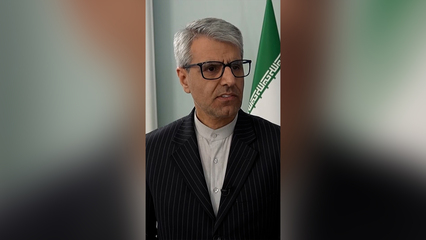
Iran is entitled to defend itself from Israeli and US attacks, the spokesman for Iran’s Ministry of Foreign Affairs has stressed.

“We have every right in accordance with international law, with the UN Charter, to defend ourselves with all might”, Esmaeil Baghaei said in an interview with Al Jazeera on Saturday.


Recommended Stories


The US and Israel launched a wave of attacks across multiple Iranian cities, including Tehran, on Saturday, in what US President Donald Trump described as “major combat operations”.

At least 201 people have been killed, according to Iranian media, citing the Red Crescent.


A plume of smoke rises following a reported explosion in Tehran on February 28, 2026 [AFP]


Iran responded by firing missiles towards Israel and US military targets in multiple countries, including Bahrain, Iraq, Jordan, Kuwait, Saudi Arabia, Qatar and the United Arab Emirates.

Baghaei said the country’s armed forces “are defending national sovereignty and the territorial integrity of Iran against these barbaric acts of aggression”.

The US-Israeli attacks came after a third round of indirect negotiations on Iran’s nuclear programme between the US and Iran ended on Friday.

“We were supposed to meet on Monday to talk about technical aspects of any possible deal on [the] nuclear issue,” Baghaei said. “And the Americans themselves acknowledged that these negotiations went quite well. The mediator, [the] foreign minister of Oman, qualified this round of negotiations as being of significant progress.”

It was the second time in less than a year that diplomacy had been scuttled by an attack on Iran, Baghaei noted. Iran and the US had engaged in several rounds of negotiations last year, when Israel launched a 12-day war on Iran in June, which the US briefly joined, despite Trump saying he was committed to a diplomatic resolution.

Baghaei said the US “launching an act of aggression against another member of the United Nations” also threatened the international body, as its main pillar, “the UN Charter, is the provision of the use of force.”

“So, I think what is at stake is not only the security and peace of the region and that of Iran, but also the whole fabric of international law. And the normative system that has been created by the United Nations Charter,” he added.


Friends in the region


Baghaei defended Iran’s retaliatory attacks in several countries across the region.

“Under international law, any place, any location, any logistical support that are given to the aggressor [is a] legitimate target for the victim state,” he said. “So, we are not attacking any country in the region. We are friendly with all countries of the region. What we are doing is just taking defensive actions.”

“We have proven that we trust our friends in the region,” Baghaei said. “That’s why we try to get together with the countries of the region in furtherance of this diplomatic process. The problem is that the United States is conducting this war of aggression at the cost of everyone, including the countries of the region.”


***


So long as the Shailok wants war, its wankee Ma Cai will kuai kuai obey and attack any target as demanded by Satanyahu.


Israel strikes two schools in Iran, killing more than 80 people


Israel strikes two schools in Iran, killing more than 80 people

State media says Israeli attack on girls’ school in the city of Minab in the south of the country kills dozens


This image grab taken from Iranian state television broadcasted on February 28, 2026, show what it says is the site of deadly US and Israeli strikes that hit a girls' elementary school in Minab, in the southern Iranian province of Hormozgan near the strategic sea route of the Strait of Hormuz. [Screengrab/IRIB TV via AFP]


By Al Jazeera Staff
Published On 28 Feb 2026


An Israeli strike has hit an elementary girls’ school in Minab, a city in the Hormozgan province of southern Iran, killing dozens of people, according to state media, as the immediate civilian cost from Israel and the United States’s huge bombardment of Iran comes into sharper focus.

Iran’s semiofficial Tasnim News Agency cited the Judiciary of Minab as saying that the death toll had risen to 85 after Saturday’s strike on the school.


Recommended Stories


Workers are continuing to clear wreckage from the site, where 63 others were injured on Saturday, said Iran’s state-run IRNA news agency. The strike is part of a wave of joint US-Israeli military attacks across Iran that has triggered an outbreak of regional violence.

Iranian Foreign Minister Abbas Araghchi shared a photo of the attack, which he said destroyed the girls’ school and killed “innocent children”.

“These crimes against the Iranian People will not go unanswered,” Araghchi wrote in a post on X.

Iran’s Foreign Ministry spokesperson Esmaeil Baghaei also slammed the “blatant crime” and urged action from the United Nations Security Council.

Separately, Iran’s Mehr news agency reported that at least two students were killed by another Israeli attack that hit a school east of the capital, Tehran.

Reporting from Tehran, Al Jazeera’s Mohammed Vall said the attacks call into question US and Israeli claims that “they are targeting only military targets and they are trying to punish the regime, not the people of Iran.”

“President Trump has promised the Iranian people that aid or help is coming their way, but now we are seeing civilian casualties; that’s something that the Iranian government will stress as a case of violation of international law and an aggression against the Iranian people,” said Vall.

There was no immediate reaction from the US or Israel on Iran’s claims about the school strikes.

The last time the US and Iran waged attacks on Iran in June 2025, sparking the 12-day war, the civilian toll in Iran was also heavy.

According to Iran’s Ministry of Health and Medical Education, thousands of civilians were killed or injured, and public infrastructure was damaged, during that conflict.


***


Lord Moloch continues to be pleased with his shailok children for their votive offerings of child sacrifices.