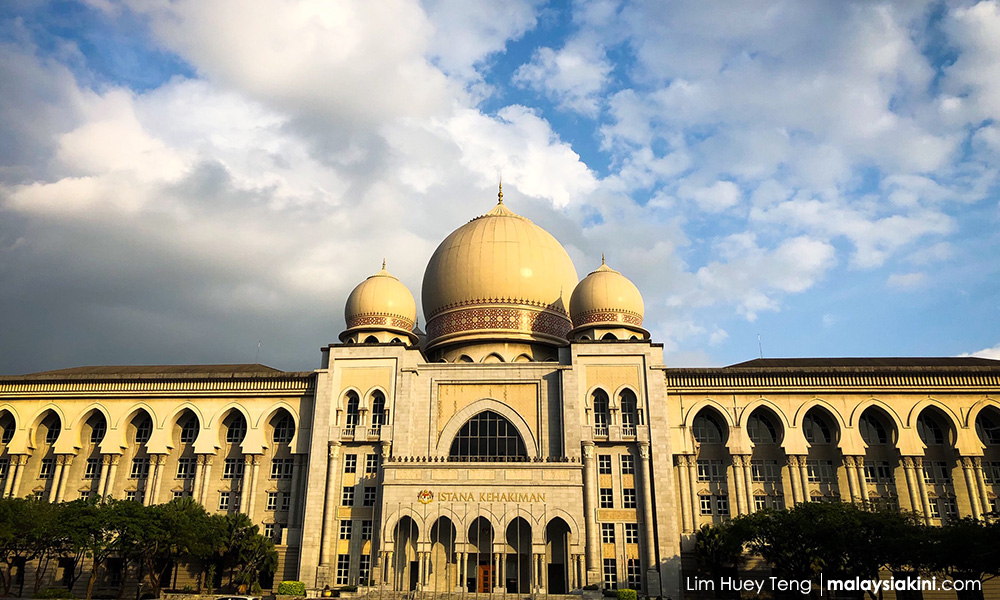
Friday, April 26, 2019

Malays Neglected & Marginalised in Matriculation Program?


Anwar Ibrahim today defended Putrajaya’s decision to maintain the 90% quota for Bumiputera students in the education ministry’s matriculation programme, saying this was to allay the community’s concerns after the government increased the number of students for the course.

The PKR president said he was told that the increase to 40,000 from 25,000 previously had led to worries that it would eat into the quota for the Malay students.
“For now, we have to allay those concerns. We don’t want them to feel like we are taking seats from the Malays.

“This is especially so in faculties where Malay participation is substantially lower,” the former education minister told reporters after being awarded the Global Citizenship Award by Saturna Capital here.

Education Minister Maszlee Malik earlier said the increased intake for matriculation students was based on a Cabinet decision to get more students into tertiary education and to spread the opportunity to all races.


He said the 90:10 quota was maintained in order to get more Bumiputera students to pursue science-related fields in public universities.

The move drew flak, with DAP’s P Ramasamy saying the government had failed to move forward, while Center to Combat Corruption and Cronyism northern region coordinator K Sudhagaran Stanley described it as “one of the worst” moves by the Pakatan Harapan administration.


To this, Anwar said Putrajaya was merely acting on the present concerns of the Malays.


For 50 years, since 1969 - May 13 to be more precise - the Malays have enjoyed affirmative actions on an unprecedented scale. The 90% reservation for Malays in the matriculation process is one example, whilst the 101% enrolment in UiTM is yet another.


And we haven't even spoken about employment in the Civil Service, Armed Forces and Police Force, especially in the hallowed Malay reserved domain of senior officers in the aforementioned services and in academia. Only one non-Malay has ever headed the Navy and that was only because of the then British control-mentorship of the armed forces.

So what is Anwar Ibrahim talking about when he said the 90% reservation for Malays in the matriculation program is to show the privileged race they are not being neglected or marginalised. What eff-ing kok-tok.

Worse, when the 90% was already reserved in the initial-original batch of 25,000 for Malays in the matriculation program, the truly neglected and marginalised have been the nons.

But following Anwar's illogical argument, to wit, that the increase to 40,000 from 25,000 previously had led to worries that it would eat into the quota for the Malay students, this must be the BIGGEST BS ever.

Even if every single spot of the extra 15,000 places (from 25,000 to 40,000) were to be given to the nons, a most unlikely, nay, impossible possibility, it would only worked out to 17,000 nons [15,000 + (10% of 25,000 = 2,500)] against 22,500 Malays [25,000 - 2,500].


Non-Malays accept (for the last 50 years) the Never-Ending-Policy's affirmative action but how do you expect any non to believe 10% allocation to them is not racist, grossly biased and dripping with the stink of socio-political apartheid.

If the allocation to non-Malays were to be, say, 25 to 35%, it would have reflected a more Malaysian social ratio, especially for the very much marginalised Indians, B40 group, and other minorities.

The persistent insistent existent 90% or 101% in some cases like UiTM, has been and is an indicator of socio-politico-ethnic apartheid, namely, racism.


Look around us and see the highest ranking officers of the nation and their very senior echelon lieutenants, and make one guess as to which race they belong to. Neglected and marginalised?

Pakatan Harapan under Mahathir shows that it is no different to, or maybe even worse, than the BN government when it comes to racial inequality, racial favouritism, and racial marginalisation.


Related:

Government's anti UEC policy began with Mahathir

Dr Kua pissing into wind, Dr M blowing with all his might


From FMT:

The PH GE14 manifesto and BN Education Blueprint by Kua Kia Soong


Education Minister Maszlee Malik has announced that the Bumiputera quota for matriculation programmes will remain at 90% while increasing the intake from 25,000 to 40,000. Non-Malay admission will only receive an increase from 2,500 to 4,000 places despite the hype about constructing a “New Malaysia” after the majority of non-Malay voters contributed to PH’s victory at the 2018 general election.

The perpetuation of this deeply flawed and racially discriminatory policy is cause for a sense of betrayal amongst democratic Malaysians who had been led to expect more inclusivity and meritocracy from the “new” Pakatan Harapan government.

The Pakatan Harapan manifesto promised to reform the education system to make national schools “the school of choice”. The manifesto included commitments to return residential schools to their original focus on low-income students and indigenous peoples without focussing on racial quotas.

The Education Blueprint formulated by the previous BN administration promised:

“By 2025, the Ministry aspires to increase access to and enrolment in higher education. If Malaysia were to successfully improve tertiary enrolment rates from 36% currently to 53% (and higher education enrolment from 48% to 70%), this will bring Malaysia on par with the highest enrolment levels in Asean today. This growth scenario will require an additional 1.1 million places by 2025, mainly through growth in technical and vocational education and training (TVET), private HLIs (higher learning institutions) and online learning.”

Note that through all that grandiose phraseology scripted by international consultants McKinsey, there is no mention that the decades-old racial discriminatory policies regarding enrolment in public institutions such as the matriculation programmes would continue.

Racially discriminatory quota system

The reality is that even within the national education system non-Bumiputeras suffer discrimination such as in access to scholarships, special schools and tertiary institutions. For decades we have witnessed the annual spectacle of non-Bumiputeras with straight As being rejected for entry into the courses of their choice at public sector universities. At the same time, there is extensive provision for Bumiputera education.

There are at least 42 fully residential elite Maktab Rendah Sains Mara (MRSM) (Mara junior Science College) with 12,440 places also in the fully residential schools. These schools have been almost exclusively reserved for Malay-Muslim students with perhaps a few token non-Bumiputeras who excel in sport to add glory to the schools. Non-Bumiputeras are largely excluded from other elite schools such as the Royal Military College, Aminuddin Baki Institution, matriculation courses and the Malay College Kuala Kangsar despite the fact that these institutions are all funded by Malaysian taxpayers.

There are two streams for entry into the public universities. One is through the matriculation 12-month programme and the other is through the 18-month and much more stringent STPM programme. The matriculation programme is mainly reserved for Malays although the government began offering 10% places for non-Bumiputera students in 2003.

University entrance criteria is not transparent and appears to be based on arbitrary factors. The same lack of transparency applies to the eligibility criteria involved in the selection process for the choice of courses, award of scholarships and loans for study. Preference for admission into public universities is reserved for Bumiputeras. One university with a student population of 170,000 in 2011, namely, UiTM, is open ‘for Bumiputeras only’ while the other 19 public universities have an overwhelming Malay majority in their enrolment. And it cannot be overstated that all of this is funded by ALL Malaysian taxpayers.

There is also discrimination in the allocation of students to competitive courses. Only a handful of seats in medical faculties of the public sector universities are made available to non-Malays. For example, out of the 62,000 diploma places and 60,000 degree places at 27 polytechnics in Malaysia in 2010, only a small number of places were allocated for non-Malay students regardless of their qualifications.

Such blatant racially discriminatory policies are the real reason the BN and PH governments have been reluctant to ratify the International Convention on the Eradication of Racial Discrimination (ICERD). Malaysia is one of the few countries in the world that practices such blatant racial discrimination.

The quota system was not part of the Independence Agreement

The Malay-based parties and their legal advisers arduously try to avoid this inconvenient truth: The quota system that has been practised in the country since 1971 was never part of the 1957 Independence Agreement! It was through the terror unleashed by the May 13 Incident that the country was presented with a fait accompli by the new Umno ruling class who proceeded to amend Article 153 with a new clause (8A):

“…where in any university, college and other educational institution providing education after Malaysian Certificate of Education or its equivalent, the number of places offered by the authority responsible for the management of the university, college or such educational institution to candidates for any course or study is less than the number of candidates qualified for such places, it shall be lawful for the Yang di-Pertuan Agong by virtue of this Article to give such directions to the authority as may be required to ensure the reservation of such proportion of such places for Malays and natives of any of the States of Sabah and Sarawak as the yang di-Pertuan Agong may deem reasonable; and the authority shall duly comply with the directions.”

This is the “quota system” we have lived with for the last 40 years or so and which has created so much acrimony for that length of time. Strictly speaking, if we were to go by Umno’s “social contract” at Independence in 1957, that “social contract” certainly does not include Clause 8A of Article 153 since this clause was introduced 14 years later.


the most anti-UEC Education Minister that was/is 

And if we scrutinise this Clause 8A more closely, we will see that it is definitely not a carte blanche for the blatant racial discrimination as is the case of enrolment at institutions such as UiTM. The 100% Bumiputera enrolment policy at UiTM and the 90% Bumiputera enrolment in matriculation courses make a mockery of the quota system itself and the justification of any affirmative action.

Compared with the affirmative action policies of other countries, for example the United States, we find some glaring inconsistencies in this country:

1. The beneficiary group in Malaysia happens to be the politically dominant and majority Malay group while the most obvious beneficiary group in any affirmative action ought to be one whose people have been historically discriminated against such as the Orang Asli;

2. Any preferential treatment for any group should be followed by specific goals, quotas and sunset clauses rather than the “Never Ending Policy” of the NEP in Malaysia;

3. Affirmative action policies are fundamentally not “special rights” as they are portrayed in Malaysia but rather, policy adjustments to rectify social inequality with sunset clauses once the objectives have been reached;

4.The definition of “the Malays” being an under-represented group is imprecise and flawed when any Muslim who is not ethnically Malay can claim to be a beneficiary;

5.Affirmative action should be extended to all discriminated groups, for example, women and other marginalised groups.

The Way forward

This gross racial discrimination in the Malaysian education system is one of the biggest obstacles to national progress and development. If the education minister and the new PH administration cannot see this, we will continue to flounder as a nation with this never-ending flawed education system.


he wanted to be also the Education Minister 

Education is the crucial institution for developing an inclusive society that is just and tolerant, and that respects diversity, equal opportunity and participation of all peoples. Our national education philosophy calls for developing the potential of all in a holistic and integrated manner, so as to produce individuals who are intellectually, spiritually, emotionally and physically balanced and harmonious. This will never materialise while racially discriminatory policies abound. The government’s call for promoting integration by doing away with vernacular schools rings hollow while there is apartheid in institutions such as UiTM.

It is time for the new education minister to turn his attention to equitable education access for all citizens to our national institutions, to think of ways to develop quality institutions, national integration and academic freedom. To start with, he should review and reform our policy of student intakes at all levels of colleges and universities, including the matriculation programme, with the aim of striking a balance between fair representation of ethnic groups, special assistance for the B40 regardless of ethnicity while maintaining academic excellence of all our institutions.

With such an inclusive vision and policy, PH could facilitate the growth of an education system that proudly welcomes its richly diverse peoples equitably, empowers all poor out of poverty and taps into the talent of ALL its citizens for the good of all:

“Ensuring that each individual has an equal opportunity for educational progress remains a challenge worldwide. Sustainable development emphasises inclusion and equity as laying the foundations for quality education. International human rights treaties prohibit any exclusion from, or limitation to, educational opportunities on the basis of socially-ascribed or perceived differences, such as by sex, ethnic/social origin, language, religion, nationality, economic condition, ability. Reaching excluded and marginalised groups and providing them with quality education requires the development and implementation of inclusive policies and programmes”.

– The UNESCO Convention against Discrimination in Education, 1960


Kua Kia Soong is the adviser to Suaram


Thursday, April 25, 2019

Mahathir Machiavellian-ish Merajuk


Malaysiakini - Source: Infuriated over exco reshuffle, Dr M mulled quitting (extracts)


Prime Minister Dr Mahathir Mohamad, infuriated over the Johor executive council reshuffle, had considered stepping down, according to a source.


The source said the Bersatu chairperson revealed this during the party's supreme council emergency meeting on Monday night.

"He was disappointed and taken aback because the new menteri besar (Dr Sahruddin Jamal) did not follow his advice to keep the cabinet as it is," the source told Malaysiakini.

According to the source, Youth and Sports Minister Syed Saddiq Syed Abdul Rahman, who is also Bersatu Youth chief, had managed to convince Mahathir not to relinquish his post.

Malaysiakini could not reach Syed Saddiq for comment, but a source close to him confirmed this.

The source said Mahathir told the meeting that he was so incensed that morning – when the three new exco members were sworn in - that he wanted to resign.

This led other supreme council members to express unhappiness over the menteri besar's apparent insubordination
.


As I wrote two days ago in Johor MB Sahruddin Jamal in deep poo, Sharuddin Jamal won't have a brilliant political future, unless you know-what, wakakaka.

What has saved him at this stage is probably the scarcity of Pribumi Party ADUNs in Johor State, wakakaka.

As for Mahathir threatening to resign in disgust at Sharuddin's insubordination, he won't lah. Just merajuking.


What's the point of working his way into the PM's position (by rubbing shoulders with the hated DAP and arch-foe Anwar) if he just throws it all away with a mere merajuk-ing? He hasn't yet achieved his Grand Design.


Let him who is without sin cast the first stone


From FMT:

An open letter to Dr M and Maszlee on extremism in schools by Abdul Rahman


Recently, my son who is in secondary school told me that he had a disagreement with his teacher during his Islamic Studies class.

The ustazah insisted that it is God’s words that an adulterer should be stoned to death. My son, a teenager, said that could not be. God could not be so cruel.

The teacher then scolded him in front of the class and said he must believe this to be true if he were to call himself a Muslim, or else he would be a murtad (apostate).

When my son asked for evidence that it was God’s words, the ustazah admonished him and told him to read the Quran.

This situation pitted the entire class against my son and caused some discord with his fellow classmates.

As a parent, I am deeply concerned about this. What kind of national school system tells students that it is God’s words to stone someone to death for adultery, and that if you do not believe it, you are an apostate?

The ustazah, as the religious teacher, holds a position of authority in a national school. What she is doing is preaching an extremist view to young impressionable minds, i.e. that stoning to death is a religious obligation that cannot be questioned.

What kind of citizens are we producing with this kind of teaching that leaves no room for debate or discussion? Peace-loving, or violent and judgmental citizens?

I have read the Quran, and there is nothing that says an adulterer or anyone should be stoned to death. And the Quran is believed by Muslims to be the word of God.

It is irresponsible to use God’s name to justify contentious viewpoints, especially when the subject matter is something still being debated even among Muslim scholars.

Many Muslims in Malaysia nowadays don’t read. They simply believe what the religious teachers tell them is the word of God.

It is worrying that contentious views are tossed around like they are God’s words that cannot be questioned. It creates an oppressive and closed society where only the powerful with religious titles can speak, and anyone who disagrees, like my son, is punished and silenced.

This is not an isolated case. It reflects the larger change in our society, where the interpretation of Islam has become more harsh and singular, with those questioning the mainstream interpretation labelled as either liberal or kafir.

They are the target of violent comments on social media, because apparently it is halal to spill the blood of those who do not follow God’s law!

Time and again, I have come across violent and threatening comments on social media against those labelled as “liberal Muslims”, whatever that means.

Dear sirs,

What is a responsible government of a multi-religious and multiethnic society doing about this trend?

It pains me as a Muslim and a citizen of this country that Islam is seen as a violent religion. Views such as the one the ustazah holds are not isolated cases.

Islam is a religion of peace. Do Muslims parrot the phrase “Bismillahi Rahmanir Rahim” (In the name of the Most Compassionate and Merciful) without understanding it?

Why has faith become so narrow and oppressive that you can be vilified or even investigated simply for having a viewpoint that is different from that of the majority?

Where is the gentle and loving religion that holds that everyone is equal before God?

I hope the prime minister and the education minister do something to stop this unhealthy and dangerous trend. It must start at the education system before it is too late.

[Editor’s note: FMT is withholding the name of the school mentioned in the above letter.]

Abdul Rahman is an FMT reader.

Wednesday, April 24, 2019

Mahathir's "New" Malaysia


MM Online - Minister: 15,000 spots added to matriculation intake, but 90pc Bumi quota to remain (extracts):


Yang Berhormat You-Know-Who 

Earlier on Sunday, the Education minister Maszlee Malik said he would raise current concerns over the programme's admission to the Cabinet, so as to reach a proper outcome.

He said the issue was brought up earlier today in a Cabinet meeting, with the additional intake implemented to ensure the best-performing students have a higher chance to further their studies
.

When the Education Minister raised the issue of uneven matriculation programs in the cabinet, he supposedly had two objectives, so he informed us (as per above news report), namely:

(1) ... so as to reach a proper outcome

(2) ... to ensure the best-performing students have a higher chance to further their studies

Very noble it would seem, but alas, I admit to my growing doubts on this "new" Malaysian government, mainly because of the brazen baffling bullshit of its adjective, namely, "new", wakakaka.

Nonetheless, on his pompous boast about his intention to make the additional intake implemented to ensure the best-performing students have a higher chance to further their studies, I was so disgusted by his ethnic-biased BS that I was compelled to publish on my FaceBook page a short message, as follows:

Minister: 15,000 spots added to matriculation intake
Who cares when 13,500 spots are already reserved for ketuanan bangsa

In response to my above message, one of my FB mates made a couple of comments expected of frustrated 'nons', the 2nd class citizens fo this great land, as follows (edited by kaytee merely for readability on this post):

When it was 25K (90% bumi/10% nons) it meant 22,500 would only be Malays seats.

But now they increase to 40K (still 90% bumi/10% nons) this means there will be 36,000 seats (out of 40,000 seats) reserved ONLY for Malay students.

This is not fair. Government admitted 90% of the taxes are paid by non Malays but 90% seats are reserved for Malay students in matriculation.

What kind of meritocracy is this, and how fair is the Malaysia Baru [we] voted in to defeat BN for changes.

The meritocracy is that nons have the glorious privilege of paying 90% of the taxes, wakakaka.

My mate then proposes (which I assess as a wet dream), as follows:

The government can have any amount of seats to their ability but admission should be based on merits alone without being biased to any race. A 10% can then be reserved for the poor and underprivileged students on a need basis.


Different pathways to universities since 1981


FMT - Make level playing field for matriculation, STPM, says bosses’ group (extracts)


MEF says all students should go through the same level of examination to enter university

PETALING JAYA: An employers’ group today urged the government to synchronise the matriculation programme, the Sijil Tinggi Persekolahan Malaysia (STPM) examination, and pre-university courses, saying the three should be of equal quality and completed within the same time frame.

Malaysian Employers Federation executive director Shamsuddin Bardan said it was not right for one of the pathways to be easier or shorter than the others.

“If the matriculation programme can be completed in one year, the government should review STPM and see if it can be completed within the same time frame,” he told FMT.


Shamsuddin Bardan

So, why are Malays having difficulties getting hired?

While admitting that some companies do openly make hiring decisions based on race, Shamsuddin said that most don't do that.

Shamsuddin Bardan pins the blame on poor English language proficiency and the reluctance to actually converse in the global language.

Being the language of commerce, it is crucial to have a good grasp of the language to survive in the globalised world and economy.

"Businessmen are out to make money, they just want someone who can do the job, regardless of their race or religion," added Shamsuddin, as reported by Free Malaysia Today yesterday, 24 August

On comments by academic Teo Kok Seong of Universiti Kebangsaan Malaysia who said the matriculation programme and pre-university courses are much easier than STPM, Shamsuddin said this should not be the case.

He said the government could continue with different pathways to universities, but the quality of examinations should not be compromised.

“If the government wants to give equal opportunities to all, it needs to re-look the whole policy, not let one course be easier or shorter than the others.”

The end result, he said, should be that all students go through the same level of examination to enter university.

From an employer’s point of view, Shamsuddin added, all three pathways have their strengths and weaknesses.

“What we want are competent graduates,” said Shamsuddin who previously attributed the low employment rate of local graduates to a lack of communication and critical thinking skills.

“For that, we also need to look at courses and the way students are being taught in universities,” he said, urging the government to consider ways to produce graduates with these skills.

Kaytee's observation: No way Maddy will ever accept Shamsuddin Bardan's recommendations, when he (Maddy) was the cause of the 'uneven' road since 1981


"New" Malaysia, "Old" Judiciary


From Malaysiakini:

Yoursay: A whiff of old Malaysia in contempt of court sentence


YOURSAY | ‘Even if the conviction (of Arun Kasi) was justified, the sentence is manifestly excessive.’

Lawyer Arun Kasi gets 30 days' jail for contempt


Human rights advocate and legal director of Fortify Rights Eric Paulsen said the sentencing was unnecessary and criticism against the judicial body should not be made an offence.

“Justice is not a cloistered virtue and everyone must be allowed to be critical, rightly, wrongly, even being rude or outspoken regarding the judiciary.

“Respect for the judiciary cannot be enhanced through contempt proceedings, ie. the courts themselves assessing whether allegations of impropriety against the judiciary are justified.

“What is at stake is freedom of speech. It is our right to speak out on matters of public interest and judges and their judgments should not be shielded from criticisms,” he said in a tweet.

Lawyer Shanmuga K. said Arun’s sentencing was a first of such a case under the Pakatan Harapan government.

He pointed out that even under the previous Barisan Nasional government, such a ruling did not take place.

“Has a lawyer in ‘Malaysia lama’ ever been sent to prison for the archaic offence of ‘scandalising the judiciary’ because of a critique of a court judgment?

“‘Malaysia baru’ keeps letting me down,” he said in a tweet. 

Abasir: "Justice Ramly Ali, who led a five-member panel, held that (lawyer) Arun Kasi's contemptuous statements against the Federal Court were serious and tarnished the good name of the judiciary as a whole, undermined the public confidence in the judiciary, and ridiculed, scandalised and offended the dignity, integrity and impartiality of the court."

Then the two guilty ones who immediately come to mind are Prime Minister Dr Mahathir Mohamad and former attorney-general Mohamed Apandi Ali. It is strange that Attorney-General Tommy Thomas is unable to wrap his head around that.

But seriously, is this Pakatan Harapan's version of speedy justice to compensate for shamelessly ignoring the injustice suffered by the spouses and children of the forcibly disappeared men and women by the state?

In any case, how can anyone, let alone a lawyer speaking up against alleged corruption, further tarnish the already soiled reputation of Malaysia's judiciary?


Latheefa Koya, the 'Lawyers for Liberty (LFL)' executive director pointed out that the same issue which landed Arun in trouble was raised by Court of Appeal Judge Hamid Sultan Abu Backer in his affidavit.

She noted the affidavit prompted the government to announce that a Royal Commission of Inquiry (RCI) would be formed to investigate the explosive allegations of judicial misconduct.

“Why go after Arun then? Easy target?” she asked in a Twitter posting this evening.

Hamid had filed his affidavit on Feb 14 in support of lawyer Sangeet Kaur Deo's application to declare that the chief justice had failed to defend the integrity and credibility of the judiciary in connection with two alleged incidents of judicial interference.

The police are also investigating the contents of the affidavit which, among others, claimed that certain members of the judiciary have been aiding private parties to defraud the government.
 

Gerard Lourdesamy: Even if the conviction was justified, the sentence is manifestly excessive.

The purpose of contempt proceedings is not to vindicate the reputation of the Federal Court judges who presided over the leave application in the case of Leap Modulation Sdn Bhd vs PCP Construction Sdn Bhd, but rather, to protect the integrity of the judicial system.

Scandalising the court is an outdated and obtuse species of contempt that has been abolished in many Commonwealth countries because it stifles fair criticism and public discussion of decisions of the courts.

Whether Arun crossed the line is debatable, given that he was speaking as an experienced lawyer with knowledge of the facts of the case in question. Where does fair comment end and contempt begin?

Whatever the case, the sentence is unwarranted even if the mitigating circumstances were limited. A fine would have been sufficient, rather than a custodial sentence.

The government should consider a royal commission of inquiry into the affairs of the arbitration centre that were the subject matter of the contempt proceedings.

It is also time that a Contempt of Court Act be enacted to reform and clarify the law of contempt.

How does one keep the streams of justice pure when the public perception of the judiciary in general, and of certain judges in particular, is largely negative?


Former Law Minister Datuk Zaid Ibrahim said the Malaysian Bar should organise a march to the Palace of Justice in a show of solidarity.“Don’t let Arun suffer alone. This is the beginning of New Malaysia that we must oppose,” he tweeted.

Anonymous 1058841433936091: Indeed, if punishing Arun was meant to improve the image of the judiciary, then I think this exercise was a waste of time.

Quigonbond: I still don’t understand this case, mainly because Court of Appeal judge Hamid Sultan Abu Backer appears to be credible enough because the government is considering an RCI over his allegations of judicial tampering.

So it is puzzling how someone speaking in defence of his obiter from being expunged is held in contempt of court.

The AG should educate the public. Maybe the difference lies between ‘concerned that a few bad apples are trying to tamper’ versus ‘the entire judiciary comprises of bad apples’, in which case I can see the distinction. But was that what Arun Kasi has alleged?

Ravinder: As a layperson, it is my opinion that expunging a dissenting judgment is a very serious matter. It amounts to the judges who expunged the said judgment wanting to keep something smelly under the carpet.

If the dissenting judgment had no merits, just let it stand and let the dissenting judge be ridiculed. But removing it from the record (expunging it), the objective seems to be to prevent that dissenting judgment being used in future court cases since dissenting judgments have also been used as 'authority'. It is akin to destruction of evidence.


Lawyers for Liberty advisor N. Surendran also tweeted on the matter and said a fine would have been sufficient in Arun’s case. “Imprisonment for contempt should be imposed only in the most serious cases. More so, since there is no right of appeal from the sentence,” he said.

Palmyra: This is not a decision of the Mahathir government (the executive branch), if you are pointing a finger at the new government.

It is a decision handed down by the judiciary. It is independent of the executive branch. I don’t think the prime minister has any influence on the decision of the highest court.

You want separation of powers, yet when the court decides on something, you quickly blame the executive branch.

The lawyer can go on to appeal against the decision or call for a judicial review, but do not blame the prime minister for the harsh decision of the court. My two cents’ worth of opinion.


Ian 2003: Arun's statements do not undermine public confidence in the judiciary, but the unjust judgment by the judges do result in the public losing faith and confidence in the judiciary.

Anonymous 1058841433936091: I just called the Bar Council to see if they are organising a collection of monies for Arun.

More than that, I am just so, so, so saddened by all of this. This is truly the most ridiculous thing that has happened.

Fairplayer: There is something grossly wrong with New Malaysia. Is gross injustice rearing its ugly head? So no one is allowed to criticise the judiciary?

Wong Fei Hoong: Contempt of court is a serious offence and appropriate punishment should be made.

I don't understand why Lawyers for Liberty is feeling so disturbed. You have the freedom to march but it won't change the punishment against Arun.

Chuen Tick: From the comments of the lawyers above, it is obvious Arun's jail sentence is excessive.

The attorney-general let the genie out of the bottle when he brought the contempt charges against Arun. He has no control over the wrath of those involved, who wanted a pound of Arun's flesh.

In any case, this is a good diversion - the initial criticisms have disappeared from public view and Arun is the 'criminal'
.


Truth Really Hurts: Does this judgment effectively mean that in future when dissenting judgments are not favourable or are inconvenient, they can be expunged so that majority judgment becomes unanimous judgment?


Tuesday, April 23, 2019

Johor MB Sahruddin Jamal in deep poo


FMT - Tensed PPBM meeting over Johor exco line-up ends with solidarity for Dr M (extracts)


PETALING JAYA: Top PPBM leaders have expressed solidarity with Dr Mahathir Mohamad amid lingering tension between the prime minister and the Johor royal household over the selection of the state cabinet.

FMT has learnt from reliable sources that the expression of support came at the end of a tensed Supreme Council meeting last night, during which party leaders discussed the new Johor state line-up which was sworn-in yesterday in front of Sultan Ibrahim Sultan Iskandar.

The meeting, which a source describes as “very heated and tensed”, was called at short notice on the back of concerns that the new line-up was never approved by PPBM.

They also questioned newly appointed Johor Menteri Besar Dr Sahruddin Jamal’s action in ignoring a Cabinet decision that there was no need for a reshuffle of the state line-up.


“But the MB went ahead with the reshuffle although he was informed of the Cabinet stand during his meeting with the prime minister prior to his swearing-in,” the source said.

FMT has also learnt that Sahruddin’s action was heavily criticised by Mahathir.

The source said many had during the meeting questioned the move
[by the new MB Sahruddin Jamal] to “kowtow to invisible hands” in the selection of the Johor exco line-up.


The Cantonese (in KL and Ipoh) have a term to depict the Cabinet decision that there was no need for the Johor MB to reshuffle the state exco line-up, to wit, 'Moe Yook', wakakaka. It means 'Don't move (or change)' the exco members.

Well, Sahruddin Jamal 'yook', wakakaka - [Penang Hokkien equivalent would be 'iieo2' or far better 'ting1tang3'].

But as I penned in a previous post DAP ADUN ousted from Johor Exco - Karma's a Bitch (extracts):

... new MB Sharuddin Jamal, he has no eff-ing say at all in the selection of the new Exco. The poor Sod is now caught between the Johor Sultan and the PM who is also his party boss.

Mahathir has just said the Johor Sultan has no say in the selection of the new Exco for the Johor State government, but DAP's Tan Hong Pin who was in the previous exco has now been clearly dropped, together with Pribumi's Mazlan Bujang (Mahathir's boy). Mahathir would not have sacrificed Mazlan Bujang because his party Pribumi has a scarcity of MPs and ADUNs.

It's obvious Sahruddin Jamal prefers to kowtow to HM rather than to his own Boss Mahathir who passed instructions NOT to change the members of the Johor Exco. Undoubtedly in accordance with the 'silent' dictates from 'invisible hands', wakakaka, the new MB kicked out DAP's Tan Hong Pin together with Pribumi's Mazlan Bujang from his new exco lineup.


HM has won in this recent round, but I am sure Mahathir won't forget nor let it go - he'll definitely think of a way to 'somehow' kowtim HM, wakakaka.

As for Sharuddin Jamal's future, what is saving him at this stage is probably the scarcity of Pribumi ADUNs in Johor State, wakakaka, but it's unlikely he'll have a great future in Pribumi unless Mahathir leaves for 'parts beyond'.