Consortium News
Volume 31, Number 271 — Friday, October 2, 2026
Craig Murray: Fatuous False Flags
The failure of the Fairford “terror plot” and the FlyDubai “hijacking” show that the public’s willingness to believe official narratives has shrunk significantly
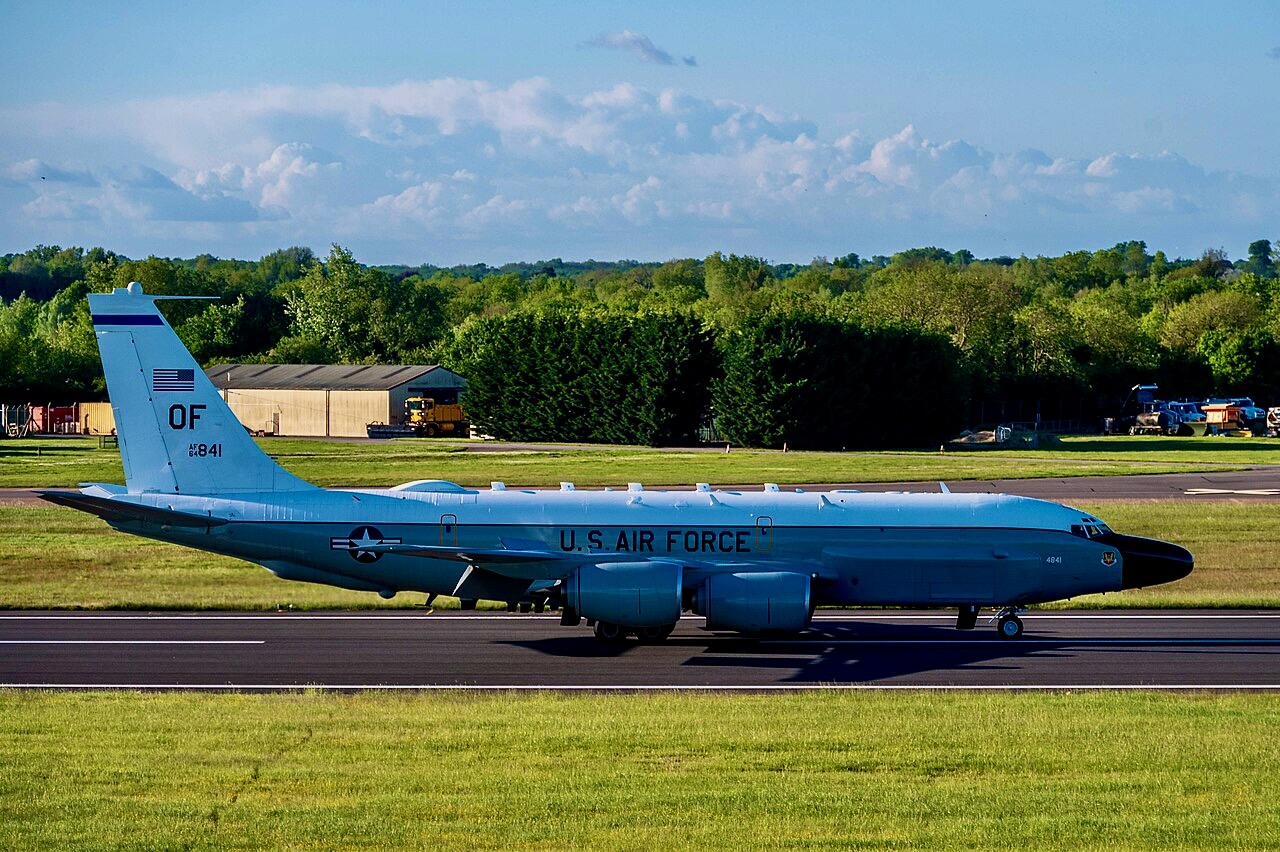
A U.S. Air Force RC-135 Rivet Joint, assigned to the 95th Reconnaissance Squadron, taxis down the runway at RAF Fairford, England, May 15, 2024. (U.S. Air Force / Staff Sgt. Jessica Avallone/ Wikimedia Commons / Public Domain)
By Craig Murray
CraigMurray.org.uk

Rather than abandoning the plainly nuts Fairford narrative, British Prime Minister Andy Burnham and his government are doubling down on the claim it is an Iranian terror plot.
It remains quite possible the men were indeed fuel thieves, simply stealing fuel from farms. They appear to have been equipped for fuel theft and all they were carrying was petrol.
It is worth a footnote that there is a very real history of U.S. military personnel, and indeed British personnel, selling military fuel from bases. Stolen red diesel meant for HMS Bulwark fuelled fairground rides throughout England, which I think is rather lovely.
But if the Fairford Five were fuel thieves, farms are more probable as the target.
We should pause here to acknowledge that USAF Fairford is falsely designated RAF Fairford, itself a propaganda lie, just like “RAF Lakenheath” or “RAF Mildenhall”. The U.K. is full of U.S. military bases, on which U.S. law applies. (My birth certificate gives my father’s occupation as “Clerk USAF.” He was employed at Mildenhall at the time).
It is a classic example of state propaganda that the petrol discovered in the Fairford vans was described by counter terror police as a potential accelerant for a bomb.
Well yes, petrol is that. It has, however, rather more obvious uses too. The same technique was used at the height of the War on Terror propaganda in the Great Easter Bomb Plot, that never was. Police rounded up and arrested many young Muslims across the Manchester region, which was front-page news. They were all later released without charge.
But at the time of arrest the police announced they had found a potential bomb-making ingredient in a kitchen.
Well, they had. It was a bag of sugar. Sugar is indeed a potential bomb-making ingredient. Yet most of us have a bag in the kitchen. At least it did not take the police ten days to find the bag of sugar in the kitchen, unlike when they searched Charlie Rowley’s flat for a vial of novichok, and it took them ten days to “find” a bottle of perfume sitting on the kitchen counter.
For Fairford, on balance I think a false flag gone wrong is a little more likely than just fuel thieves. We know the men had no bombs and no guns, which makes the terrorist narrative rather hard for the government to sustain.
But if they were patsies set up in a false flag, there would be plenty of things already on the base that go bang which could have been used to create the “terrorist incident” around them.
Two key points make me think this was a false flag. Firstly, the lady farmer who called 999 was adamant that there were more men than the five arrested and bailed. The others would have been the spycops — agents provocateurs — who would have been quietly spirited away from the scene. That also fits with the released information that it was one of the men who phoned in a warning about the “attack.”
It looks to me like a false flag spectacular had been planned, with U.S. involvement as claimed by Donald Trump and possibly Israeli knowledge as claimed by Benjamin Netanyahu.
This operation by the security services was viewed as over the pay grade of local police (who might be inconveniently honest), who were not in the picture. It all went horribly wrong for the government when an alert local farmer called the local police, and when a participant also called it in. That could have been one of the recruited “terrorists” who got cold feet, or one of the agents, panicked they had lost contact with their line of command.
It remains quite possible the men were indeed fuel thieves, simply stealing fuel from farms. They appear to have been equipped for fuel theft and all they were carrying was petrol.
It is worth a footnote that there is a very real history of U.S. military personnel, and indeed British personnel, selling military fuel from bases. Stolen red diesel meant for HMS Bulwark fuelled fairground rides throughout England, which I think is rather lovely.
But if the Fairford Five were fuel thieves, farms are more probable as the target.
We should pause here to acknowledge that USAF Fairford is falsely designated RAF Fairford, itself a propaganda lie, just like “RAF Lakenheath” or “RAF Mildenhall”. The U.K. is full of U.S. military bases, on which U.S. law applies. (My birth certificate gives my father’s occupation as “Clerk USAF.” He was employed at Mildenhall at the time).
It is a classic example of state propaganda that the petrol discovered in the Fairford vans was described by counter terror police as a potential accelerant for a bomb.
Well yes, petrol is that. It has, however, rather more obvious uses too. The same technique was used at the height of the War on Terror propaganda in the Great Easter Bomb Plot, that never was. Police rounded up and arrested many young Muslims across the Manchester region, which was front-page news. They were all later released without charge.
But at the time of arrest the police announced they had found a potential bomb-making ingredient in a kitchen.
Well, they had. It was a bag of sugar. Sugar is indeed a potential bomb-making ingredient. Yet most of us have a bag in the kitchen. At least it did not take the police ten days to find the bag of sugar in the kitchen, unlike when they searched Charlie Rowley’s flat for a vial of novichok, and it took them ten days to “find” a bottle of perfume sitting on the kitchen counter.
For Fairford, on balance I think a false flag gone wrong is a little more likely than just fuel thieves. We know the men had no bombs and no guns, which makes the terrorist narrative rather hard for the government to sustain.
But if they were patsies set up in a false flag, there would be plenty of things already on the base that go bang which could have been used to create the “terrorist incident” around them.
Two key points make me think this was a false flag. Firstly, the lady farmer who called 999 was adamant that there were more men than the five arrested and bailed. The others would have been the spycops — agents provocateurs — who would have been quietly spirited away from the scene. That also fits with the released information that it was one of the men who phoned in a warning about the “attack.”
It looks to me like a false flag spectacular had been planned, with U.S. involvement as claimed by Donald Trump and possibly Israeli knowledge as claimed by Benjamin Netanyahu.
This operation by the security services was viewed as over the pay grade of local police (who might be inconveniently honest), who were not in the picture. It all went horribly wrong for the government when an alert local farmer called the local police, and when a participant also called it in. That could have been one of the recruited “terrorists” who got cold feet, or one of the agents, panicked they had lost contact with their line of command.

President Donald Trump and Israeli Prime Minister Benjamin Netanyahu in the White House on Sept. 29, 2025. (White House/Daniel Torok)
The use of recruited patsies to carry out false flags is now better understood. I have been writing about it since before the Newburgh bomb plot which was a particularly egregious example. In the United States there has been more awareness of and reaction to agent provocateur incited plots than in the U.K.
For anyone sceptical, here is a summary of Newburgh:
In May 2009 the F.B.I. arrested four poor men from Newburgh, New York and announced it had foiled a plot to bomb two synagogues in the Bronx and shoot down military planes at Stewart Air National Guard base. The plot, the targets, the inert bombs and the disabled Stinger missile were all supplied by the Bureau.
The recruiter was Shahed Hussain, a Pakistani fraudster who had become an informant to avoid deportation after a driving-licence scam. Paid nearly $100,000, he spent more than a year fishing at a Newburgh mosque, posing as a wealthy Jaish-e-Mohammed agent, before latching onto James Cromitie, a Walmart stocker and petty drug dealer.
Hussain offered heavenly reward and as much as $250,000. Cromitie brought in three others: Onta Williams, David Williams and Laguerre Payen. Hussain drove them across a state line to inspect the fake weapons, which federalised the charges and carried a 25-year minimum. They were convicted in 2010.
The sentencing judge, Colleen McMahon, said she believed beyond a shadow of a doubt that there would have been no crime except that the government instigated it, planned it and brought it to fruition. “The real lead conspirator was the United States,” she said.
[McMahon said:
“The essence of what occurred here is that a government, understandably zealous to protect its citizens from terrorism, came upon a man [the supposed terrorism ringleader] both bigoted and suggestible, one who was incapable of committing an act of terrorism on his own.
It [the F.B.I.] created acts of terrorism out of his fantasies of bravado and bigotry, and then made those fantasies come true. The government did not have to infiltrate and foil some nefarious plot there was no nefarious plot to foil.”]
In 2023 she ordered the release of three of them, calling it an F.B.I.-orchestrated conspiracy and writing, as quoted above, that the real lead conspirator was the United States.
She freed Cromitie in 2024 on the same basis, describing him as a small-time grifter with no history of violence and Hussain as a villain who had lured him with promises of both heavenly and earthly rewards.
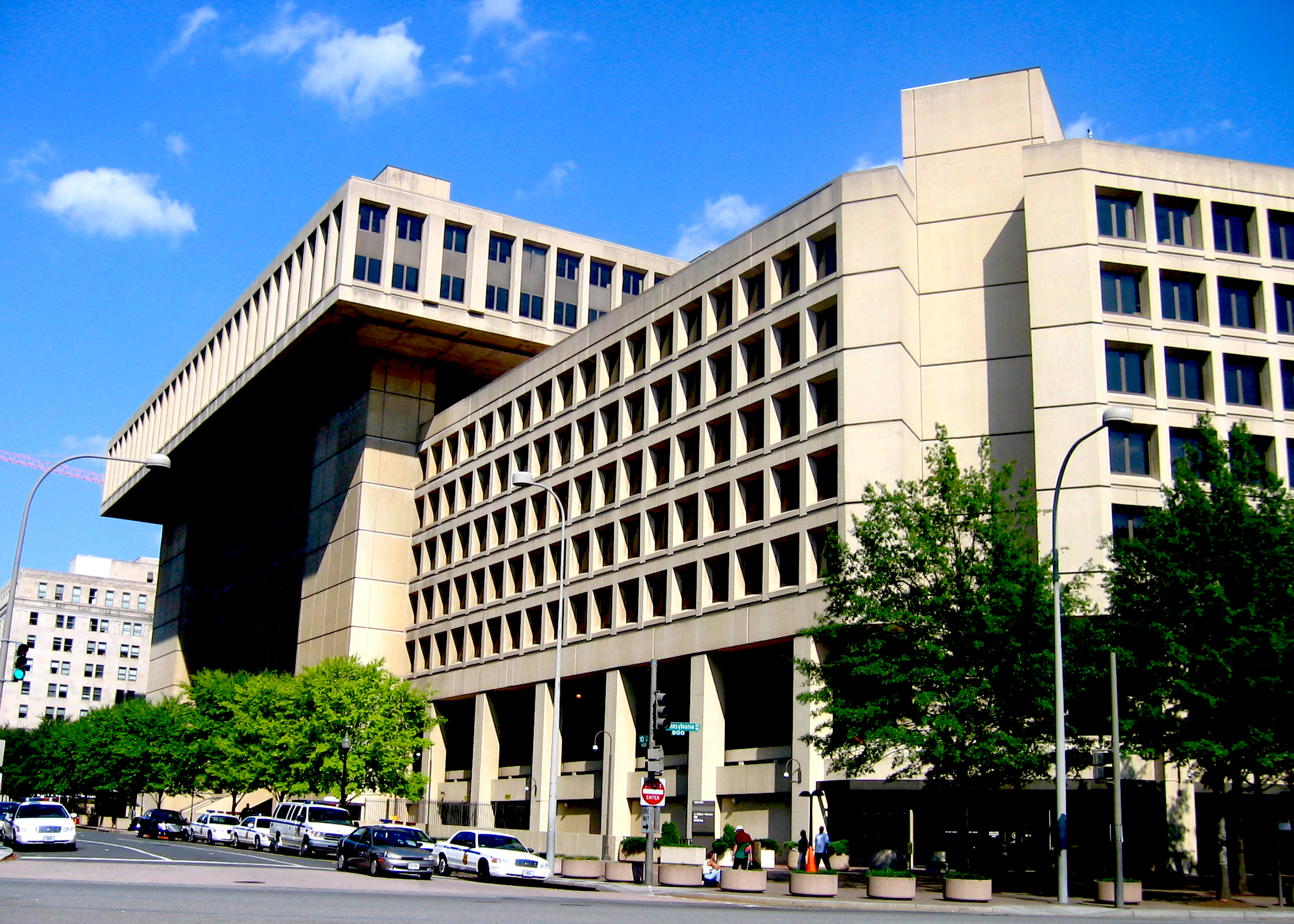
F.B.I. headquarters in Washington. (Aude / Wikimedia Commons / CC BY-SA 3.0)
The Golders Green ambulances arson was a classic of this false flag genre.
Four young Muslims were recruited, in this case online rather than in person, by someone they never saw who was almost certainly a Mossad agent. They were offered money to attack the ambulances, which they did. The attack is then blamed on Iran through a claim on a Telegram channel on behalf of an “Iranian organisation,” Harakat Ashab al-Yamin al-Islamia, which is a Mossad fabrication.
HAYI first became known to the world through simultaneous press releases on March 16 by five Israeli government outlets in Israel, U.S. and U.K. (including BICOM) and an article by the Israeli front “Foundation for Defending Democracy.” The FDD’s Nick Stewart travels with Kushner and Witkoff as part of the U.S. negotiating team on the Middle East.
There are numerous reasons for doubting the real existence of HAYI. None of its material is in Farsi. All of its “attacks” have been minor arson attacks on pointless targets that hurt nobody. The grammar, calligraphy and imagery of its materials are all wrong.
The U.K. state itself has now debunked some of the Mossad HAYI narrative. On April 29, when Essa Suleiman stabbed three men, the entire media blocked out the first Muslim victim and claimed an antisemitic terrorist attack on the two in Golders Green.
The HAYI Mossad run “Iranian” Telegram channel immediately put out a statement claiming responsibility for the attack. But then police and prosecution were forced to drop the claim it was a terrorist attack at all. The stabbing of the Muslim is charged as attempted murder, though still ignored by the media. So “HAYI” claimed responsibility for a non-existent terrorist incident.
A false flag can be, but is not necessarily, the state planting a bomb and then blaming someone else. It can be more complex — the state recruiting people to plant bombs. Those people may believe they are genuinely part of an ideological campaign, or may just be doing it for money.
The opaque Starmer rent-boy arson plot, in which Ukrainian male models burnt property associated with Keir Starmer, remains unclear, largely because any discussion of what lay behind the attacks was banned by the judge in the trial.
But the media, with government encouragement, continually relays the story that the arsonists were recruited online by a man known as “El Money.” An interesting twist here is that the media constantly refer to him as Russian-speaking. But the evidence in court is that he spoke both Russian and Ukrainian.
Almost all adult Ukrainians can speak Russian. The number of Russians who speak Ukrainian is very small. Yet El Money is now routinely portrayed as Russian.
Which brings us to the whole question of Russian “hybrid attacks,” where we are asked to believe the narrative of the security services of states whose leaders are openly promoting war with Russia, about desultory and mysterious attacks.
The rather sorry Leipzig drone is a good example. We have a more recent claim of Russian arson from Estonia, a state which has instituted massive discrimination against the 29 percent of its population who speak Russian.
Not only has Estonia closed Russian schools, libraries, theatres, churches, cinemas and university courses, it even refuses passports to people born and bred in Estonia, whose parents were born and bred in Estonia, if they cannot speak Estonian. That is totally contrary to numerous U.N., Council of Europe and OSCE instruments on protection of minority linguistic rights.
It is one thing to insist on language qualification for citizenship for new immigrants. Many countries do. It is quite another thing to deny citizenship to a native linguistic minority. Estonia was part of Russia from 1721 to 1919 and of the Soviet Union from 1941 to 1991. It has Russian speakers.
So I decline to believe the Estonian government on Russian “hybrid attacks.”
Which brings us to the amazing “FlyDubai” hijacking and the heroic plumber who knew how to rescue a plane from a death dive because he watched Air Crash Investigation.
There are real problems with this narrative. One is that the plane is said to have dived approximately 15,000 feet in about 30 seconds. This is said to be confirmed by independent flight trackers.
The force was so enormous that the rudder ripped off the plane.
Picture a dive of 500 feet — that is more than a 40 storey building — per second. Picture that. 500 feet in a second. Imagine yourself falling that fast. The forces would be enormous inside the cabin.
Anybody not strapped in would be lifted right out of their seats and probably hit the ceiling. Many would be injured. Any unfastened object, including major ones like food trollies, would be hurled about with great force.
Baggage lockers would come unlocked as the weight of the bags inside was hurled up. Remember this dive ripped the rudder off. It would be impossible for anyone not strapped into their chair to keep their footing or seat.
We have a great many videos from on board the plane but nothing like this is shown. No video shows this kind of extreme situation, and the cabin at the end of the flight is remarkably undisturbed.
There is also a problem with that flight-tracking data. As pointed out by this commercial pilot on CNN, a plane can’t easily slow down in mid-air. He is disbelieving of how quickly the flight trackers show the plane returning to normal speed.
He is also deeply sceptical of the ability to control the plane after the rudder came off due to loss of hydraulic fluid, and of the chances of the airframe staying together. Now compare that to the lack of cabin tumult.
I have seen it argued that if you entered the dive very gently and carefully without sudden change of pitch, and exited it similarly smoothly, then you would avoid extreme G-forces and the cabin might be relatively undisturbed.
Even if so, it is hard to imagine the kind of smooth transition into the dive in the circumstances we are told were occurring in the cockpit, with the co-pilot deliberately putting the plane in a death dive while fighting with the pilot.
The smooth transition out of the dive in the official story was achieved by a plumber who knew what to do from watching Air Crash Investigation. I don’t think I need to comment on that.
We will never find out the truth about FlyDubai. The plane diverted to Saudi Arabia. The copilot who is being painted as an Islamic extremist will be isolated there and tortured by the Saudis.
Netanyahu has already said Israel will join the interrogation. Do not believe any confession or evidence from the co-pilot.
The plane was a Boeing, so the U.S. will join the initial investigation alongside UAE, Saudi Arabia and Israel. A more potent coalition of Zionist evil does not exist. We will certainly have faked flight data recorder and cockpit voice recorder evidence coming from that shower.
I do feel something has snapped in people’s willingness to believe official narratives. The Skripal narrative was even crazier than any of these, but most people still trusted government. Thankfully that faith has been seriously shaken.
Craig Murray is an author, broadcaster and human rights activist. He was British ambassador to Uzbekistan from August 2002 to October 2004 and rector of the University of Dundee from 2007 to 2010.
***
UK-Iranian dual national arrested over RAF Fairford incident released on bail 😂😂😂