
7 hours ago
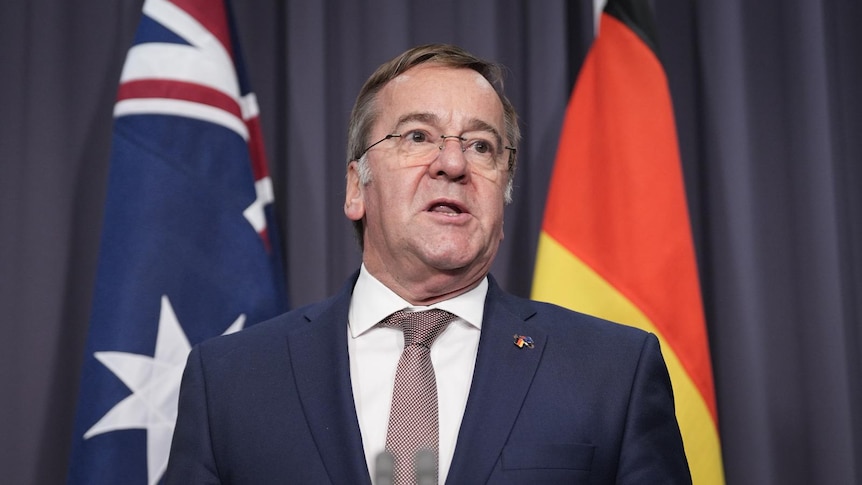
Boris Pistorius told the National Press Club in Canberra the Trump administration has "no exit strategy" in Iran. (ABC News: Matt Roberts)
In short:
Germany's defence minister has accused the Trump administration of sending contradictory messages to its European allies.
Boris Pistorius told the National Press Club in Canberra the US has "no exit strategy" in Iran.
Boris Pistorius told the National Press Club in Canberra the Trump administration has "no exit strategy" in Iran. (ABC News: Matt Roberts)
In short:
Germany's defence minister has accused the Trump administration of sending contradictory messages to its European allies.
Boris Pistorius told the National Press Club in Canberra the US has "no exit strategy" in Iran.
What's next?
He said Germany would only provide support to ships in the Strait of Hormuz once a ceasefire deal was struck.
Germany's defence minister has lashed the Trump administration over the Iran war, saying it has "no exit strategy" and accusing it of sending contradictory demands to European allies.
Boris Pistorius also told the National Press Club in Canberra his nation will not get "sucked in" to the conflict, vowing that Germany will only help to secure the Strait of Hormuz after the United States and Iran have struck a ceasefire.
While US President Donald Trump has declared that Iranians are trying to sue for peace — despite the regime's public denials — Mr Pistorius made it clear he was worried about the war's trajectory.
"What really concerns me the most about that war is there was no consultation, there is no strategy, there is no clear objective and the worst thing from my perspective is that there is no exit strategy," he said.
Mr Trump has previously lashed US allies in Europe, saying they were "cowards" and calling NATO a "paper tiger" because they refused to help the US reopen the Strait of Hormuz for oil tankers.
But multiple European officials have insisted there has been no formal request for military assistance from the US.
Mr Pistorius said Mr Trump had also contradicted his own administration's demands to Germany over the last 12 months, saying top American officials had instead been pushing Berlin to spend more money and focus on defending its own borders.
"The United States demanded from Europe to take more responsibility for our conventional deterrence and defence, and demanded that we need to ramp up to achieve 3.5 per cent [on defence spending]," he said.
"Some voices in Washington even said, 'OK, take care of your own backyard and Europe, and don't mix up with us in the Indo-Pacific.'
"That was before the war started against Iran. Now, the arguments are different. Now they are saying: 'Where are you, you are cowards, you don't help us.'"
Germany calls on Iran to stop blockade of Strait
Germany has put its name to a joint statement signed by 22 countries which calls on Iran to stop blocking commercial traffic through the Strait, and which says the signatories are willing to "contribute to appropriate efforts" to ensure safe passage.
But Mr Pistorius was adamant Germany's military would not enter the Strait until after Iran and the US reached a peace settlement — or at least a ceasefire.
"We are ready to secure any peace. If it comes to a point where we have a ceasefire, then we will discuss every kind of operation to secure the peace, to secure, especially, the freedom of navigation," he said.
The defence minister also met with his Australian counterpart, Richard Marles, in Canberra this morning, where the two unveiled plans to begin negotiations on a new Status of Forces agreement designed to make it easier for Australian Defence Force personnel to operate in Germany, and vice versa.
Mr Pistorius said the two countries had also signed a letter of intent to help develop an "early warning system" to detect space threats from Russia and China.
"We need to be aware of what is going on up there. This is the only way to protect our own systems," Mr Pistorius said.
"We are taking a huge leap forward. We are strengthening the space capabilities of both countries."
Richard Marles and Boris Pistorius held a bilateral meeting in Canberra this week. (ABC News: Matt Roberts )
Mr Marles heaped praise on Germany following the meeting.
"To have a country where we share values, but we share a commitment to the rules-based order, seeking to play a part in the Indo-Pacific, I mean, that is deeply welcome, and it is much more than symbolic," he said.
"In a challenging world, I fundamentally feel safer having had the kind of conversation that we've had today."


fuck will just declare victory and go leave the region.
ReplyDeleteThere is only One Possible Exit for Falastinos but Nobody Will Ask Them To Take It.
ReplyDeletefuck plays 5-dimensional chess.
ReplyDeleteHe doesn't need to work with conventional strategy ...wakakakaka...