
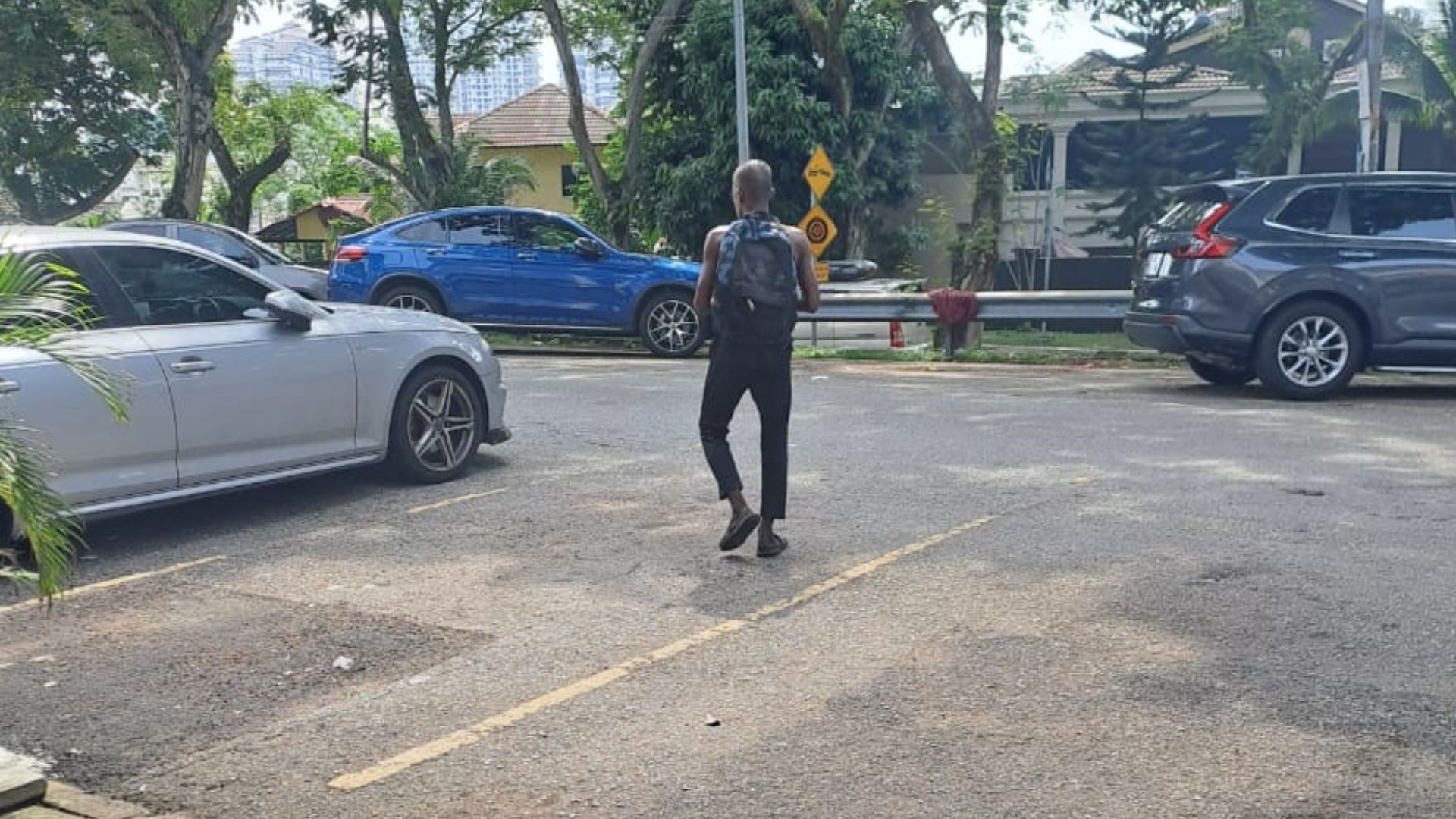
A lone vagrant walks through a neighbourhood car park, a familiar yet overlooked presence that reflects a deeper failure in care, coordination and accountability for the vulnerable. – Social media pic, March 28, 2026
Whose responsibility are the vagrants? – Ravindran Raman Kutty
A chance encounter with a mentally unwell man left to wander the streets for years exposes a troubling gap in care, accountability and coordination among authorities meant to protect society’s most vulnerable
Updated 1 minute ago
28 March, 2026
11:48 AM MYT
IT was close to midnight when I first saw him.
The streets were quiet, the shop lights dimmed, and the township was winding down for the day. At a junction I have driven through a thousand times without thinking, a lone figure stood under the harsh glare of a streetlamp. Thin. Bony. Dark-skinned. A man in nothing but his underwear, stomach caved in, a few abs jutting out as if he had come straight from a gym instead of the margins of survival. His hair short, his face unshaven, his eyes… distant. He looked to be between 45 and 55, an age where a man should be safely in bed, surrounded by walls, by family, by some kind of care.
But he stood alone at that junction, as if he belonged to no one.
I stopped the car. I hesitated, not out of fear for myself, but out of fear for him. Who was he? How long had he been wandering like this? How many cars had driven past him without a second thought? I stepped out and asked, gently, “Why are you here?” He looked at me, listened, and then, in clear English, asked me why I was asking him questions. His words were coherent, but his presence was not. His body was here. His mind was somewhere else.
I kept my distance, but I could not keep my conscience at a distance.
I drove straight to the nearby police pondok. The sergeant knew who I was talking about before I finished my sentence. “Yes, yes, that man. We know him,” he said, casually. He assured me he would send someone to tell the man to go home, to his low-cost flat nearby.
That was two years ago.
Today, that same man is still roaming our township. Still half-dressed, still drifting from corner to corner, still living in a space between visibility and invisibility. The police know him. The community recognises him. And yet, somehow, he belongs to no one. He is everyone’s problem and no one’s responsibility.
This is not a story about one man. It is an indictment of the system that has abandoned him.
When I tried to find out how to help, I did what any ordinary citizen would do. I went to the welfare department’s website, searching for some pathway, some clear process, some signal that the State sees people like him, the mentally unwell, the homeless, the forgotten, as human beings worth saving. I looked for any section that spoke about vagrants, about people roaming the streets in obvious distress, about those who cannot advocate for themselves.
There was nothing.
No clear channel to report. No dedicated unit to respond. No simple, humane protocol that says: if you see a person clearly in need, here is how we will help you help them. The silence was deafening, not just from the website, but from the very agencies that should be the first line of dignity for our most vulnerable.
We like to tell ourselves we are a caring society. We hold campaigns. We post hashtags. We talk about mental health, social protection, inclusion. But what does all that talk mean if a man can walk half-naked through our streets for years and no structure, no system, no agency has stepped forward to claim responsibility for his safety, his treatment, his dignity?
How can it be that our ministries, our welfare agencies, our local authorities and even our police have procedures and forms for everything, licences, compounds, inspections, enforcement, but not a clear, actionable, compassionate protocol for a human being who is clearly unwell and at risk?
Do they not see what we see?
A man roaming the streets like this is not just “an eyesore” or “a nuisance”. He is at risk of violence, bullying, sexual assault, and exploitation. He is an easy target for cruel boys looking for entertainment, for criminals looking for someone to use, for drivers who will not stop in time. Every day that he is left untreated, unfed, unprotected is a day that our institutions quietly declare: your life does not matter as much as a permit, a parking ticket, or a policy paper.
And yet, in the middle of this institutional indifference, there is a flicker of humanity.
In our township, a restaurant owner has quietly taken it upon herself to feed this man – not once, not twice, but up to five to seven times a day. Hot food. Cold drinks. Small bites. Rice. Enough to keep him going. No one told him to do it. There was no directive, no scheme, no subsidy. Just one human being recognising another and deciding that “not my problem” is not good enough.
But charity cannot replace responsibility.
We cannot depend on the goodwill of a few kind souls to compensate for the failure of entire ministries and agencies. That restaurant owner is doing more for this man than the entire machinery of the State. Is that not a shame? Is that not a scandal? How can we have budgets, officers, departments and strategies, yet not even a simple, clear path for someone who wants to help a mentally unwell person get proper treatment and care?
The question is no longer, “Why is this man still here?” The real question is, “Why are our agencies still asleep?” We do not need another committee. We do not need another glossy brochure. We need basic, practical, urgent action:
A dedicated, visible channel – hotline, online form, or local office – where members of the public can report cases like this and know they will be acted upon.
A clear, cross-agency protocol between the Welfare Department, Health Ministry, Police and Local Authorities on how to respond, assess, and safely transport such individuals to the nearest hospital or care centre.
Training for frontline officers, police, RELA, local council enforcers, to recognise mental distress and respond with restraint, empathy and professionalism, not force or ridicule.
Outreach teams that do not wait for tragedies, but proactively identify and assist people who are clearly living on the streets in distress.
Temporary shelters and long-term treatment options that treat these individuals not as criminals to be removed, but as human beings to be restored.
None of this is impossible. It is not even particularly complex. It simply requires the one thing that seems to be missing: the will to care.
The Ministry of Welfare cannot continue to act as though these lives are outside its mandate. The Health Ministry cannot pretend that mental illness walking on the streets is somehow less urgent than mental illness inside a ward. Local authorities cannot sweep people away like rubbish when they become inconvenient. The police cannot be content to “tell him to go home” when home is clearly not enough.
If our systems cannot protect the ones who have no voice, then our systems are failing at their most basic test.
This man, in his underwear, wandering our township for years, is a mirror. He reflects back to us who we truly are as a society – how much we really value human life when there is no power, no money, no status attached to it. We can look away from him. We can speed past him in our cars. We can pretend he is someone else’s problem.
But one day, that “someone else” could be our own brother, our own father, our own child or a member of our family.
To the Ministry of Welfare, the police, and the local authorities: your silence is not neutral. It is a choice. Every day that passes without a plan, without a protocol, without a response is a day you choose bureaucracy over humanity. We do not need more statements. We need to see you act.
Because no human being should be left to rot on our streets while the State looks the other way. – March 28, 2026
Whose responsibility are the vagrants? – Ravindran Raman Kutty
A chance encounter with a mentally unwell man left to wander the streets for years exposes a troubling gap in care, accountability and coordination among authorities meant to protect society’s most vulnerable
Updated 1 minute ago
28 March, 2026
11:48 AM MYT
IT was close to midnight when I first saw him.
The streets were quiet, the shop lights dimmed, and the township was winding down for the day. At a junction I have driven through a thousand times without thinking, a lone figure stood under the harsh glare of a streetlamp. Thin. Bony. Dark-skinned. A man in nothing but his underwear, stomach caved in, a few abs jutting out as if he had come straight from a gym instead of the margins of survival. His hair short, his face unshaven, his eyes… distant. He looked to be between 45 and 55, an age where a man should be safely in bed, surrounded by walls, by family, by some kind of care.
But he stood alone at that junction, as if he belonged to no one.
I stopped the car. I hesitated, not out of fear for myself, but out of fear for him. Who was he? How long had he been wandering like this? How many cars had driven past him without a second thought? I stepped out and asked, gently, “Why are you here?” He looked at me, listened, and then, in clear English, asked me why I was asking him questions. His words were coherent, but his presence was not. His body was here. His mind was somewhere else.
I kept my distance, but I could not keep my conscience at a distance.
I drove straight to the nearby police pondok. The sergeant knew who I was talking about before I finished my sentence. “Yes, yes, that man. We know him,” he said, casually. He assured me he would send someone to tell the man to go home, to his low-cost flat nearby.
That was two years ago.
Today, that same man is still roaming our township. Still half-dressed, still drifting from corner to corner, still living in a space between visibility and invisibility. The police know him. The community recognises him. And yet, somehow, he belongs to no one. He is everyone’s problem and no one’s responsibility.
This is not a story about one man. It is an indictment of the system that has abandoned him.
When I tried to find out how to help, I did what any ordinary citizen would do. I went to the welfare department’s website, searching for some pathway, some clear process, some signal that the State sees people like him, the mentally unwell, the homeless, the forgotten, as human beings worth saving. I looked for any section that spoke about vagrants, about people roaming the streets in obvious distress, about those who cannot advocate for themselves.
There was nothing.
No clear channel to report. No dedicated unit to respond. No simple, humane protocol that says: if you see a person clearly in need, here is how we will help you help them. The silence was deafening, not just from the website, but from the very agencies that should be the first line of dignity for our most vulnerable.
We like to tell ourselves we are a caring society. We hold campaigns. We post hashtags. We talk about mental health, social protection, inclusion. But what does all that talk mean if a man can walk half-naked through our streets for years and no structure, no system, no agency has stepped forward to claim responsibility for his safety, his treatment, his dignity?
How can it be that our ministries, our welfare agencies, our local authorities and even our police have procedures and forms for everything, licences, compounds, inspections, enforcement, but not a clear, actionable, compassionate protocol for a human being who is clearly unwell and at risk?
Do they not see what we see?
A man roaming the streets like this is not just “an eyesore” or “a nuisance”. He is at risk of violence, bullying, sexual assault, and exploitation. He is an easy target for cruel boys looking for entertainment, for criminals looking for someone to use, for drivers who will not stop in time. Every day that he is left untreated, unfed, unprotected is a day that our institutions quietly declare: your life does not matter as much as a permit, a parking ticket, or a policy paper.
And yet, in the middle of this institutional indifference, there is a flicker of humanity.
In our township, a restaurant owner has quietly taken it upon herself to feed this man – not once, not twice, but up to five to seven times a day. Hot food. Cold drinks. Small bites. Rice. Enough to keep him going. No one told him to do it. There was no directive, no scheme, no subsidy. Just one human being recognising another and deciding that “not my problem” is not good enough.
But charity cannot replace responsibility.
We cannot depend on the goodwill of a few kind souls to compensate for the failure of entire ministries and agencies. That restaurant owner is doing more for this man than the entire machinery of the State. Is that not a shame? Is that not a scandal? How can we have budgets, officers, departments and strategies, yet not even a simple, clear path for someone who wants to help a mentally unwell person get proper treatment and care?
The question is no longer, “Why is this man still here?” The real question is, “Why are our agencies still asleep?” We do not need another committee. We do not need another glossy brochure. We need basic, practical, urgent action:
A dedicated, visible channel – hotline, online form, or local office – where members of the public can report cases like this and know they will be acted upon.
A clear, cross-agency protocol between the Welfare Department, Health Ministry, Police and Local Authorities on how to respond, assess, and safely transport such individuals to the nearest hospital or care centre.
Training for frontline officers, police, RELA, local council enforcers, to recognise mental distress and respond with restraint, empathy and professionalism, not force or ridicule.
Outreach teams that do not wait for tragedies, but proactively identify and assist people who are clearly living on the streets in distress.
Temporary shelters and long-term treatment options that treat these individuals not as criminals to be removed, but as human beings to be restored.
None of this is impossible. It is not even particularly complex. It simply requires the one thing that seems to be missing: the will to care.
The Ministry of Welfare cannot continue to act as though these lives are outside its mandate. The Health Ministry cannot pretend that mental illness walking on the streets is somehow less urgent than mental illness inside a ward. Local authorities cannot sweep people away like rubbish when they become inconvenient. The police cannot be content to “tell him to go home” when home is clearly not enough.
If our systems cannot protect the ones who have no voice, then our systems are failing at their most basic test.
This man, in his underwear, wandering our township for years, is a mirror. He reflects back to us who we truly are as a society – how much we really value human life when there is no power, no money, no status attached to it. We can look away from him. We can speed past him in our cars. We can pretend he is someone else’s problem.
But one day, that “someone else” could be our own brother, our own father, our own child or a member of our family.
To the Ministry of Welfare, the police, and the local authorities: your silence is not neutral. It is a choice. Every day that passes without a plan, without a protocol, without a response is a day you choose bureaucracy over humanity. We do not need more statements. We need to see you act.
Because no human being should be left to rot on our streets while the State looks the other way. – March 28, 2026
Ravindran Raman Kutty is an award-winning PR practitioner


The vagrancy is usually associated with mental illness. Sometimes drug addiction. My neighbourhood has one or two. Likely with mental illness.
ReplyDeleteIt's not really about poverty per se, but poverty arising from mental illness and family abandonment.
My neighbourhood has almost full employment, which is a fact in Penang today, while it is true some people struggle to make ends meet, especially with rising costs of living.