
‘Let Cuba live in peace’: Under US pressure, Havana appeals for international help
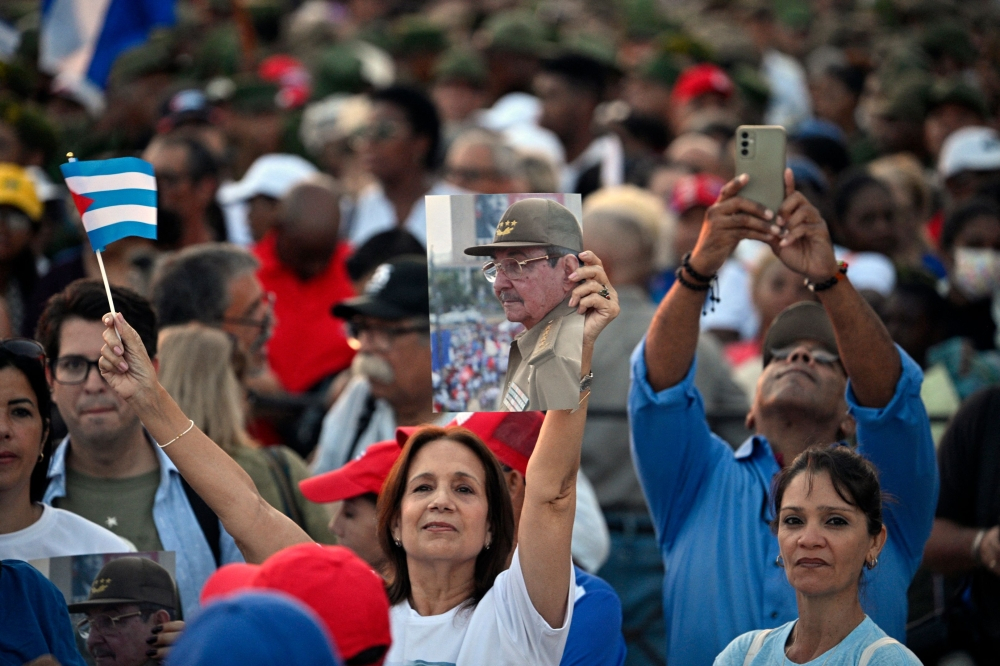
A woman holds a photograph of former Cuban president Raul Castro and a Cuban flag during a rally in support of Castro, 94, who has been indicted by a US court, outside the US Embassy in Havana May 22, 2026. — AFP pic
Wednesday, 27 May 2026 11:52 AM MYT
NEW YORK, May 27 — Cuban Foreign Minister Bruno Rodriguez Parrilla asked the international community for urgent help to prevent disaster in his country, which is under a US energy blockade, in a speech to the UN Security Council yesterday.
“I call on the international community to mobilize to prevent a humanitarian catastrophe that could be imposed through arms or the fuel blockade,” Rodriguez said.
He added, “now should be the time for solidarity with Cuba.”
US President Donald Trump has openly mused about taking over communist Cuba, saying that after the US attack in January that ousted Nicolas Maduro in Venezuela, Havana could be his next target for military action and big change.
Due in part to a US trade embargo imposed after Fidel Castro came to power in 1959, Cubans have suffered dire economic conditions for years, with shortages of food, medicine and other basics. Nationwide power blackouts are common.
Things got worse when Trump cut off the supply of oil from Havana’s ally Venezuela after the ouster of Maduro.
The Trump administration tightened the screws last week by indicting Raul Castro over the downing of two small US-based planes in 1996, fuelling fears the United States was seeking a pretext to overthrow the government in Havana.
The day after the Castro indictment was announced, Secretary of State Marco Rubio warned Cuba that the United States was laser-focused on changing the communist system.
Yesterday, Rodriguez called the indictment politically motivated and denied US allegations that Cuba poses a national security threat to the United States.
“It is an idea that goes against logic and common sense,” he told the council. “Let Cuba live in peace.” — AFP
***
Wankee bullies Cuba for donkey years - whether GOP or Democrats, all have been S-Wholes


Russia wants to RAMPAS neighbour Ukraine, China wants to RAMPAS neighbour Taiwan, why can't US RAMPAS neighbour Cuba?
ReplyDeletehAS cUBA BEEN ever PART OF THE WANKEES?
DeleteHa ha ..... ha. He has no answer to you. He is just yakking for his presence to be felt
DeleteI made many answers but KT censor....ha3....biasa lah....
DeleteWars Have Consequences. When You Lose the War You Lose Territory. Just Ask the Spaniards.
ReplyDeleteEver heard of the Spanish-American War?
Hari Ini Dalam Sejarah.
1898-1902
After the Spanish-American War which resulted in American victory and ownership of Cuba (& Philippines) and subsequently America quickly helped establish the Cuban state.
Terima Kasih Umrica.
Filipinos know this history well. Why are so many Filipinos in America today? Because Spain lost the same said War.
so, deep down MIGHT overshadows every mfering & twist logic u ranted about!
DeleteRight, mfer?
It’s Also A Historical fact that after WW2, Yapan Surrendered to ROC, not CCP gomen. Today the successor gomen to ROC is in Taipei, not BJ.
ReplyDeletewalau-eh, yr understanding of the continuity of sovereignty!
DeleteThere is a Main Road in Downtown Manila named after the 25th President (1897-1901) William McKinley. Pilipinos honor Him So much.
ReplyDeleteMcKinley successfully led the U.S. in the Spanish–American War and oversaw a period of American expansionism, with the annexations of Hawaii, Puerto Rico, Guam, the Philippines, and American Samoa.
That’s Why I call them Western Bully lah ha3.
But Cuba they quickly granted independence, unfortunately a bad mistake becos the Komunis took over. They should have kept it.
崇洋媚外, WOW… typically doggie behaviorism
DeleteHistorical Fact:
ReplyDeleteIndependence as a Republic (May 20, 1902): Following the Spanish-American War and a period of US military administration, the Republic of Cuba was officially established, with Tomás Estrada Palma as its first president.
so, what have the yankee gave to the pinky, mfer?
DeleteOoop… spurious independence but true & through serfdom, worst than a vassalized mouse
Let Taiwan, Ukraine, Isaacs LIVE IN PEACE.
ReplyDeleteWhy do you think Western Bully still owns Guantanamo Bay?
ReplyDeleteBACA lah Sejarah Baik2 Dan Faham.
Dont Simply Tembak.
Prior to the Civil War, there were 15 slave states in America: Alabama, Arkansas, Delaware, Florida, Georgia, Kentucky, Louisiana, Maryland, Mississippi, Missouri, North Carolina, South Carolina, Tennessee, Texas, and Virginia.
DeleteSo?
Mfer, tembaklah yrself.
Arab slave trade predates and dwarfs trans Atlantic slave trade to the Americas.
DeleteThe Arabs introduced slavery into Africa in 652 AD via the trans-Saharan and Indian Ocean routes.
It was introduced by Abdullah ibn Saad (governor of Egypt) in Nubia (Sudan).
The practice lasted until the 20th century, enslaving 10-18 million people.
At that time, approximately 7 million women and 4 million children were enslaved.
It was the world's longest and largest slave trade.
https://x.com/Patelindianlion/status/2059664135017623931?s=20
Arabs conducted Indian Ocean slave trade and it ended only in 1970, in Oman.
DeleteNah bacalah.
The Indian Ocean slave trade conducted by Arab merchants lasted twelve hundred years, moved an estimated seventeen million people from East Africa to Arabia, Persia, and India, castrated the majority of male slaves in transit, and has received less than one percent of the scholarly attention devoted to the Atlantic slave trade.
The Indian Ocean slave trade — conducted primarily by Arab, Persian, and Swahili Coast merchants from approximately the 7th century AD through the early 20th century — operated across a longer time span and involved comparable numbers of enslaved people to the Atlantic trade, yet occupies a fraction of the space in global historical consciousness, public discourse, and museum representation.
The reasons for this asymmetry are themselves historically significant — the Atlantic trade's direct connection to the economic foundations of Western Europe and North America, the survival of large descendant communities in the Americas, and the moral and political urgency of 20th-century American civil rights discourse all oriented historical attention toward the transatlantic system in ways that left the Indian Ocean trade relatively unstudied in Western scholarship until the late 20th century.
The East African coastal peoples — primarily from the regions of present-day Mozambique, Tanzania, Kenya, Somalia, and Madagascar — were the primary source population for the Indian Ocean trade, captured through a combination of Arab-led slave raids, the operations of Swahili Coast intermediary merchants, and the inland expansion of slave-raiding networks that penetrated deep into the African continent.
The castration of male enslaved people during the trade — documented in Arab, Persian, and European sources across multiple centuries — was practiced at rates that historians including John Lovejoy and Abdul Sheriff have estimated affected the majority of enslaved African men transported to Arab markets, creating a demographic pattern in which the descendant populations in receiving societies are far smaller relative to the number of people transported than in the Americas.
The mortality rate during castration, performed without anesthesia or antiseptic technique, was estimated by contemporary observers at between 75 and 90 percent, meaning that the number of people who died in the castration process alone represented an enormous additional casualty figure beyond those who died during capture, transit, and enslavement.
The trade was formally suppressed in Oman in 1970 — within living memory of people still alive today.
https://x.com/ImtiazMadmood/status/2059243160962752806?s=20
Slavery was introduced in Old Malaya by the Ishmaels in the 14th century.
DeleteMalay Elites and the Sultans then LOVED the hambas, who were the non-Ishmaels. The slave servants, concubines and harems.
It was the British that forced the locals to give up this cruel practice.
Nah...bacalah....
https://en.wikipedia.org/wiki/Slavery_in_Malaysia
Libyan Slave Trade.....TODAY
DeleteAs reported by Al Jezebel (KT's Trusted News Source)
https://youtu.be/dV7o31P4q4g?si=pcp4PdlOld4tUsgj
wakakaka… yr mfering twist of slavery trade.
DeleteMfer, why don't u quote those mentioned in the book of the zionist?
Or in ur mfering selectivity, issacs ain't product of the Abrahamic faith.
Only bloody fool would believe his-story told in wikipedia, such as
'It was the British that forced the locals to give up this cruel practice'
The First Governor of Cuba was the Secretary of War himself (William Howard Taft) from 29 September 1906 to 13 October 1906.
ReplyDeleteSecond Governor of Cuba Charles Edward Magoon from 13 October 1906 to 28 January 1909.
Western Bully generously granted Cuba it's Independence, but kept Guantanamo Bay.
so?
Delete