Murray Hunter
Zelensky’s warnings on attacks on civil aviation threatens the opening of a new front to the war
Murray Hunter
Sep 03, 2026
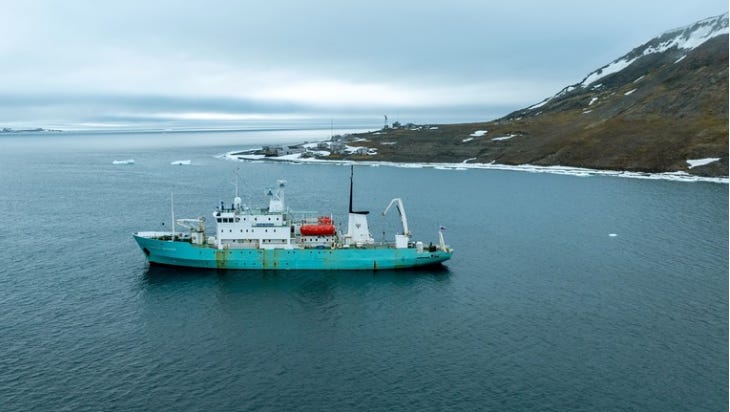
The research vessel Professor Molchanov is anchored near Hooker Island in the Franz Josef Land archipelago, Russia, July 7, 2026 © Ilya Timin / Sputnik
Ukrainian President Volodymyr Zelensky recently issued a public warning to airlines and insurers about the growing risks of operating in Russian airspace. In a nightly address, he stated that “the Russian sky is becoming completely dangerous” due to the scale of Ukrainian drone operations, adding that “drone-infested skies are no place for civilian aviation” and that Russian airspace would effectively be closing as a result of the war.
Russian officials and state media interpreted the remarks far more aggressively. President Vladimir Putin labeled them a “declaration of state terrorism.” Dmitry Medvedev, deputy chairman of Russia’s Security Council, called for retribution, and Russian diplomats described the comments as signs of terrorism. Aviation commentator Roman Gusarov called it a direct threat to civil aviation unprecedented from a head of state. These reactions reference the 2014 downing of Malaysia Airlines Flight MH17 over eastern Ukraine, which killed 298 people.
The world still remembers the attack on and destruction of the Malaysian flight MH17 on its way from Amsterdam to Kuala Lumpur back in 2014. Zelensky’s warning brings back ‘images’ of the potential disaster reoccurring again.
Around the same time, Norwegian authorities, acting on a court order obtained by Ukraine’s state energy company Naftogaz, seized the Russian vessel Professor Molchanov in Svalbard’s Barentsburg port. The action aims to enforce a 2023 Hague arbitration award requiring Russia to pay approximately $4.22 billion plus interest for assets expropriated after the 2014 annexation of Crimea.
The ship, used for commercial expedition cruises, was ordered to remain docked. Naftogaz described it as part of ongoing global efforts to collect on the unpaid judgment. Moscow has previously characterized Western seizures of Russian vessels or assets as “piracy and robbery,” with Putin and Foreign Minister Sergey Lavrov warning of reciprocal measures against vessels linked to countries pursuing such policies.
These developments coincide with Germany’s attribution of a failed explosive drone incident at Leipzig/Halle Airport in early August to Russian hybrid operations. German officials stated that police investigations, operational patterns, and intelligence findings are claimed to point to Russian responsibility, leading to the planned closure of Russia’s consulate in Bonn and termination of a cultural center agreement in Berlin. Russia denied the accusations, calling them fabricated.
The combination of Zelensky’s warning, the Arctic vessel seizure, and mutual accusations of hybrid threats has heightened rhetoric between Russia and Western states.
Russian voices argue these steps risk opening new fronts, while Ukrainian and Western positions frame the drone activity as a legitimate response to ongoing Russian strikes on Ukrainian cities and infrastructure, and the vessel action as lawful enforcement of an international arbitral award.
Commercial airlines from Europe and the United States have long avoided Russian airspace; carriers from other regions continue to use it and now face heightened risk assessments.
The statements and actions illustrate how the prolonged conflict continues to generate friction far beyond the battlefield. Airspace warnings, asset enforcement, and hybrid incident attributions are raising the stakes for civilian safety and diplomatic stability without constituting a formal expansion of combat operations into new theaters.
No comments:
Post a Comment