Consortium News
Volume 31, Number 163 — Wednesday, June 17, 2026
PATRICK LAWRENCE: Trans–Pacific Paskudniks
Is Beijing preparing for war? Of course: It has no choice. But the war it is bracing to wage is one the United States seems intent on provoking. The Chinese have no other such plans
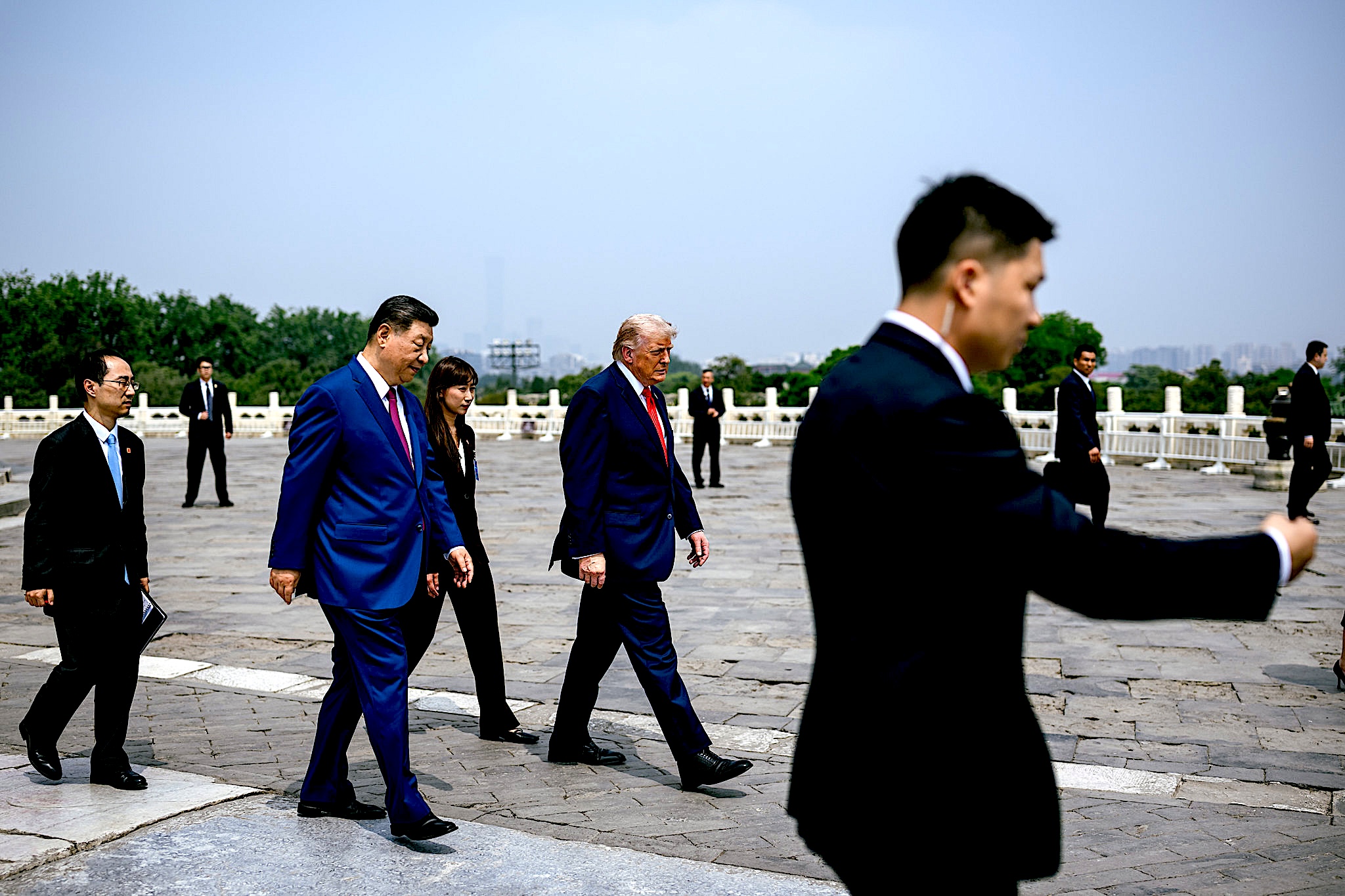
China’s President Xi Jinping with President Donald Trump outside the Temple of Heaven in Beijingon on May 14. (White House / Daniel Torok)
By Patrick Lawrence
Special to Consortium News

I have never quite got over how completely Antony Blinken and Jake Sullivan, who Joe Biden assigned to oversee his foreign policy, blew it during their first encounter with Chinese counterparts at a hotel in Anchorage. This was in March 2021, a few months into Biden’s White House years, and all concerned understood the meeting was going to be a big deal one way or another.
It was: Biden’s secretary of state and national security adviser, facing officials representing a nation whose power was about to supersede the United States’, took it upon themselves to shake their fingers at figures such as Wang Yi, who is now Beijing’s distinguished foreign minister, about democracy, human rights, Hong Kong, press censorship, the Uighurs of Xinjiang and who knows what all.
The Chinese across the table, foregoing their customary courtesies, abruptly shut them down. Nothing got done. It made for stunning video footage as Blinken and Sullivan sat there flabbergasted that another people — non–Western, of all things — did not succumb to the scoldings of high officials from “the indispensable nation,” in Madeleine Albright’s memorably ridiculous phrase.
That wonderful Yiddish word for contemptible clods came immediately to mind. What a pair of tone-deaf paskudniks, I recall thinking. They read from scripts written in the mid–1950s.
No idea what time it was on history’s clock, no idea that the time for browbeating the Chinese into submission had passed long, long earlier — no idea, to go straight to the point, that the People’s Republic was well into the project of building a new world order and that it was about to emerge as its most influential proponent.
How could I not recall the Blinken-and–Sullivan act as I watched President Trump give the world a 2026 variation of the very same farce? History turned when Donald J. Trump arrived in Beijing for a two-day summit with Xi Jinping last month, as I wrote in this space at the time. The Chinese president all but told his visitor this.
And what was the Trumpster doing? Like the child he is, he went halfway to ga-ga at the sight of the red carpets and the displays of made-for-tourists pageantry while his planeload of greedy cronies chicken-scratched for “deals.”
It was: Biden’s secretary of state and national security adviser, facing officials representing a nation whose power was about to supersede the United States’, took it upon themselves to shake their fingers at figures such as Wang Yi, who is now Beijing’s distinguished foreign minister, about democracy, human rights, Hong Kong, press censorship, the Uighurs of Xinjiang and who knows what all.
The Chinese across the table, foregoing their customary courtesies, abruptly shut them down. Nothing got done. It made for stunning video footage as Blinken and Sullivan sat there flabbergasted that another people — non–Western, of all things — did not succumb to the scoldings of high officials from “the indispensable nation,” in Madeleine Albright’s memorably ridiculous phrase.
That wonderful Yiddish word for contemptible clods came immediately to mind. What a pair of tone-deaf paskudniks, I recall thinking. They read from scripts written in the mid–1950s.
No idea what time it was on history’s clock, no idea that the time for browbeating the Chinese into submission had passed long, long earlier — no idea, to go straight to the point, that the People’s Republic was well into the project of building a new world order and that it was about to emerge as its most influential proponent.
How could I not recall the Blinken-and–Sullivan act as I watched President Trump give the world a 2026 variation of the very same farce? History turned when Donald J. Trump arrived in Beijing for a two-day summit with Xi Jinping last month, as I wrote in this space at the time. The Chinese president all but told his visitor this.
And what was the Trumpster doing? Like the child he is, he went halfway to ga-ga at the sight of the red carpets and the displays of made-for-tourists pageantry while his planeload of greedy cronies chicken-scratched for “deals.”
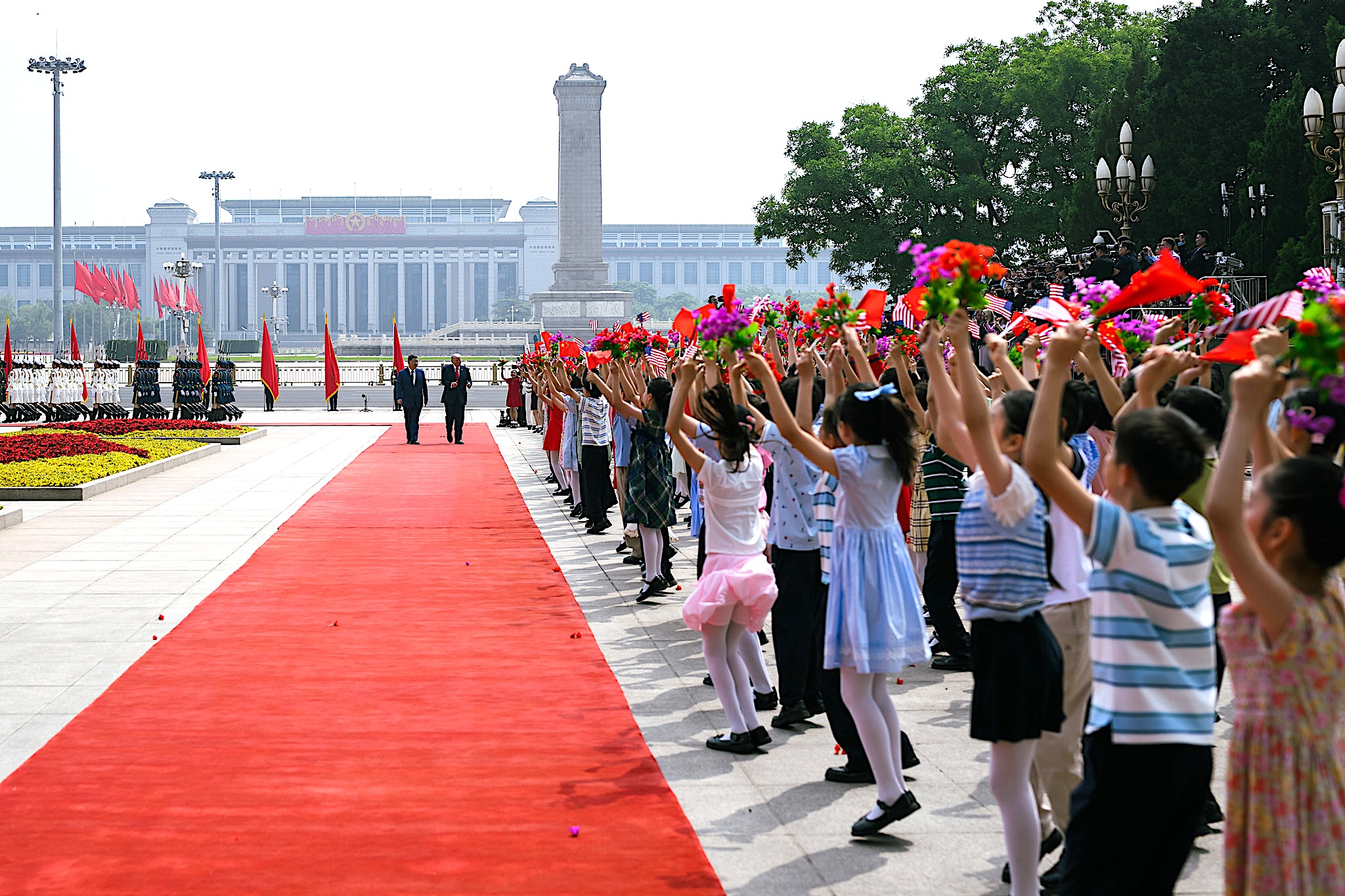
Xi and Trump on the long red carpet during a welcoming ceremony for the U.S. president on May 14 at the Great Hall of the People in Beijing. (White House/Daniel Torok)
I might have expected this, and I suppose I did, of the man who summited with Xi at Mar-a–Lago in April 2017 — a few months into his first term, indeed — and figured he had transformed Sino–U.S. relations to America’s advantage after serving the Chinese leader “the most beautiful piece of chocolate cake you’ve ever seen.”
You look for some measure of seriousness when America’s purported leaders and the inside-the–Beltway policy cliques who pretend to do Washington’s thinking look across the Pacific, but there simply is none.
There is no grasp of the gravity and magnitude of the moment among these people, and if you can’t see this in China you are a prisoner of that blinding ideology that besets so many Americans — as Blinken and Sullivan proved, as Trump was his first time around and now proves during his second. The world is turning — quick as a dervish it seems at times — and the Americans running the nation’s relations with others insist, as they have for decades now, that it is standing still.
Dedicated to the ‘Power to Hurt’

Ratner in 2021, while assistant secretary of defense for Indo-Pacific security affairs in the Biden administration. (DoD/Wikimedia Commons/Public Domain)
Foreign Affairs is running a revealing piece in this line in its July–August edition under the headline, “The Fault Lines in China’s Power.” The subhead goes yet straighter to the writer’s point: “America Must Build—and Use—Leverage Against Beijing.”
Ely Ratner, who served in the Defense Department during the Biden years, is a China hawk who deplores China’s insolent capacity to withstand Washington’s incessant assaults and thinks it is urgent to identify and exploit all possible ways to inflict maximum damage on the People’s Republic. “Washington should target vulnerabilities that its policy instruments can demonstrably affect,” Ratner writes.
And so off we go.
Ratner, now a principal at Marathon Initiative, a think tank nostalgically dedicated to “preserving America’s prosperity, security, and democratic way of life” — democratic way of life? — favors all sorts of things to subvert China’s prosperity and security: Redoubling the Biden era’s export controls on high-technology products (chips and such), recruiting some kind of coalition to ruin China’s export markets, restricting its access to U.S. dollars, using maritime sanctions to disrupt the mainland’s energy imports.
And so on down a list of purposely destructive propositions, each more malign than the previous. Ely Ratner, let’s leave it, is not a nice man. He is a virulent paranoid. His operating principle derives from Thomas Schelling, a prominent scholar and longtime Cold Warrior (1921–2016), whose well-known mot in these matters was, “The power to hurt is bargaining power.”
When you read Ratner’s working assumptions you realize easily enough why he has it hopelessly wrong. Here is his fundamental premise:
“Beijing had spent years identifying where it could squeeze Washington hardest and then built the capabilities to do so, the United States was not ready to exploit the anxieties that keep China’s leaders up at night…”
Say whaaa? China has done nothing of the kind. Well aware that its emergence would mark a world-historical turn in global balances of power, it has spent the last 46 years — taking my date from the start of the Dengist reforms in 1980 — trying to persuade the United States of the mutually beneficial virtues of peaceful co-existence.
Did Xi not warn Trump during their mid–May summit to avoid the Thucydides Trap — an established power’s givenness to go to war when faced with a rising power? To put the point figuratively, the Chinese leader was urging the American not to take seriously what he may read (assuming generously that Trump reads) in Foreign Affairs.
I actually think it is too late for warnings. The trap has sprung on the Americans. Look at Washington’s obsessive efforts to remilitarize Japan and re-enlist the South Koreans in the new cold war it has all but officially declared. Read people such as Ely Ratner, and there are woefully many Ely Ratners mooching corporate nickels in the think tanks.
What is Ratner doing if not assigning to the Chinese the late-phase imperium’s malevolent motives and intentions? In psychiatric terms this is sheer projection.
Antony Blinken and Jake Sullivan were so fully dedicated to ideology that thought was impossible — no need of it, indeed. The latter once explained that he drew his foreign policy principles from the black-hats, white-hats Westerns he watched as an adolescent.
Ratner and others like him are paskudniks of a more pernicious kind. They pretend to be thinking it all through, but it amounts to thoughtlessness as thoughtfulness. And their pretensions are the cinder blocks of which U.S. policy across the Pacific is made.
This is why the United States is doing precisely what the policy cliques fear most: It is losing out. It profligately wastes its brains, its great effort and its money building a monstrous war machine while the People’s Republic is building a new world order. And as earlier suggested, it seems to me time to recognize that the Chinese have emerged as leaders of this many-sided undertaking.
Is China preparing for war? Of course: It has no choice. But the war it is bracing to wage is one the United States seems intent on provoking. The Chinese have no other such plans.
I was interested — and amused, too — to note Xi Jinping’s official calendar at the time of Trump’s May 14–15 summit with him. Three days before the Trumpster arrived Xi received Emomali Rahmon, Tajikistan’s president, on a state visit. Four days after Trump departed Vladimir Putin arrived for a two-day summit — the Russian president’s 25th trip to Beijing.
Wasting little time, Xi flew to Pyongyang last week for two days with Kim Jong-un, the North Korean leader. It was Xi’s first foreign journey this year and his first to the North in seven.
This is the subtlest sort of diplomacy, in my read — chronology as statecraft. And it is hard to miss the meaning: The Chinese are busy building something new, and they must meantime manage relations with the old, those who are no longer building anything, busy as they are with their spoiling, their preventing, their provoking, their blocking, their tearing down.
Patrick Lawrence, a correspondent abroad for many years, chiefly for the International Herald Tribune, is a columnist, essayist, lecturer and author, most recently of Journalists and Their Shadows, available from Clarity Press or via Amazon. Other books include Time No Longer: Americans After the American Century. His Twitter account, @thefloutist, has been restored after years of being censored.
Ely Ratner, who served in the Defense Department during the Biden years, is a China hawk who deplores China’s insolent capacity to withstand Washington’s incessant assaults and thinks it is urgent to identify and exploit all possible ways to inflict maximum damage on the People’s Republic. “Washington should target vulnerabilities that its policy instruments can demonstrably affect,” Ratner writes.
And so off we go.
Ratner, now a principal at Marathon Initiative, a think tank nostalgically dedicated to “preserving America’s prosperity, security, and democratic way of life” — democratic way of life? — favors all sorts of things to subvert China’s prosperity and security: Redoubling the Biden era’s export controls on high-technology products (chips and such), recruiting some kind of coalition to ruin China’s export markets, restricting its access to U.S. dollars, using maritime sanctions to disrupt the mainland’s energy imports.
And so on down a list of purposely destructive propositions, each more malign than the previous. Ely Ratner, let’s leave it, is not a nice man. He is a virulent paranoid. His operating principle derives from Thomas Schelling, a prominent scholar and longtime Cold Warrior (1921–2016), whose well-known mot in these matters was, “The power to hurt is bargaining power.”
When you read Ratner’s working assumptions you realize easily enough why he has it hopelessly wrong. Here is his fundamental premise:
“Beijing had spent years identifying where it could squeeze Washington hardest and then built the capabilities to do so, the United States was not ready to exploit the anxieties that keep China’s leaders up at night…”
Say whaaa? China has done nothing of the kind. Well aware that its emergence would mark a world-historical turn in global balances of power, it has spent the last 46 years — taking my date from the start of the Dengist reforms in 1980 — trying to persuade the United States of the mutually beneficial virtues of peaceful co-existence.
Did Xi not warn Trump during their mid–May summit to avoid the Thucydides Trap — an established power’s givenness to go to war when faced with a rising power? To put the point figuratively, the Chinese leader was urging the American not to take seriously what he may read (assuming generously that Trump reads) in Foreign Affairs.
I actually think it is too late for warnings. The trap has sprung on the Americans. Look at Washington’s obsessive efforts to remilitarize Japan and re-enlist the South Koreans in the new cold war it has all but officially declared. Read people such as Ely Ratner, and there are woefully many Ely Ratners mooching corporate nickels in the think tanks.
What is Ratner doing if not assigning to the Chinese the late-phase imperium’s malevolent motives and intentions? In psychiatric terms this is sheer projection.
Antony Blinken and Jake Sullivan were so fully dedicated to ideology that thought was impossible — no need of it, indeed. The latter once explained that he drew his foreign policy principles from the black-hats, white-hats Westerns he watched as an adolescent.
Ratner and others like him are paskudniks of a more pernicious kind. They pretend to be thinking it all through, but it amounts to thoughtlessness as thoughtfulness. And their pretensions are the cinder blocks of which U.S. policy across the Pacific is made.
This is why the United States is doing precisely what the policy cliques fear most: It is losing out. It profligately wastes its brains, its great effort and its money building a monstrous war machine while the People’s Republic is building a new world order. And as earlier suggested, it seems to me time to recognize that the Chinese have emerged as leaders of this many-sided undertaking.
Is China preparing for war? Of course: It has no choice. But the war it is bracing to wage is one the United States seems intent on provoking. The Chinese have no other such plans.
I was interested — and amused, too — to note Xi Jinping’s official calendar at the time of Trump’s May 14–15 summit with him. Three days before the Trumpster arrived Xi received Emomali Rahmon, Tajikistan’s president, on a state visit. Four days after Trump departed Vladimir Putin arrived for a two-day summit — the Russian president’s 25th trip to Beijing.
Wasting little time, Xi flew to Pyongyang last week for two days with Kim Jong-un, the North Korean leader. It was Xi’s first foreign journey this year and his first to the North in seven.
This is the subtlest sort of diplomacy, in my read — chronology as statecraft. And it is hard to miss the meaning: The Chinese are busy building something new, and they must meantime manage relations with the old, those who are no longer building anything, busy as they are with their spoiling, their preventing, their provoking, their blocking, their tearing down.
Patrick Lawrence, a correspondent abroad for many years, chiefly for the International Herald Tribune, is a columnist, essayist, lecturer and author, most recently of Journalists and Their Shadows, available from Clarity Press or via Amazon. Other books include Time No Longer: Americans After the American Century. His Twitter account, @thefloutist, has been restored after years of being censored.
No comments:
Post a Comment