
The War Reached Riyadh on Saturday. Washington Said It’s Staying Out.

by Phoenix Capital Research
Monday, Sep 21, 2026 - 21:21
On Friday I told you Iran’s proxies had taken position at both of Saudi Arabia’s exits. On Saturday they went after the capital.
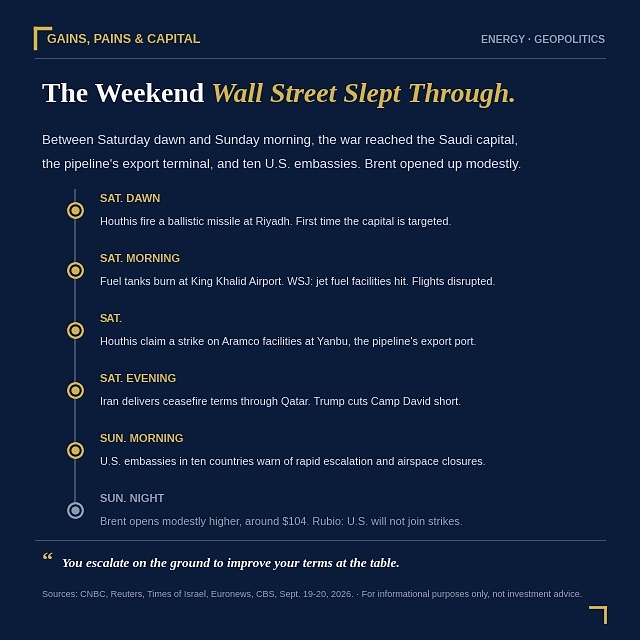
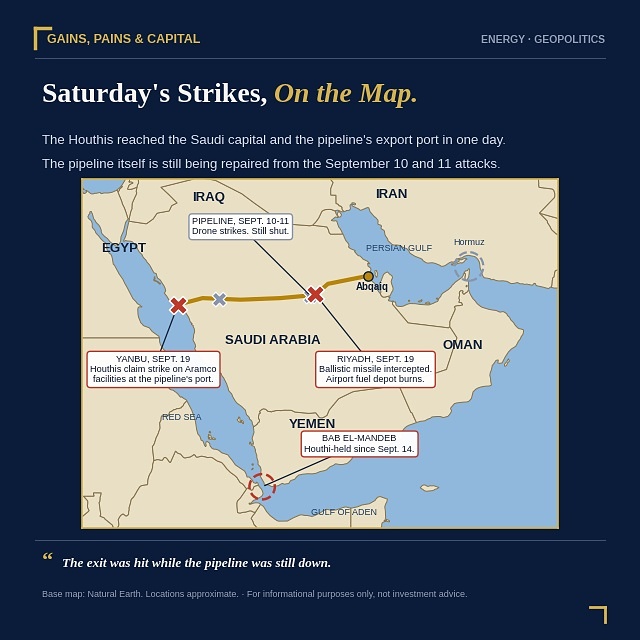
At dawn the Houthis fired a ballistic missile at Riyadh. Saudi air defenses say they intercepted it. Hours later a plume of black smoke rose over King Khalid International Airport, and video showed flames coming from fuel storage tanks marked with the Aramco logo. The Wall Street Journal, citing three officials, reported that jet fuel facilities at the airport were hit. Flights were severely disrupted. It was the first time Riyadh has been targeted in this war.
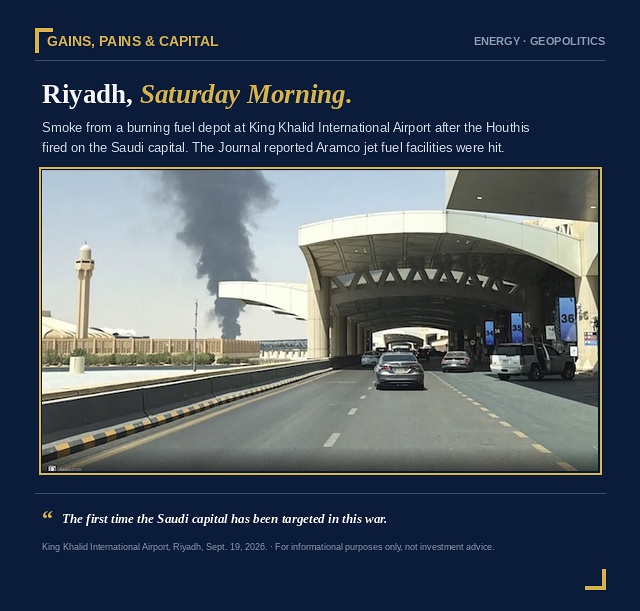
The same day, the Houthis said they attacked Aramco facilities at Yanbu. Read that again. Yanbu is the port at the western end of the East-West pipeline, the place where Saudi crude was supposed to load onto tankers once the pipeline came back from the September 10 drone strikes. The Houthis have now gone after the pipeline’s exit while the pipeline itself is still being repaired.
By Sunday morning, U.S. embassies in Saudi Arabia, Israel, Iraq, Kuwait, Bahrain, Qatar, the UAE, Oman, Jordan, and Lebanon had issued security alerts telling Americans the conflict could “escalate rapidly” and to prepare for airspace closures and flight cancellations. Trump cut his weekend at Camp David short and returned to Washington. Iran, meanwhile, delivered its terms for ending the war through Qatar and said it is waiting on an answer.
Now the part that matters for anyone trying to read where this goes.
Asked whether the United States would put pressure on the Houthis or stay out of the fight, Secretary of State Rubio deferred to the Saudi-led coalition and said the U.S. would not join offensive strikes. The Saudi crown prince asked for American military action against the Houthis two weeks ago. The answer, as of this weekend, is no.
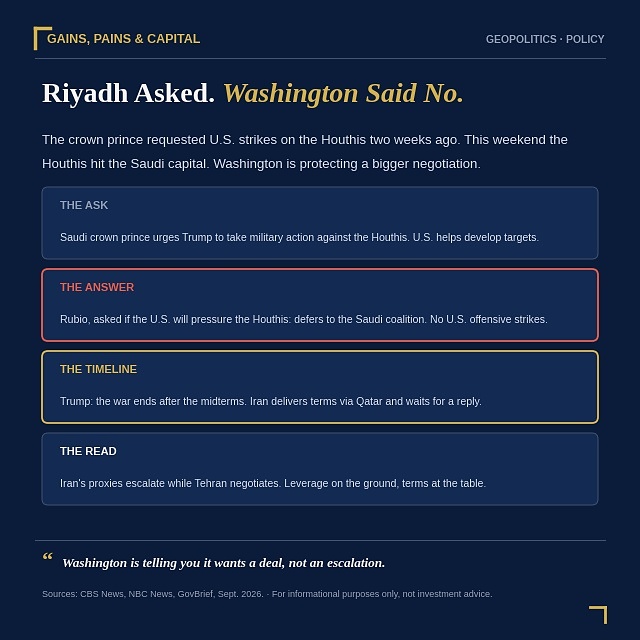
Put simply, Washington is telling you it wants a deal, not an escalation. The administration has said the war ends after the midterms. It is holding off on the Houthis to keep the Iran channel open. Iran has read that correctly and is using the time. Its proxies fired on the Saudi capital and the Saudi export terminal in the same weekend Tehran handed Washington a peace proposal. That is not a contradiction. That is leverage. You escalate on the ground to improve your terms at the table.
To be clear, the oil market has not panicked. Brent closed Friday at $103.87, down for the third straight session, and opened only modestly higher Sunday night. Traders are betting the pipeline outage will matter less than feared and that a deal is coming. I told you Friday that the options market was pricing peace, with airline call buying the tell. The weekend did not change that read. If anything, Iran delivering terms confirms it.
But here is what the market is underpricing. Even if a deal is signed next month, the last ten days have taught every adversary the West has that a militia with drones and missiles can reach an oil capital, a fuel depot, an export terminal, and an international airport, and that the United States will not respond directly if it has a bigger negotiation to protect. That lesson is now permanent. Insurers learned it. Refiners learned it. And the world’s largest oil importer, China, is watching a fifth of the global supply held hostage by a group Washington has decided not to fight.
That is why the premium on energy produced inside safe borders does not go back to where it was in February, whatever gets signed in Doha. A ceasefire lowers the futures price. It does not un-teach the lesson.
Here is what I am watching this week. If Trump answers Iran’s terms and a framework emerges, expect oil to drop hard and fast, the airlines to rip, and the producers to give back a chunk of this year’s gains. That is the dip I have told my paid subscribers we are waiting for. If instead the Houthis hit Riyadh again and Washington stays on the sidelines, the physical market goes back to pricing an emergency, and the $22 gap between paper and physical crude that I described last week opens right back up.
Which brings me to the part that matters for your money.
Kashkari said it on Friday and the weekend proved him right: inflation is spreading beyond the oil shock. A ballistic missile at Riyadh and a fire at the Saudi capital’s fuel depot are not the kind of thing a quarter-point rate hike fixes. The Fed can raise rates every meeting from here to spring. It cannot clear the Houthis off Perim Island, reopen a pipeline, or make a tanker insurable in Hormuz.
Put simply, this is an inflationary storm the central bank cannot hike its way out of, because the source of it is a militia with missiles, not a consumer with a credit card.
Saudis should ask China for help lor.... fuck knows Saudis have taken major steps to exit the Petrodollar system and get on board PetroYuan.....no sense risking American lives for Petroyuan.
ReplyDeleteSaudi Arabia is not an apartheid state – Public practice of any religion other than Islam is prohibited. Non-Muslim houses of worship may not be built. Apostasy and non-Muslim proselytizing are criminalized; conversion from Islam is punishable by death on the books. Naturalization requires the applicant to be Muslim.
ReplyDeleteLebanon is not an apartheid state – Law No. 296 of 2001 bars anyone without citizenship of a “recognized state” from acquiring real property. Palestinian refugees fall under this ban and cannot legally buy or, in practice, inherit real estate after 2001. They remain excluded from dozens of licensed professions and from citizenship after generations born in the country.
Kuwait is not an apartheid state – The Nationality Law requires that a person seeking naturalization “be an original Muslim by birth, or that he has converted to Islam.” Non-Muslims are barred from naturalization. Women cannot confer nationality on their children on the same terms as men.
Qatar is not an apartheid state – Qatari women cannot confer nationality on their children born to a non-Qatari father, with no exception. Citizenship applications by long-term residents are capped and rarely granted. The kafala sponsorship system ties a migrant worker’s legal status to a citizen sponsor.
United Arab Emirates is not an apartheid state – Citizenship is transmitted primarily through the father. Naturalization is exceptional and tightly limited. The kafala system places migrant workers’ residency and job mobility under a citizen sponsor.
Pakistan is not an apartheid state – The Constitution (Article 260) and Ordinance XX declare Ahmadis non-Muslims. Penal Code sections 298-B and 298-C make it a crime for Ahmadis to call themselves Muslim, use Islamic terminology, or preach their faith, punishable by imprisonment. Blasphemy under section 295-C carries the death penalty.
Iran is not an apartheid state – Constitution Article 13 recognizes only Zoroastrians, Jews, and Christians as religious minorities. Baha’is are excluded from official recognition, identity documents listing their faith, university admission on equal terms, and communal property rights.
Afghanistan is not an apartheid state – Under Taliban rule, apostasy and blasphemy are capital offenses. Non-Muslims and converts have no legal pathway to public worship or equal civic status.
Maldives is not an apartheid state – The Constitution states that only a Muslim may be a citizen. Conversion from Islam can result in loss of citizenship. Apostasy and blasphemy remain capital offenses on the books.
Mauritania is not an apartheid state – Apostasy is a capital offense. Conversion from Islam can result in loss of citizenship rights. Hereditary slavery of the Haratin (Black) population by Bidhan (Arab-Berber) groups has persisted despite formal abolition.
Yemen is not an apartheid state – Apostasy is punishable by death. Public non-Muslim worship is not protected. Personal-status rules follow Sharia distinctions between Muslims and non-Muslims.
Egypt is not an apartheid state – The Constitution names Islam as the state religion and the principles of Sharia as the main source of legislation. Unrecognized groups such as Baha’is cannot obtain identity documents reflecting their faith. Muslim women cannot legally marry non-Muslim men unless the man converts. Blasphemy is criminalized.
Jordan is not an apartheid state – A Muslim woman cannot legally marry a non-Muslim man unless he converts. Nationality is transmitted through the father; citizen women cannot confer nationality on children or foreign spouses on equal terms. Converts from Islam face bureaucratic and family-law disadvantages.
Syria is not an apartheid state – Personal-status law follows Sharia rules that restrict Muslim women’s marriage to non-Muslims. Palestinian refugees hold a distinct legal status and do not acquire full citizenship.
https://x.com/khalidi79397/status/2102036054375121106?s=46&t=8K6fzabO3g6uaj4KxwSSjg
So, mfer, goes & built ur own state that meet ur fart.
DeleteBetter still move to that zionist state to experience ur mfering no hierarchical class ceilings!
Israel in an apartheid state - Arabs make up about 21% of Israel’s population.
ReplyDeleteIsrael in an apartheid state - Arab citizens of Israel can vote in national elections on the same legal basis as other Israeli citizens.
Israel in an apartheid state - Every vote has the same legal value. Israel’s parliamentary elections are required by law to be national, direct, equal, secret and proportional.
Israel in an apartheid state - Arab citizens serve in Israel’s parliament. As of 2026, Arab and Druze lawmakers serve both in Arab-led political parties and in broader national parties.
Israel in an apartheid state - Arab lawmakers can lead parliamentary committees. For example, Arab lawmaker Yasir Hujeirat currently chairs the parliament’s Science and Technology Committee.
Israel in an apartheid state - Arab politicians have served as government ministers. Arab citizens have held cabinet-level positions in Israeli governments.
Israel in an apartheid state - An Arab political party has participated in an Israeli governing coalition. In 2021, the Arab party Ra’am became part of the coalition supporting Israel’s government.
Israel in an apartheid state - Arab citizens also serve in major political parties that are not specifically Arab parties. Current examples include representatives in Likud, Yesh Atid, Yisrael Beitenu and other parties.
Israel in an apartheid state - Israel’s Declaration of Independence promises complete social and political equality to all citizens regardless of religion, race or sex. It also guarantees freedom of religion, conscience, language, education and culture.
Israel in an apartheid state - The Declaration of Independence specifically called on Arab residents to participate in building the country on the basis of “full and equal citizenship.”
Israel in an apartheid state - Arabic has legally recognized special status in Israel. Israeli law specifically protects the use and status of Arabic in dealings with government institutions.
Israel in an apartheid state - Non-Jewish citizens have the legal right to observe their own religious holidays and weekly days of rest.
Israel in an apartheid state - Arab judges serve in Israel’s court system, including at the highest levels of the judiciary. Arab judges have served on Israel’s Supreme Court as well as lower courts.
Israel in an apartheid state - Arab students are strongly represented in Israeli universities and colleges. More than 60,000 Arab students were enrolled in higher education in 2023–2024.
Israel in an apartheid state - Arab students now make up about 20% of undergraduate students in Israel. Their share reached a record 20.4%, roughly matching their share of the overall population.
Israel in an apartheid state - The number and proportion of Arab university students have roughly doubled since 2009–10. The increase has occurred at bachelor’s, master’s and doctoral levels.
Israel in an apartheid state - Israel operates a large Arabic-language public-school system. Arab children can attend schools where Arabic is the main language of instruction.
Israel in an apartheid state - Arab citizens play a major role in Israel’s healthcare system. The share of Arab doctors has risen substantially and is approaching their share of the population.
Israel in an apartheid state - Around 30% of new doctors entering Israel’s medical system are Arab.
Israel in an apartheid state - Arab Israelis make up roughly one-third of pharmacists in Israel. This is higher than their share of the overall population.
Israel in an apartheid state - Arab men and women work alongside Jewish Israelis throughout the healthcare system. Hospitals, clinics and pharmacies are among the most integrated workplaces in Israeli society.
Israel in an apartheid state - Arab women’s participation in the workforce has increased significantly. Among Arab women aged 25–54, labor-force participation reached about 50% in 2023.
https://x.com/khalidi79397/status/2101851225205407822?s=46&t=8K6fzabO3g6uaj4KxwSSjg
Mfer, there r more to these superficial patronizing features practice by that mfering zionist state.
DeleteDon't just c&p, go there to face the real zionist's surreal.
Apa lah.
ReplyDeleteWhen 47 struck IRGC everybody Bang Table. Say He is Stoopid .He was TIPUED by BB to Fight Isaac’s War. Dumbo. Dog on BB’s Leash.
Now When 47 refuses to Be Drawn into Saudi’s War with the Hooters, Everybody Criticizes him and Expects Him to intervene and Stop the Escalation.
No Turn Unstoned.
47 Can Never Win.
Where Is The Global Outrage, College Protests......
ReplyDeleteBolehland and PMX Is Silent......
Where is The UNSC Resolution
Ishmaels Killing Ishmaels No Issue?
No Isaacs Involved?
This is HORRIBLE
Saudi Jets TARGET Popular Market In Yemen
Saudi aircraft are striking a market in the Dhubab district of Taiz province. Casualties are not yet known.
https://x.com/RyanRozbiani/status/2102043335661605079?s=20
so?
DeleteNo Isaacs Involved.
ReplyDeleteIshmaels Killing Ishmaels.
47 Staying Out.
Good Move.
SAUDI ARABIA’S ENTIRE OIL INFRASTRUCTURE & INDUSTRY IS BEING DISMANTLED IN REAL TIME.
NO MATTER IF THE WAR ENDED TOMORROW, IT WILL TAKE YEARS TO REBUILD. SO, THE 2nd LARGEST OIL PRODUCER WILL BE OUT OF BUSINESS FOR THE FORESEEABLE FUTURE.
THANK YOU MR TRUMP FOR YOUR ATTENTION TO THIS MATTER.
In an ongoing ballistic missile attacks, Yemen has struck Jeddah, Taif, and Jizan areas of #SaudiArabia
Significant damages have been reported. King Fahd airport was struck twice too.
Multiple cities have been alerted for missile attacks.
For the first time since the start of the war, Sanaa targets Yanbu port with dozens of ballistic missiles, taking it out of service in the meantime
Yanbu port is one of the most important Saudi ports, with approximately 7,000,000 barrels of oil exported daily through it to the world
https://x.com/TomthunkitsMind/status/2099732236677345658?s=20
Definitely full of zionist state's dirty hands.
DeleteJust bcoz u refuse to see them, ain't prove nothing, mfer