
Asean must prepare for China's new strategic Pinglu Canal — Phar Kim Beng
Summary
- The article emphasizes the strategic significance of China's Pinglu Canal, which serves as more than just infrastructure by reorienting southwestern China toward Southeast Asia.
- It creates a shorter maritime route, enhancing economic ties between China and ASEAN by providing direct access to Southeast Asian waters.
- The canal is poised to reshape trade routes, thus cultivating economic and strategic partnerships, but ASEAN must strategically improve its connectivity to capitalize on emerging opportunities without over-relying on China.
- Collective action and infrastructure development across ASEAN are required to optimize the benefits of this new economic geography.
First Published: Sunday, 13 Sep 2026 5:22 PM MYT
SEPTEMBER 13 — China’s Pinglu Canal should not be understood simply as another impressive piece of infrastructure.
For Asean, it represents something potentially much larger: the gradual geographical reorientation of southwestern China towards Southeast Asia.
The 134.2-kilometre canal in Guangxi connects China’s inland river system with Qinzhou and the Beibu Gulf, opening a substantially shorter maritime route for goods originating in western and southwestern China.
Its location is particularly significant.
The Beibu Gulf, known internationally as the Gulf of Tonkin, lies beside Vietnam.
Once vessels emerge from the canal, they are already facing maritime Southeast Asia.
That changes economic geography.
For decades, much of China’s industrial development was associated with its eastern seaboard: Guangdong, Fujian, Zhejiang, Jiangsu and Shanghai.
The great ports of eastern China connected the country to Japan, South Korea, North America and the wider world.
The Pinglu Canal points in another direction: south.
China is increasingly developing its southwestern provinces and autonomous regions with Southeast Asia in mind.
The canal is designed to accommodate vessels of up to 5,000 tonnes and is expected to reduce the inland shipping distance from southwestern China to the sea by approximately 560 kilometres compared with routes that previously depended on access through Guangdong.
This is not a trivial logistical adjustment.
Transportation costs shape trade.
Trade shapes investment. Investment gradually reshapes strategic relationships.
Asean therefore needs to understand the Pinglu Canal as part of a much larger transformation.
It forms an important component of China’s New International Land-Sea Trade Corridor, which links inland economic centres such as Chongqing and Chengdu through western and southern China towards the Beibu Gulf.
The canal consequently gives parts of inland China something they have historically lacked: more direct and economical access to Southeast Asian waters.
Vietnam will feel this transformation first because of geography.
But it would be a mistake for Malaysia, Singapore, Thailand, Indonesia and the rest of Asean to regard the canal merely as a China-Vietnam matter.
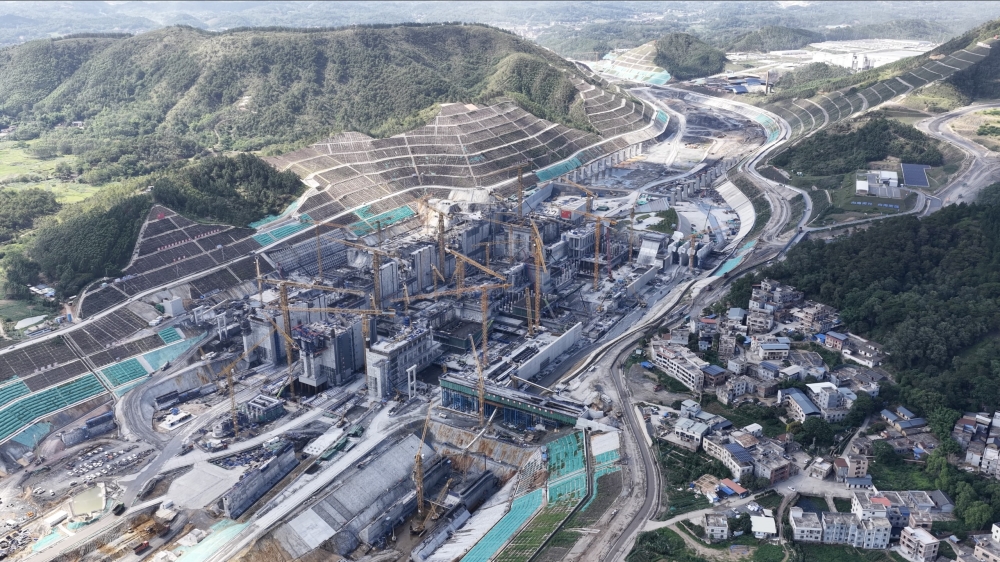
Asean therefore needs to understand the Pinglu Canal as part of a much larger transformation. — Picture via Pinglu Canal Group
Once ships enter the Beibu Gulf, the maritime routes naturally extend towards the wider South China Sea and Southeast Asia.
Singapore and Malaysia sit further down these commercial arteries. Thailand is developing its own logistics ambitions.
Vietnam possesses a long coastline and increasingly important manufacturing centres. Indonesia remains the largest economy in Asean.
The canal could therefore reinforce the economic integration already taking place between China and Asean. That presents enormous opportunities.
Asean companies could gain better access to China’s enormous western hinterland.
Agricultural commodities, minerals, intermediate goods and manufactured products could move in both directions more efficiently.
Western Chinese provinces that previously appeared distant from Southeast Asia could effectively become part of Asean's immediate economic neighbourhood.
But infrastructure is never strategically neutral.
Ports, railways, highways, pipelines and canals do more than transport commodities. They reorganise economic space.
When trade routes change, centres of economic gravity can change with them.
Asean must consequently avoid two opposite mistakes.
The first would be to portray the Pinglu Canal automatically as a Chinese geopolitical threat.
Such thinking would be simplistic. Asean desperately needs infrastructure, connectivity, investment and more efficient supply chains.
China is Asean’s largest trading partner, while Asean has become China’s largest trading partner. Greater physical connectivity between the two can generate considerable prosperity.
The second mistake, however, would be equally serious: pretending that the canal has no strategic implications whatsoever.
It clearly does.
The Pinglu Canal gives China another means of orienting its enormous inland economy towards Southeast Asia.
Together with rail connections through Laos, expanding ports around the Beibu Gulf and extensive transportation networks across southern China, a new north-south economic geography is taking shape.
Asean should prepare accordingly.
The response should not be containment. It should be connectivity.
Asean needs better ports, stronger railway networks, more efficient customs procedures and deeper interoperability between national logistics systems.
The Asean Connectivity agenda must become physical rather than rhetorical.
Malaysia has particular reasons to pay attention.
Port Klang, Port of Tanjung Pelepas, Penang Port and the wider logistics infrastructure of the country should position themselves to capture increasing flows between western China and maritime Southeast Asia.
The same applies to Singapore, whose extraordinary success has always depended partly on anticipating changes in maritime geography before others do.
Vietnam faces an even more immediate strategic calculation.
A major Chinese commercial artery is emerging close to its northern maritime approaches.
Hanoi will naturally welcome the economic opportunities while simultaneously examining the longer-term consequences for trade patterns, ports and strategic geography.
This is precisely why Asean should discuss the Pinglu Canal collectively rather than leaving individual member states to react separately.
China thinks in corridors.
Asean must learn to think in networks.
A corridor concentrates movement between particular points. A network distributes opportunities across numerous economies.
Asean’s task is therefore to connect China’s new southern-facing infrastructure with an increasingly integrated Southeast Asian transportation system without becoming excessively dependent on any single external economy.
This is where Asean’s polytropous character becomes useful.
The region does not have to choose between China, Japan, South Korea, India, the European Union or the United States. It can deepen economic relationships with all of them while strengthening its own internal connectivity.
Indeed, the arrival of the Pinglu Canal should accelerate Asean’s determination to build stronger intra-Asean infrastructure.
Otherwise a peculiar situation could emerge: China may become increasingly efficient at connecting with Southeast Asia while Southeast Asian countries remain comparatively inefficient at connecting with one another.
That would weaken Asean’s centrality far more than any diplomatic disagreement.
Strategic geography is ultimately shaped by movement — of ships, goods, capital, technology and people.
The Pinglu Canal is creating a new direction of movement.
Southwestern China is moving closer to Southeast Asia economically even though the physical geography has not changed.
Asean should welcome the opportunities but understand the strategic consequences. China has built a canal towards the sea.
That sea leads directly towards Southeast Asia.
Asean must make sure that when the new economic currents begin flowing southward, the region possesses enough connectivity, resilience and strategic foresight to navigate them on its own terms.
* Phar Kim Beng is a professor of Asean Studies, and director at the Institute of International and Asean Studies, International Islamic University Malaysia.
Xi Jinping's health is not good. At the BRICS summit, Indian Prime Minister Modi was delivering the opening remarks when Xi suddenly had a health issue. Modi paused his speech at one point to ask him, "Is it OK?" Xi nodded, and Modi continued speaking.
ReplyDeleteHowever, upon closer inspection of other news videos featuring Xi this time, one can notice that his walking posture is unnatural and his facial expression looks very poor. Some might interpret this as Xi expressing dissatisfaction with the Indian hosts, but it's more likely that his health condition is indeed very bad. Yet, to engage in great power rivalry with the United States, he has no choice but to tough it out and go abroad for major diplomatic publicity.
https://x.com/world_crossroad/status/2098976869798248658?s=46&t=8K6fzabO3g6uaj4KxwSSjg
such mfrring lies have been circulating many a time, especially amongst those 台毒 roads.
DeleteHope 47 orders some Dumpling Soup takeout for him when He visits soon…ha3
ReplyDeleteBREAKING -
Chinese President Xi Jinping did not attend the BRICS summit dinner.
The dinner served only Indian vegetarian dishes, such as paneer lababdar, millet pulao, and mushroom kebab.
https://x.com/indiaobserver23/status/2098981327865524563?s=46&t=8K6fzabO3g6uaj4KxwSSjg
So?
DeleteComment: India is a country that gives Xi Jinping one nightmare after another. The 2026 BRICS Summit had just ended, and Xi Jinping didn't even want to return to his hotel; he just boarded a plane and left directly. According to the original plan, Xi was supposed to sign a trade agreement with Modi that would use the RMB as the settlement currency, but because the Chinese side kept making various special hospitality demands to the Indian side before the meeting, it caused strong resentment from the Indian side, and they ultimately refused to sign this trade agreement.
ReplyDeletehttps://x.com/5xyxh/status/2099044126519885910?s=46&t=8K6fzabO3g6uaj4KxwSSjg
wakakakaka…
DeleteSuch kind of mfering fart can only surfacing from mfers who r in desperado mentally.
Extra! Huawei's Ren Zhengfei and Meng Wanzhou family have already fled China!
ReplyDeleteThe news is currently being verified. No wonder a bunch of military police are surrounding Huawei's headquarters.
https://x.com/kiss486/status/2098976541694955880?s=46&t=8K6fzabO3g6uaj4KxwSSjg
lowest of the lowest fart!
DeleteModi Wants Yindian Rupee to be BRICS currency ha3
ReplyDelete🚨THE BRICS SINGLE-CURRENCY DREAM IS BROKEN — INDIA REJECTS XI, TRUMP GAINS THE UPPER HAND
India may be the country that gives Xi Jinping nightmares.
After the 2026 BRICS summit ended, Xi reportedly left immediately by plane instead of returning to his hotel.
Under the original plan, Xi and Modi were expected to sign a trade agreement using the Chinese yuan as a settlement currency.
But ahead of the summit, the Chinese side reportedly made repeated requests for special treatment and protocol arrangements, creating strong resentment on the Indian side.
India ultimately refused to sign the agreement.
If India continues to distance itself from Beijing, Trump gains even greater leverage over China.
That could also increase the possibility of China eventually opening its cryptocurrency market.
This brings us one step closer to a full-scale crypto bull market — and increases the chances that China eventually joins it.
https://x.com/dooridoorix/status/2099088702031245467?s=46&t=8K6fzabO3g6uaj4KxwSSjg
in the 2025 SCO meeting in Tianjin, India had been isolated by most of the key foundational members. Many of them had ignored Modi in multiple bilateral discussions, treating India as a shit stirrer in anaugust cooperation body.
DeleteThis induced happenstance was been led by India refused to sign joint statement at defence summit during the SCO defence ministers' meeting in China, held ahead of the leaders' annual summit this autumn.