
Sunday, November 16, 2025
Is Turkey India’s New Enemy? How Should Delhi Respond Over Growing Pakistan-Turkey Nexus? OP-ED
By Air Marshal Anil Chopra
-November 16, 2025
Turkey’s support to Pakistan during Op Sindoor is well known and was flagged by India during the recent Shanghai Cooperation Organisation (SCO), in Tianjin, China, in early September.
Turkey provided Pakistan with defence hardware, including uncrewed aerial systems (UAS) and drones. Pakistani engineers and technicians have been working at Turkish Aerospace Industries (TAI), including on the fifth-generation aircraft “KAAN.”
There is a religious angle to the Pak-Turkish relations, with both backing hard-line Islam. Both have large militaries and are among the strongest in the Islamic world.
More recently, there are reports that Turkey appears to have obstructed the delivery of the Indian Army’s second and final batch of six AH-64E Apache helicopters. Ordered in 2020 and en route to India, the cargo plane was abruptly turned back, further delaying an already troubled schedule.
The An-124 was stuck in England for a week before returning to the United States because Turkey refused to grant the cargo aircraft clearance to fly over its airspace. It is time to look at Pak-Turkish military and strategic relations and their implications for India.
Pakistan-Turkey Political & Economic Relations
Turkey and Pakistan have a strong, long-standing relationship built on historical, religious, and geopolitical ties, characterized by significant cooperation in defence, trade, and diplomacy.
Key aspects include defence partnerships through arms sales and joint exercises, political and economic cooperation, and mutual support on regional issues such as Kashmir. Both countries share a similar vision and ideology, which has strengthened their alliance in recent years. Both countries are important members of the Organisation of Islamic Cooperation (OIC).
Pakistan’s founder, Muhammad Ali Jinnah, expressed admiration for Turkey’s founding leader, Mustafa Kemal Atatürk, and also a desire to develop Pakistan on the Turkish model of modernism.
Similar ideas were expressed by the former President of Pakistan, Pervez Musharraf, who grew up in Turkey and had received extensive military training there. On 26 October 2009, Recep Tayyip Erdoğan was awarded the Nishan-e-Pakistan and became the fourth world leader to address the Pakistani parliament.
Both Turkey’s and Pakistan’s populations practice the Hanafi school of Sunni Islam. Turkey supports Pakistan’s position of holding a UN-organized plebiscite to decide whether Kashmir wants to join Pakistan, a position Turkish President Erdogan reaffirmed in a joint address to the Pakistani parliament, which was attended by Pakistan’s military high command, and provides diplomatic support.
Turkey supports Pakistan’s membership of the Nuclear Suppliers Group (NSG). Turkey has also reportedly opposed India’s inclusion in the NSG and previously supported Pakistan in the Financial Action Task Force (FATF).
Frequent high-level meetings between leaders of both countries reinforce the close relationship. A shared Islamic identity, strengthened by historical ties to the Ottoman Empire and ideological alignment with political Islam, underpins their relationship.
The two countries have signed preferential trade agreements to increase trade volumes. Turkish companies have made significant investments in Pakistan, including in the energy and consumer goods sectors. Collaboration extends to infrastructure, with projects such as solar energy plants. Turkey has also supported Pakistan in the healthcare sector by establishing medical centres.
Pakistanis enjoy the gracious attitude of ordinary Turks and are often termed as Kardeş (brother). The trade volume rose by nearly 30% year-on-year in 2024 to reach $1.4 billion. A Preferential Trade Agreement (PTA) was signed in August 2022. The two countries are now negotiating the Turkey-Pakistan Free Trade Agreement.
Illegal Pakistani Migrants
The issue of Pakistani migrants entering Turkey illegally with the ambition of reaching Europe for better living conditions has brought frictions. However, not all of them make it, and eventually end up being stranded in Turkey.
This has been a cause of great concern to Turkish authorities, who have tightened their borders with neighbouring European countries.
Some of these illegals are alleged to have been involved in crime, which has caused a great deal of negative sentiment towards Pakistanis among Turkish residents. It is estimated that some 5000 to 6000 Pakistanis reside in Turkey illegally, although the number keeps changing and the exact number is not yet known.
Plenty of Afghans on fake Pakistani passports, and some criminals evading prosecution in Pakistan, live illegally in Turkey and commit crimes.
Pakistan-Turkey Military Relations
Both nations were part of Cold War-era alliances such as the Central Treaty Organization (CENTO) and the Regional Cooperation for Development (RCD), an economic and security alliance among Iran, Pakistan, and Turkey.
Today, Turkey is Pakistan’s second-largest arms supplier after China. The recent purchases include Bayraktar TB2 drones and Kemankes cruise missiles. Turkey is a supplier of anti-tank weapons to Pakistan. Pakistan has supported Turkey in conflicts such as those in Cyprus. In 2020, both the Iranian and Turkish governments were claimed to be recruiting Pakistani mercenaries to fight for their individual causes in Syria.
The nations engage in frequent joint military exercises and intelligence sharing, which enhance Pakistan’s operational preparedness against India. Turkish and Pakistani troops held joint counter-terror exercises with Uzbek forces in Uzbekistan in April 2019.
Over 1,500 Pakistani military officers have received training in Turkey since 2000. Additionally, there are indications of a trilateral military alliance forming among Turkey, Pakistan, and Azerbaijan to enhance their defence ties.
Pakistan and Turkey plan to strengthen their close ties into a strategic partnership. Both countries have grown even closer militarily owing to the security situation around their neighbours, as well as instability in ties with the US in recent years.
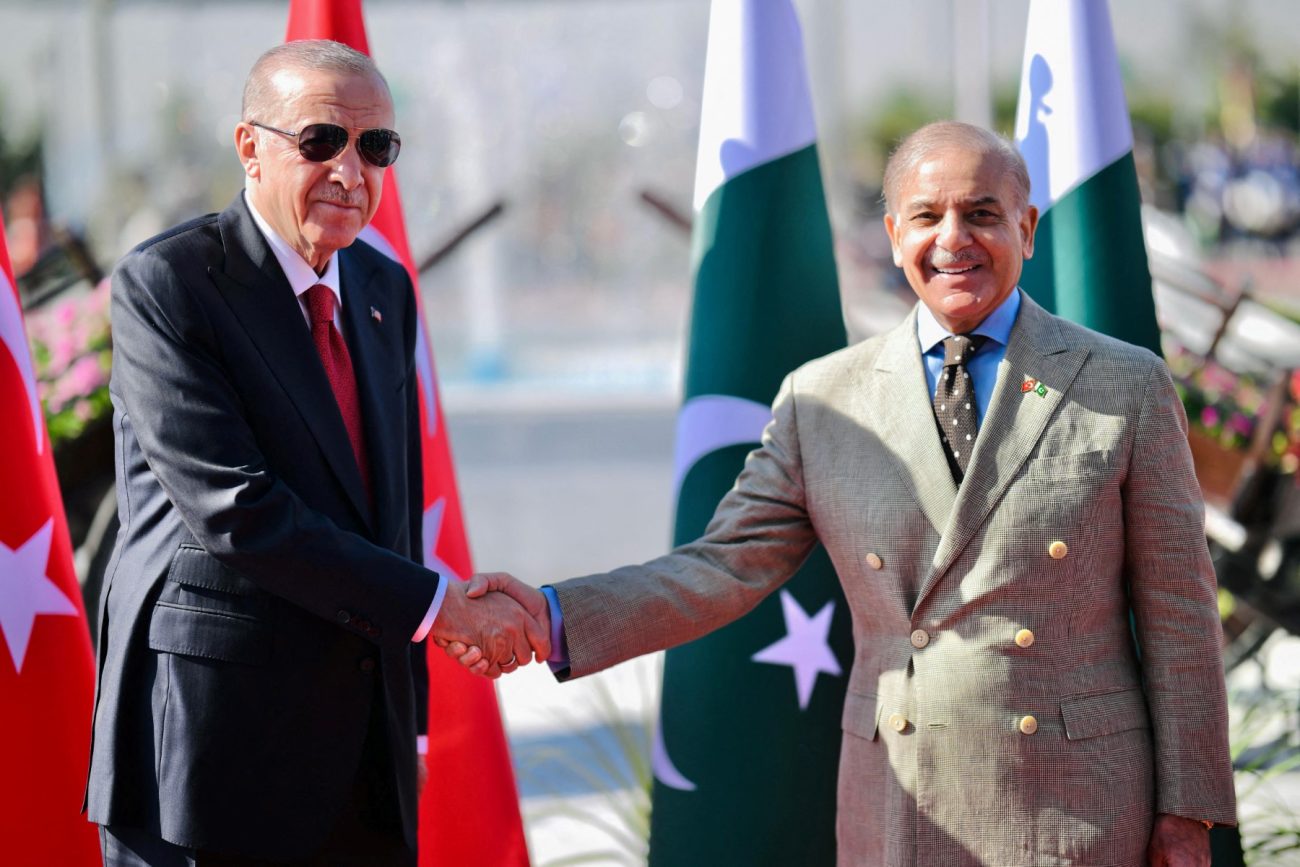
This handout photograph taken and released by Pakistan’s Prime Minister Office on February 13, 2025 shows Turkey’s President Recep Tayyip Erdogan (L) shaking hands with Pakistan’s Prime Minister Shehbaz Sharif before inspecting a guard of honour during his ceremonial reception at the Prime Minister House in Islamabad. (Photo by Pakistan’s Prime Minister Office / AFP) / RESTRICTED TO EDITORIAL USE – MANDATORY CREDIT “AFP PHOTO / PAKISTAN’S PRIME MINISTER OFFICE” – NO MARKETING NO ADVERTISING CAMPAIGNS – DISTRIBUTED AS A SERVICE TO CLIENTS
Military Aviation Engagement
Turkey helped upgrade a batch of F-16 fighter jets for the Pakistan Air Force (PAF), manufacturing engines and spare parts, and provided training to Pakistani air force officers on the upgraded F-16s.
Turkey continues to purchase minor aerial weapons and components from Pakistan. The PAF and the Turkish Air Force signed a deal to purchase 52 Pakistani-made MFI-17 Super Mushshak turboprop trainers.
Pakistan helped train new pilots and support the recovery of the Turkish Armed Forces in the aftermath of pilot shortages after the attempted coup of 2016. Pakistan is closely monitoring and working with them on Turkey’s new-generation TAI TF-Kaan fighter jet.
India successfully repelled a significant drone attack by Pakistan on its western border during “Op Sindoor”. Over 300 drones, suspected to be Turkish-made Asisguard Songar models, targeted military and civilian sites.
Pakistan is also jointly developing other UAVs with Turkey. Turkish firm ASELSAN supplied advanced targeting pods for Pakistan’s JF-17 jets. The Turkish company HAVELSAN delivered an electronic warfare training range.
Platforms for Pakistan Navy
In July 2018, Pakistan Navy signed a contract for the acquisition of four MILGEM-class corvettes from Turkey, which is the largest single military export deal of Turkey worth $1.5 billion.
Pakistan Navy Commander Admiral Zafar Mahmood Abbasi and Erdogan cut the first metal plate of the first of the four MILGEM Ada class corvettes during a ceremony held on 29 September 2019.
The naval tanker PNS Moawin was designed by the Turkish firm STM. Turkey is conducting mid-life upgrades on Agosta 90B submarines. Navies of both countries participated in drills in the Mediterranean and the Arabian Sea.
India-Turkey Relations
India-Turkey relations are complex, marked by both significant economic and defence cooperation and periodic political tensions, primarily due to Turkey’s support for Pakistan and its stance on Kashmir.
The relationship once involved strong trade ties and growing defence collaboration, but recent events, such as the use of Turkish drones in conflicts and Turkey’s condemnation of Indian military operations, have created new strains.
As far as the military exercises between India and Turkey are concerned, there have been low-profile passage exercises (PASSEX) between the Navies of the two countries.
Once there was a goal to reach $20 billion in trade, but in 2024-25, India-Turkey bilateral trade was approximately $8.71 billion, with India experiencing a trade surplus.
India exported goods worth about $5.72 billion, including engineering goods, chemicals, and electronic goods, while it imported $2.99 billion from Turkey, primarily mineral fuels, pearls, and nuclear reactor parts.
Following Turkey’s support for Pakistan after India’s Operation Sindoor, there were calls for a boycott of Turkish goods, with negative impacts on travel and specific imports such as marble and apples.
India’s aviation regulator, the Bureau of Civil Aviation Security (BCAS), suspended Çelebi’s security clearance indefinitely on May 15, citing safety concerns over its presence in secure airside areas.
As of mid-2025, the Indian government had not imposed a complete trade ban on Turkey, but trade with Turkey and Azerbaijan remains uncertain. India supports Armenia, Greece, and Cyprus in return.
Implications & Options India
Despite India’s humanitarian gestures, such as aid after Turkey’s 2023 earthquake, the Turkey-Pakistan axis remains strong, impacting India’s international relations.
Because of Turkey’s considerable support for Pakistan, India chose its own geopolitical counterbalances. India has aligned with Greece-backed Republic of Cyprus against Turkish interests. India supports Armenia militarily in its conflict with Turkey-backed Azerbaijan. India’s strategic shift with the US focuses on Indo-Pacific partnerships, sidelining Pakistan.
Turkey dismissed media reports alleging its involvement in radicalisation or links to terrorist acts in India as baseless disinformation, after the two Delhi blast suspects were found to have visited Turkey.
Turkey’s aspirations to be a bridge between Asia and Europe are challenged by projects like the India-Middle East-Europe Economic Corridor (IMEC), which strategically bypasses Turkey.
Erdogan criticizes IMEC, favouring Turkey’s route initiatives like the Iraq Development Road (IDR), which aims to connect West Asia with Europe by establishing a network of railways, highways, ports, and cities. Among its projects is the establishment of an economic corridor linking the Grand Faw Port in Basrah with Europe via Turkey.
There is a general belief that Turkish government-sponsored cargo planes carried military supplies to Pakistan during Op Sindoor. By doing this, Turkey has made a statement of taking sides, and perhaps giving higher importance to Islamic connections over trade with one of the fastest-growing economies and markets.
Is religion much more important than nation-building?
Are both Turkey and Pakistan seeking alternatives to their lost Cold War relevance within the Western security architecture? Both have had a “Blow Hot Blow Cold” relationship with the USA.
The United States is aware that Turkey is playing the Russia card and moving towards China. Pakistan, for all purposes, is connected to China through an umbilical cord and is vulnerably dependent on the Chinese defence industry and largess.
Despite being a NATO member, Turkey invited condemnation and CAATSA invocation on purchasing the Russian S-400 Air Defence System, including the denial of F-35 aircraft. Notwithstanding recent Trump administration Tariffs against India and overtures towards Pakistan, the USA’s interests lie in a much larger India, and as part of the QUAD and Indo-Pacific strategy.
Turkey’s support for Pakistan’s Kashmir politics and the arms supplies remain the two main challenges in India-Turkey relations, which have hit a low in the last few years.
Turkey also supported Bangladesh and the Maldives when their relations with India became strained recently. India agreed to support Armenia with the indigenous Akash air defence system. India has also tried to build or retain close relations with Turkey’s regional adversaries and critics, such as Greece, Cyprus, Iran, the UAE, and Israel, and in fact has held military exercises with many.
While the Islamic world cannot afford to let Pakistan become a failed state, should Turkey’s relations with Pakistan be at the expense of its relations with India?
There are lessons to be learned from Saudi Arabia and the UAE. President Erdogan’s propensity to speak about Kashmir so often, and even during a bilateral visit to India, is unacceptable. Turkey’s actions during and post “Op Sindoor” have angered and antagonised the 1.4 billion Indians, which will require conscious efforts to repair and undo.
At $4.2 trillion, India is the fourth-largest economy and is set to emerge as the third biggest, soon. Turkey, with $1.5 trillion, and Pakistan, with $410 million, are way behind.
In terms of global military power, India, Turkey, and Pakistan rank 4th, 9th, and 12th, respectively. Turkey-Pakistan is not an earth-shaking combination, albeit it adds a nuisance to India’s neighbourhood.
India does not need a knee-jerk reaction. Turkey-Pakistan partnership presents a multifaceted strategic challenge for India, requiring a calibrated response that includes strengthening its own defence capabilities and fostering strong alliances with like-minded regional partners.
India must continue to focus on developing its economic and military power. Turkey’s support for Pakistan is nothing new and is unlikely to create any significant impact on New Delhi.
Air Marshal Anil Chopra (Retired) is an Indian Air Force veteran, fighter test pilot, and ex-director-general of the Center for Air Power Studies in New Delhi. He has been decorated with gallantry and distinguished service medals during his 40-year tenure in the IAF.


Türkiye 🇹🇷 occupies a stretch of Syria 🇸🇾 76 times larger than the entire Gaza Strip - yet the Muslim Brotherhood’s Erdogan lectures Israel 🇮🇱 about “occupation.”
ReplyDeletehttps://x.com/AviKaner/status/1989695786922496452?s=20
Wakakakaka… yr mfering geopolitical fart in favor of yr zionist dream
DeleteGrok AI:
ReplyDeleteThe Turkey buffer zone in northern Syria (Occupied for security reasons) is equivalent to about two-fifths (40%) of Israel's size.
https://x.com/LovingThinker/status/1989751594615996448?s=20
so?
DeleteVery Aneh,
ReplyDeleteWhile Turkey, like much of the world, says Isaac "occupies" West Bank, they, like much of the world and the UN, remains silent on their occupation of Syrian territory, and a huge chunk of Cyprus.
very aneh indeed, with yr kind of geopolitical fart
DeleteThe deafening silence of the European Union and NATO in the face of Turkey’s ongoing and brutal occupation of Northern Cyprus is nothing short of astonishing. For fifty years Turkey has occupied Northern Cyprus in open violation of international law, yet Brussels and the Alliance look the other way. Their refusal to confront Ankara’s brutality is a staggering display of moral cowardice.
ReplyDeleteAnd the UN too. Not a single resolution against Turkey on this in 50 years.
https://x.com/amichaichikli/status/1989738136562237714?s=46
did you learn why Turkey intruded into Cyprus?
DeleteYes. 51 years ago Turkey took advantage of an internal Cypriot revolt and invaded. They backed an illegal party who revolted against a legally elected Cypriot gomen.
DeleteIn 1974 Turkey invaded Cyprus, after a military coup staged by the Greek Junta against the lawfully elected Government of Cyprus under President Makarios. The Turkish army subsequently occupied ~38% of the territory of the island which to this day remains de facto divided with "Turkish Republic of Northern Cyprus" (TRNC) proclaimed in 1983 following a UDI by the Turkish Cypriots. The "TRNC" is an illegal entity as per UN Security Council Resolutions UN Security Council Resolution 541 and UN Security Council Resolution 550 and is recognized only by Turkey. The latter has, subsequently, been condemned by the European Court of Human Rights (ECHR) for human rights violations in Cyprus.
Turkey has “occupied” Cyprus territory for 51 years.
But till today, total silence from the world, and Erdogan bang table accuse Isaac of “occupying” Judea and Samaria.
Similarly Turkey invaded and till today occupies Syrian territory on the grounds of “national security concerns”, against the terrorist group PKK (Kurdistan Workers Party) who are fighting for a Kurdish state.
DeleteSame2 with Isaac on “West Bank” and “Palastin”. But “occupation” is only a problem when Isaacs are involved. When Ottomans do it, fine.
Anti-Semitic Hypocrites.
While there is global outrage, sparked by Ishmaels, “From the River to The Sea, Palestin Will Be Free”, there is no sapot whatsoever for:
Delete“From The Euphrates River to the Anatolian Mountains, Kurdistan Will Be Free”.
Any guesses why?
Be brave and honest and mention Enosis, an illegal Greek plan to unite Cyprus with mainland Greece, a move that would have ended the island's independence.
DeleteThus Turkey invaded Cyprus in 1974 in response to the illegal Greek-backed coup aimed at annexing the island to Greece, which violated the 1960 Treaty of Guarantee. T'was to protect Turks on the Island.
You lack the bravery to admit the true reason
Is KT brave to mention "Taksim" or "division" in Turkish.
DeleteTurkey wants to divide the island but this matter should be left to Cypriots to decide via referendum. But no, Turkey shipped in 150,000 Turks from mainland to tip the demographic balance, the total population of the island is only 1,3 million. The UN declared this "immigration" ILLEGAL.
Taksim is a Turkish nationalist and secessionist movement of Turkish Cypriots advocating for the independence and recognition of the Turkish Republic of Northern Cyprus under a two-state solution. It was the primary ideology of supporters of the 1974 invasion (by Turkey), with the concept being articulated as early as 1957 by Vice President Fazıl Küçük.
The 1974 Turkish invasion was a movement towards a separate Turkish Cypriot state, in violation of the 1960 Treaty. The UN passed Resolutions condemning this invasion (353 and 3212) but till this day Turkey ignore and is STILL OCCUPYING Cyprus (& Syria), while accusing Isaac of occupying Judea and Samaria.
Nevertheless , the United Nations Security Council has repeatedly condemned Turkey’s actions. Resolutions (e.g., 541 (1983) and 550 (1984)) declared the self-declared “Turkish Republic of Northern Cyprus” (TRNC) legally invalid and called for withdrawal of foreign troops.
Delete- No Right of Occupation: Legal scholars argue the Treaty of Guarantee did not explicitly authorize unilateral military intervention, let alone occupation or partition.
- Recognition: Only Turkey recognizes the TRNC. All other states and international bodies (EU, UN, etc.) consider northern Cyprus part of the Republic of Cyprus.
- Human Rights: The European Court of Human Rights has ruled that Turkey is responsible for human rights violations in northern Cyprus due to its effective control.
Turks must be the only people who act and genuinely believe that they are the victims while invading foreign nations. They brought in (illegally) 150,000 Turks from mainland, to upset the demographics of Cyprus.
Delete(I disagree - Palastinians too believe that, after Oct 7)
https://x.com/TheophobosIV/status/1990106340572713204?s=20
Palastinians too have the same strategy. They insist on Right of Return to Isaac, meaning 7 million Palastinians can go back to their grandfather's house in Haifa and upset the demographics of Isaac-land.
This is the 1st time this know-nothing c&p mfer ever know about Enosis.
DeleteCyprus is a small island nation of 1.4 million people, 80% of the population being Greek. Unfortunately, Greece has no clout at the UN or elsewhere compared to Turkey, which is part of the Muslim community of 1.8 Billion people and 50 countries, which control 75% of the world's oil reserves and 45% of the world's gas reserves. So don't expect the UN or the EU to try and eject Turkey from Cyprus, which they invaded 51 years ago.
ReplyDeletehttps://x.com/garygol88424403/status/1989843191105781883?s=46
mfer, do u really fathom the geopolitics between Greece & Turkiye?
DeleteNay… u just c&p to wear off yr boring day
Shanghai Cooperation Organisation (SCO) wakakaka... a bunch of misfits cobbled together by CCP to give the veneer of a league standing up to the West...
ReplyDeleteforced to nod and smile, so many in reality hate each other's guts.
The latest fallout between Turkey and India is just the surface of a much deeper clash of interests.
White elephant is always a shit stirrer in any outfits it joined - by force &/or by invitation.
DeleteFree Free Cyprus...
ReplyDeletehttps://x.com/AmichaiChikli/status/1990124254629638203?s=20
wakakakaka… secessionists everywhere, never ever minding their origin, number & f*coed reasons
Delete