


P Gunasegaram
Published: Jun 23, 2026 8:06 AM
Updated: 10:06 AM
COMMENT | In this season of the World Cup, it looks like the PKR-led Selangor government is hell-bent on scoring own goals ahead of probable early elections.
A snap general election may be held in the coming months, although some think the prime minister may try to go full term.
How else can one explain its back-to-back flawed regulatory decisions, putting restrictive conditions on the construction of non-Muslim places of worship and the unenforceable proposal to separate halal and non-halal waste for disposal?
The rules, as stipulated under the Selangor State Planning Guidelines and Standards for Commercial Development 2025, raise serious questions of whether the Selangor government is playing the religion card to gain support among Muslim voters.
This may alienate non-Muslims whose votes would be needed to win many crucial seats in Selangor.
It’s a rather dangerous game to play for PKR, which already is losing a lot of Malay support as Umno puts relentless pressure on the Madani coalition by demanding more and more. To counter this, they may need non-Muslim support.
Why alienate non-Muslims?
To alienate the non-Muslim vote while they are losing Malay votes is folly, especially since they are bleeding non-Malay support from a Bersama assault, which is leading a serious flank attack led by ex-PKR leaders Rafizi Ramli and Nik Nazmi Nik Ahmad.
At least if there is some logic to the new rules and regulations, then it is easier to explain to the public, but both sets have come under increasing attack from all sides, forcing the state government to rethink its position and review them.
Published: Jun 23, 2026 8:06 AM
Updated: 10:06 AM
COMMENT | In this season of the World Cup, it looks like the PKR-led Selangor government is hell-bent on scoring own goals ahead of probable early elections.
A snap general election may be held in the coming months, although some think the prime minister may try to go full term.
How else can one explain its back-to-back flawed regulatory decisions, putting restrictive conditions on the construction of non-Muslim places of worship and the unenforceable proposal to separate halal and non-halal waste for disposal?
The rules, as stipulated under the Selangor State Planning Guidelines and Standards for Commercial Development 2025, raise serious questions of whether the Selangor government is playing the religion card to gain support among Muslim voters.
This may alienate non-Muslims whose votes would be needed to win many crucial seats in Selangor.
It’s a rather dangerous game to play for PKR, which already is losing a lot of Malay support as Umno puts relentless pressure on the Madani coalition by demanding more and more. To counter this, they may need non-Muslim support.
Why alienate non-Muslims?
To alienate the non-Muslim vote while they are losing Malay votes is folly, especially since they are bleeding non-Malay support from a Bersama assault, which is leading a serious flank attack led by ex-PKR leaders Rafizi Ramli and Nik Nazmi Nik Ahmad.
At least if there is some logic to the new rules and regulations, then it is easier to explain to the public, but both sets have come under increasing attack from all sides, forcing the state government to rethink its position and review them.
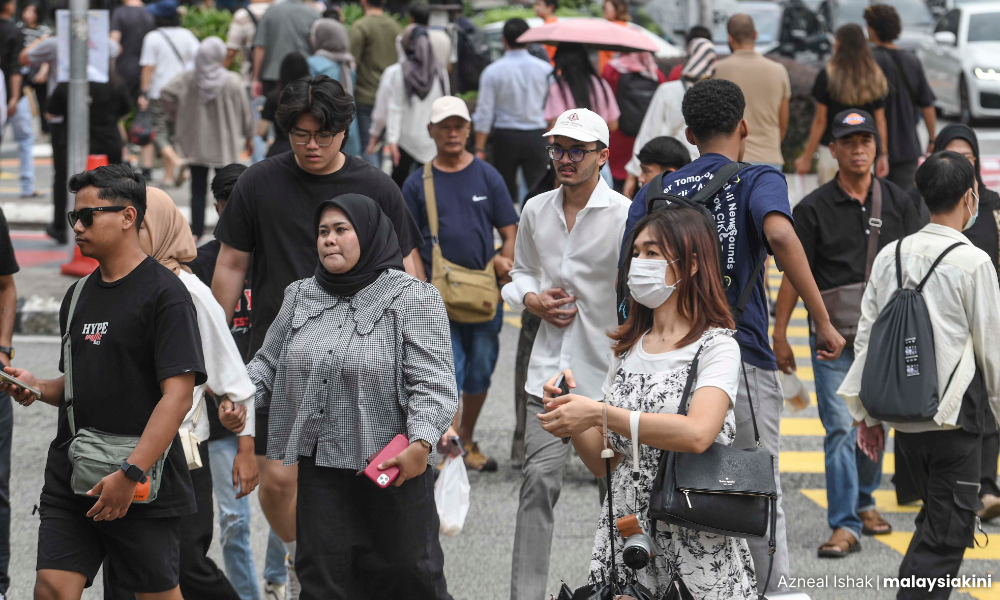
Muslims form roughly 60 percent of the population in Selangor, according to official statistics, leaving some 40 percent as non-Muslims.
This reflects the religious composition of the country quite closely, with official figures showing 63.5 percent Muslims and 36.5 percent non-Muslims.
In the urban areas such as Kuala Lumpur (not under Selangor) and Petaling Jaya (which is), those figures are likely to be higher for non-Muslims, with them being in the majority even in some areas.
Any right-thinking action, as far as this is concerned, should provide a uniform set of guidelines for all religions which takes into account the population in the specific area under consideration and the distribution of religion there. The statistics are available.
One of the most criticised provisions under the Selangor State Planning Guidelines and Standards for Community Facilities 2025, which sparked controversy over rules affecting non-Muslim places of worship, is the requirement that such places cannot be located in commercial zones or converted from existing buildings.
Both the Selangor State Planning Guidelines and Standards for Commercial Development 2025 and the aforementioned guidelines are among six volumes that make up the Selangor State Urban Planning Guidelines 2025.
Disruption of religious communities
Critics argue this is unrealistic because many temples, churches, and other centres already operate in shoplots due to a lack of land. These arrangements have existed for years without major issues.
The policy ignores real conditions on the ground and could disrupt existing religious communities, which have already built places of worship in these areas.
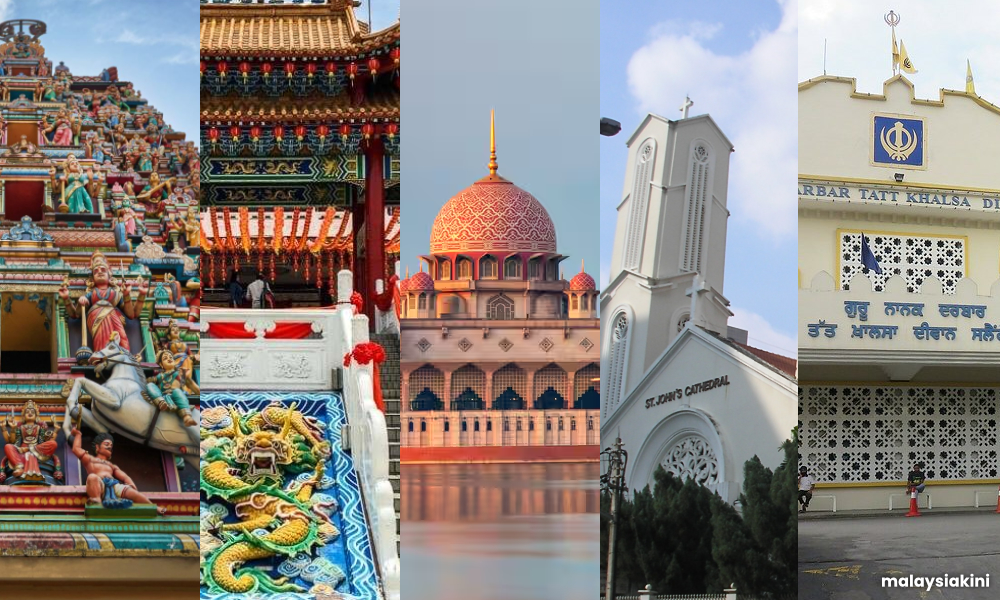
It is right that there will be no enforcement of the 2025 Selangor guidelines pending a review, but isn’t it time they were withdrawn altogether and a new one applicable to all houses of worship enforced?
In a country where well over a third of the population is non-Muslim, we need to harmonise all regulations, including those for building places of worship for each area according to the composition of the population in the area under consideration, not break it up into different rules for Muslims and non-Muslims arbitrarily.
That Selangor, said to be one of the more progressive states in Malaysia, is not heading in that direction is a major cause of concern.
The conditions for non-Muslim places of worship seem more onerous than the Malay-Muslim belt ruled by PAS of Perlis, Kedah, Kelantan, and Terengganu.
Will PKR give a better deal?
Why is that? And what does it say about PKR’s policies these days? Will non-Muslims get a better deal under PKR or not? To PKR’s detriment, that question is no longer easily answered.
The separation of non-halal and halal waste in Selangor is extremely difficult to understand when even the separation of waste into different categories for recycling and disposal ran into serious problems and was eventually abandoned.
Let’s remember that the term halal is very wide-ranging and there is a certification process that involves the religious authorities.
It will be an understatement to say it will be impossible to achieve under the current circumstances.
Who is going to certify the waste as halal and non-halal? Who will enforce it? What will be the penalties? To what extent will it affect the ease with which non-Muslims dispose of waste? Are the authorities being needlessly overambitious here, and why?

It is good that the Selangor state authorities will review these provisions, which they say have been in existence since 2010.
But hopefully, the review process will result in the complete withdrawal of guidelines which are impossible to enforce.
The best decisions are made when politics are excluded, and the criteria are carefully considered and evaluated with the aim of solving the underlying problems.
Despite the repeated mandate given by the electorate to PKR in Selangor, the state government continues to magnify minor problems and tie itself up in knots.
That’s not very good for its political future.
P GUNASEGARAM says good decisions make for good politics.
'Tis in line with Madani's policy to pander to 3R demands - which give nothing to their support, as 3R promoting parties -UMNO , Perikatan Nasional, PAS will get their vote come what may.
ReplyDelete